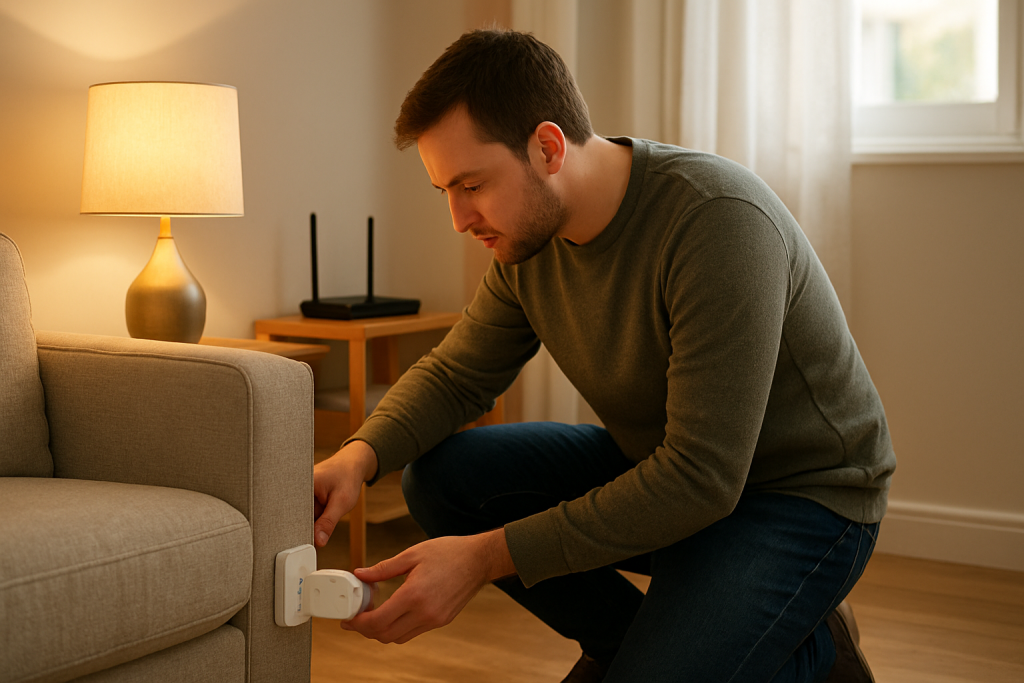
Smart Plug Turns Off by Itself? What to Check First
Quick Answer
When a smart plug (or smart switch) turns off by itself, the most common cause is an automation you forgot about or one you didn’t realize was duplicated across apps (for example: the manufacturer app plus Alexa, Google Home, Apple Home, or SmartThings). The plug is usually doing exactly what it was told—just not where you’re looking.
The second most common cause is a power-related event: a brief outage, voltage dip, or the plug’s “power recovery” setting causing it to default to Off after power returns. This can look like “random” shutoffs, especially overnight or when a high-load appliance starts on the same circuit.
Do these three checks first: (1) review schedules/timers in every app that can control the device, (2) check the device’s power-on/power-recovery behavior setting, and (3) confirm whether the plug shows an “offline” moment around the time it turned off (which points to a power drop or reconnect event).
Why This Happens
Unexpected “off” events almost always come from either automation logic or a brief loss of power/connection that triggers a default behavior. Smart plugs and switches sit between your appliance and the outlet, so they’re sensitive to both command sources (apps, voice assistants, hubs) and the electrical environment (power blips, overloaded loads, and reboot timing).
Common root causes that directly lead to surprise shutoffs include:
One real-world scenario: A home has the plug added to the manufacturer app and also to Alexa. Someone creates a “Goodnight” routine in Alexa that turns off “Kitchen” devices, not realizing the smart plug is assigned to the Kitchen group. The plug turns off every night “by itself.”
One common user mistake: Setting a one-time countdown timer (like “turn off after 1 hour”) and forgetting it exists. Some apps keep that timer active or reapply it after reconnecting, so the plug keeps turning off later.
One overlooked technical cause: A short power dip or router restart causes the plug to reconnect and briefly appear offline. If the device or ecosystem applies a “last known state” rule, a conflicting rule may set it to Off when it comes back online, even if you last turned it on manually.
Most Likely Causes in Real Homes
These are the most common reasons, in order of probability:
1) Duplicate schedules/automations across apps: The same device is controlled by the brand app plus Alexa/Google/HomeKit/SmartThings, and an automation exists in one place you don’t check often.
2) Countdown timers or “auto-off” features: Many smart plugs/switches support timers separate from schedules; they can be triggered accidentally and feel random.
3) Power recovery/default state after an outage: After a brief outage or flicker, some devices are set to come back Off (or follow “last state”), which may not be what you expect.
4) Power dips or overloaded/unsupported load behavior (smart plugs): A heater, compressor, or motor load can cause a momentary drop; some plugs protect themselves by shutting off or rebooting.
5) Time, time zone, or location mismatch: If the phone, hub, or account time zone is wrong, schedules fire at the “wrong” time and look like unexplained shutoffs.
Step-by-Step Fix
-
Check the device event history in the primary app (manufacturer app, SmartThings, Apple Home, or hub app). Look for entries like “turned off by schedule,” “automation,” “scene,” “assistant,” “offline,” or “power restored.”
If you see “turned off by schedule/automation,” it usually means a routine exists somewhere and is working as configured.
If you don’t see any history or it’s unclear, move to the next step and isolate where the command is coming from.
-
Search for schedules, timers, and automations in every place that can control the plug/switch: the manufacturer app (TP-Link/Kasa/Tapo, Meross, etc.), Alexa routines, Google Home automations, Apple Home automations, SmartThings routines, and any Zigbee/Matter hub automations. Also check “Scenes,” “Groups,” and “Away/Vacation” modes.
If you find a rule that matches the timing, that’s almost always the cause—disable it or adjust conditions (time, days, presence, sunrise/sunset).
If you find nothing, continue—this often means the issue is power recovery behavior or a hidden timer.
-
Look specifically for countdown timers and “auto-off” settings inside the device settings. Some apps label this as “Timer,” “Inching,” “Auto turn off,” or “Turn off after.” Cancel any active timer and disable auto-off if it’s not intentional.
If cancelling the timer stops the shutoffs, the issue was a timer that was being set manually, by a scene, or by a routine.
If it still turns off, the next most likely cause is power recovery behavior or a brief power/connection drop.
-
Check the device’s “power-on state” or “power recovery” option (wording varies). Common choices are “On,” “Off,” or “Last state” after power returns. Set it to the behavior you actually want, then test by turning the plug on and leaving it for a while.
If the plug previously defaulted to Off after a flicker, changing this setting often fixes “it turns off overnight” complaints.
If your app doesn’t offer this setting or it doesn’t help, move on to determining whether you’re experiencing brief outages or voltage dips.
-
Confirm whether the shutoff coincides with a power event. Think about when it happens: during storms, when HVAC starts, when a microwave runs, or at a regular time when your router/modem reboots. Also check if other clocks (microwave/oven) blink or reset around the same time.
If other devices show signs of a power flicker, the smart plug turning off is likely a reaction to power loss and recovery rather than an app command.
If there’s no sign of a power event, proceed to isolate ecosystem conflicts and sync issues.
-
Temporarily simplify control to one ecosystem for a day. Leave the plug in the manufacturer app (or hub app) and disable the device in one assistant at a time (for example, disable it in Alexa or remove it from an Alexa group) so only one platform can command it.
If the problem stops when one ecosystem is removed, that ecosystem likely has the automation (or a group/scene) sending the Off command.
If it still turns off even with one controller, move to a connectivity/power stability check.
-
Do a targeted connectivity test only as it relates to unexpected offs: check whether the device goes “offline” near the shutoff time. If it’s WiFi-based, confirm it’s on 2.4 GHz (most plugs are) and watch for mesh roaming issues if the plug is near the edge of coverage. If possible, temporarily place it closer to the main router (not just a mesh node) and observe.
If moving it closer reduces or eliminates off events, the “off” behavior is often the device rebooting/reconnecting and then applying a power-on state or a cloud-synced rule.
If placement changes don’t help, continue to advanced checks (account sync, firmware, and ecosystem links).
Advanced Troubleshooting
This section is only needed if basic fixes fail.
Account/cloud sync issue: If the plug shows correct state in the manufacturer app but assistants show a different state (or vice versa), sign out and back into the controlling app and confirm the device is assigned to the correct “Home” and “Room.” A stale session or duplicated home can cause automations to target an old device entry.
Network behavior tied to unexpected offs: Some routers perform nightly maintenance or change channels; mesh systems may roam clients aggressively. If the plug frequently drops offline, it may reconnect and then receive delayed automation commands (for example, an “Off” that was queued while it was unreachable). As a test, disable any scheduled router reboots for a night, or temporarily connect the plug in a location with stronger signal stability.
Firmware/software cause: After a firmware update (or app update), schedules can shift if time zone/location permissions changed, or an old “timer” feature behaves differently. Confirm the plug firmware is up to date, and also confirm your phone’s OS time zone and the app’s location permissions are correct. If the schedule is based on sunrise/sunset, verify the home address is correct in the ecosystem.
Configuration conflict (groups/scenes/permissions): In shared homes, another user may have created a routine you can’t see if you’re not the owner of that home. Check sharing/permissions in Alexa/Google Home/Apple Home/SmartThings and confirm who has admin rights. Also check whether the device is in a group like “All Lights” or “Downstairs,” where a broad “turn everything off” command can include a plug unexpectedly.
Ecosystem sync issue (Matter/bridges/controllers): If the plug is exposed via Matter or a bridge (for example, a hub exposing devices to another platform), you can end up with duplicate device entries. Automations may target the wrong entry, causing “off” commands to hit unexpectedly. Remove duplicate entries, then re-sync device discovery in the assistant so only one representation exists.
When to Reset or Replace the Device
A soft restart is simply power-cycling the plug/switch by unplugging it (or turning it off at the app, waiting 10–20 seconds, then turning it back on) to clear a temporary software hang. This is low-impact and doesn’t remove it from your smart home.
A factory reset should be used when you’ve confirmed there are no automations/timers causing the shutoffs, but the device still goes offline, ignores settings like power recovery, or behaves inconsistently across apps. Resetting typically removes the device from all ecosystems and you may lose: pairing information, schedules, timers, routines, room/home assignment, and for energy-monitoring smart plugs, some or all historical energy data depending on how the app stores it.
Replacement becomes reasonable if the device repeatedly fails firmware updates, cannot stay connected even in strong signal locations, or the relay behavior seems unstable (for example, frequent clicking or rapid on/off cycling not tied to commands). Stop using the device and replace it immediately if you notice overheating, a burning smell, discoloration, melting, or any visible damage.
How to Prevent This in the Future
Keep control paths simple: choose one “source of truth” for schedules (either the manufacturer app, your hub, or one assistant) and avoid duplicating the same off schedule in multiple places.
Use consistent naming and room assignments across apps. If a plug is named “Heater” in one app and “Living Room Outlet” in another, it’s easier to accidentally include it in a “turn off living room” routine.
Review automation changes after app updates and after adding new integrations (Matter pairing, hub linking, or assistant linking). That’s when duplicates and re-discovered devices commonly appear.
Build stable outage recovery habits: if your area has flickers, set an intentional power recovery behavior (On/Off/Last State) rather than leaving defaults. After an outage, give your router and hub a minute to fully come online before assuming the plug’s behavior is “random.”
Reduce surprise disconnect/reconnect events that can trigger recovery logic: keep WiFi plugs on 2.4 GHz, avoid placing them at the edge of mesh coverage, and try not to plug them where the signal is blocked by appliances or dense cabinetry.
Maintain sharing hygiene: confirm who is an admin in the home, remove old users, and periodically review routines created by all household members so no one’s “goodnight” routine becomes your “mystery shutoff.”
FAQ
My smart plug turns off at the exact same time every day. Is it defective?
Usually not. A consistent time strongly points to a schedule, timer, or routine. Check the manufacturer app first, then Alexa/Google Home/Apple Home/SmartThings routines, including “Away,” “Vacation,” and any group-based automations.
It turns off when the internet goes down. Does that mean it needs better WiFi?
Not necessarily. Many plugs keep their last state locally even without internet, but a brief power flicker or a router reboot can make the plug restart and apply its power recovery setting (often Off). Focus on whether it went offline due to power loss versus just losing cloud access.
Common misconception: “If I don’t have a schedule, it can’t be automation.” Is that true?
No. Automations can be hidden in scenes, groups, voice assistant routines, presence-based rules, sunrise/sunset triggers, or even countdown timers. You may have zero “Schedules” but still have an automation turning it off.
Why does the app show the plug On, but the connected device is Off (or vice versa)?
This is often a sync delay or a duplicate-device issue across ecosystems. Refresh in the controlling app, check for duplicate entries (especially with Matter or hub bridges), and verify only one platform is actively managing schedules. If the plug is frequently offline, the displayed status can also be stale.
When the dust settles, the story feels oddly simple—like the last piece of the puzzle finally clicking into place. Not because everything got easier overnight, but because the choices stop feeling slippery.
For once, the conversation can move past the same tired standoffs. There’s room again for everyday life to look a little more like itself.