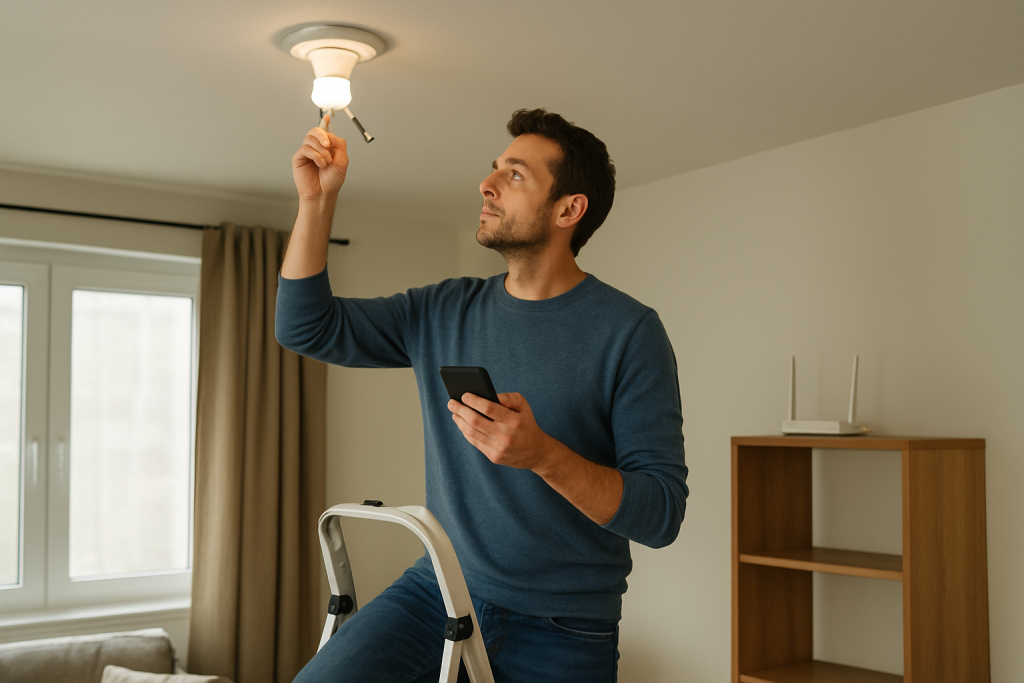
Smart Bulb Wont Connect to WiFi During Setup Fixes That Work
Quick Answer
Most smart bulbs fail to connect during setup because the phone and bulb are trying to complete a “temporary local handshake” (often via Bluetooth or a temporary WiFi connection) but the home network can’t finish the final handoff to your 2.4 GHz WiFi. In real homes, this is usually caused by the router steering devices between 2.4/5 GHz, a mesh system choosing a different access point mid-setup, or the phone using a VPN/private relay that blocks local discovery.
This affects WiFi bulbs directly, but you can see similar symptoms with hub-based systems (Zigbee hubs like Hue/SmartThings, or Matter controllers) when the app can’t discover the device on the local network or can’t complete account linking.
Do these three diagnostics immediately: (1) confirm the phone is on the same 2.4 GHz WiFi you want the bulb to use (not cellular), (2) temporarily disable VPN/iCloud Private Relay/“Private DNS” and retry setup, and (3) move the bulb and phone within a few feet of the router (or the hub/controller) for the first pairing attempt.
Why This Happens
During setup, most smart lighting ecosystems rely on local network discovery and a short-lived pairing process. The bulb (or hub) must be reachable locally, the app must be allowed to talk to nearby devices, and the router must keep the phone and bulb on the same local network long enough to exchange credentials and register with the vendor cloud (for WiFi bulbs) or with the controller (for Zigbee/Matter).
Common technical causes tightly tied to setup-time connectivity include:
(1) Band steering and “smart connect” behavior: many routers combine 2.4 GHz and 5 GHz under one name. Your phone may jump to 5 GHz while the bulb only supports 2.4 GHz. If the app tries to pass WiFi details while the phone is on 5 GHz, the handoff can fail or the router can isolate the device briefly.
(2) Mesh roaming during setup: mesh systems may move your phone between nodes while the bulb is still trying to join. If the phone is talking to Node A and the bulb joins through Node B, some apps fail to discover it, especially if client isolation, guest mode, or AP isolation is enabled on one node.
(3) Local network permission and privacy settings: iOS/Android can block “Local Network” access, Bluetooth scanning, or nearby device discovery. If discovery is blocked, the app may never see the bulb even if the bulb is broadcasting correctly.
(4) Router security features: WPA3-only mode, “Protected Management Frames required,” MAC randomization quirks, or aggressive firewall settings can prevent the bulb from completing the join process. Many bulbs behave best on WPA2/WPA3 mixed mode during setup.
(5) Cloud/account timing: some apps require a successful sign-in and region match before they finalize device registration. If the cloud is slow, the app may look like it “hangs” at 70–90% even though the bulb joined WiFi.
Real-world scenario: you’re standing in a hallway trying to add a bulb while your phone is connected to a mesh node upstairs. The bulb is closer to the main router downstairs and joins that node instead. The app keeps searching and eventually fails because the phone and bulb are briefly on different paths or the mesh isolates clients during onboarding.
Common user mistake: attempting setup on a guest WiFi network. Guest networks often block device-to-device traffic, which breaks discovery and pairing even when the internet works.
Overlooked technical cause: the phone is using a VPN, iCloud Private Relay, or “Private DNS.” These can interfere with local discovery and device registration steps that assume normal LAN routing.
Most Likely Causes in Real Homes
(1) Phone on 5 GHz while bulb needs 2.4 GHz: the app can’t complete the handoff or can’t rediscover the bulb after it joins.
(2) Mesh node switching mid-setup: the phone roams to a different node and the app loses the bulb.
(3) Local network/Bluetooth permissions blocked: the app can’t find the bulb even when it’s ready to pair.
(4) Guest network or client isolation enabled: the bulb joins WiFi but becomes “invisible” to the phone during setup.
(5) Router security mode mismatch (WPA3-only, PMF required): the bulb fails to authenticate and never fully joins.
Step-by-Step Fix
Confirm you’re setting up the right device type (WiFi bulb vs hub-based bulb) and the app matches the ecosystem. What to do: check the packaging/app instructions and confirm whether the bulb connects directly to WiFi, or whether it must be added to a hub/controller (Zigbee hub, Hue Bridge, Matter controller). Open the correct app and make sure you’re signed into the correct account.
What the result means: If you were using the wrong app or trying to add a hub-based bulb as a WiFi bulb, setup will consistently fail at discovery or registration.
If it fails: Switch to the correct controller/app and retry. If it is a hub-based bulb, ensure the hub is powered, online, and on the same home network as your phone.
Force the phone onto the 2.4 GHz WiFi network you want the bulb to use. What to do: in your phone’s WiFi settings, connect to your main home network and disable cellular data temporarily. If your router has separate names for 2.4 and 5 GHz, connect explicitly to 2.4 GHz. If it uses one combined name, stand near the router and toggle WiFi off/on until the phone connects reliably, then start setup.
What the result means: If setup works after forcing 2.4 GHz, the problem was band steering or the phone being on 5 GHz during the handoff.
If it fails: Temporarily split the SSIDs (separate names for 2.4 and 5 GHz) or temporarily disable 5 GHz just for onboarding, then retry.
Disable VPN, iCloud Private Relay, and “Private DNS,” then retry setup. What to do: turn off any VPN app, disable iCloud Private Relay (iOS), and disable Private DNS (Android) for the duration of setup. Also turn off “Limit IP Address Tracking” for your WiFi network if available.
What the result means: If the bulb pairs immediately after disabling these, local discovery or cloud registration was being disrupted by privacy routing.
If it fails: Keep them off for now and continue to the next step, because other LAN restrictions may still be blocking discovery.
Check app permissions that affect discovery (Local Network, Bluetooth, Nearby Devices, Location). What to do: on iPhone, ensure the app has Bluetooth and Local Network permission enabled. On Android, ensure Nearby Devices/Bluetooth permissions are allowed; some apps also require Location for Bluetooth scanning. Then fully close and reopen the app.
What the result means: If the bulb appears in the app only after enabling these permissions, discovery was blocked by the phone OS.
If it fails: Restart the phone and try again. If you use multiple phones/tablets, try setup from a different device to rule out a permission/profile issue.
Do a clean power cycle sequence to put the bulb into pairing mode. What to do: turn the light switch off for 10 seconds, on for 10 seconds, then follow the bulb’s pairing-mode pattern (often a specific on/off sequence until it blinks). Leave the bulb powered on and blinking before starting the app’s “Add device” process.
What the result means: If the bulb never enters pairing mode (no blink/pulse), the app won’t find it because the bulb isn’t advertising setup mode.
If it fails: Try a different lamp/socket that you know is stable, and avoid dimmer switches. If the bulb still won’t enter pairing mode, skip ahead to the reset guidance later.
Move the bulb and phone close to the router (or close to the hub/controller) for the first pairing. What to do: use a nearby lamp or fixture within a few feet of the router, or within a few feet of the Zigbee hub/Matter controller. Keep the phone near the bulb during the entire setup.
What the result means: If setup succeeds only when close, the issue is weak signal, interference, or mesh roaming during onboarding.
If it fails: Continue, because the bulb may be joining WiFi but getting blocked by network settings.
Verify you are not using a guest network and that client isolation is off. What to do: confirm the phone is on the main LAN SSID, not “Guest.” In router settings, disable “AP/client isolation” for the SSID used for smart devices. If you have separate IoT and main networks, ensure they can talk locally during setup (you can re-isolate later if your system supports it cleanly).
What the result means: If the bulb joins WiFi but the app can’t find it, isolation is a prime suspect.
If it fails: Temporarily put the phone and bulb on the same simple network (main SSID, no isolation) and retry setup.
Run a hotspot isolation test to separate bulb issues from router issues. What to do: enable a phone hotspot with a simple name and password (2.4 GHz if your phone allows choosing). Try setting up the bulb on the hotspot.
What the result means: If the bulb connects to the hotspot but not your home WiFi, the bulb is likely fine and your router configuration (band steering, security mode, isolation, DNS filtering) is the issue.
If it fails: If it also fails on the hotspot, the bulb may be stuck in a bad state, the app/account is failing, or the bulb hardware is defective.
Adjust router security settings that commonly block smart bulbs. What to do: set WiFi security to WPA2 or WPA2/WPA3 mixed mode (not WPA3-only). If your router has “PMF required,” set it to optional. Avoid special characters that some devices mishandle in the WiFi password (temporarily change to letters/numbers if needed).
What the result means: If the bulb connects after changing security settings, authentication compatibility was the problem.
If it fails: Revert changes you don’t want to keep and proceed; the next step checks whether the bulb actually joined but the app didn’t update.
Check the app’s device status and your router’s connected device list. What to do: in the router admin page/app, look for a newly connected device around the time you attempted setup. In the smart lighting app, check for “offline,” “pending,” or a device that appears in a different room/location.
What the result means: If the router shows the bulb connected but the app doesn’t, the problem is usually discovery, account sync, or the app being on a different network path (mesh node/guest/isolation).
If it fails: Reopen the app, refresh device list, and ensure the phone is still on the same SSID. If the bulb is connected but not usable, proceed to account sync and firmware checks.
Test mesh behavior: temporarily lock the phone to one node or pause mesh steering. What to do: if your mesh system allows it, temporarily connect to the main node (or disable “fast roaming/mesh steering” features) during setup. Keep the phone stationary and close to the node you want the bulb to join.
What the result means: If setup succeeds when roaming is reduced, the failure was caused by node switching during the handshake.
If it fails: Consider onboarding all bulbs near the main node first, then moving them to their final locations.
For hub-based ecosystems: verify hub online, then do a controlled add and group sync check. What to do: confirm the hub/bridge shows “online” in its app. Then add the bulb and immediately test a simple on/off command. If you use groups/rooms, add the bulb to a room and confirm it appears correctly. Avoid importing scenes/automations until the bulb is stable.
What the result means: If direct control works but group control fails, the issue is likely a group/room sync problem rather than connectivity.
If it fails: Reboot the hub/bridge (power off 20 seconds, then on) and retry the add process.
Check schedules and automation conflicts that can look like “setup failed.” What to do: after pairing, if the bulb immediately turns off, changes color, or goes “unresponsive,” check for existing schedules, scenes, or automations in the app and in any connected platform (voice assistants, Matter controllers). Temporarily disable automations and retest manual control.
What the result means: If manual control works after disabling automations, the bulb was connecting but being overridden.
If it fails: Remove the bulb from groups/scenes, then re-add it cleanly once stable.
Advanced Troubleshooting
This section is only needed if basic fixes fail.
Account or cloud issue: If setup consistently stops at the same percentage (often near the end), sign out of the lighting app, force close it, then sign back in. Confirm your phone’s date/time are set automatically. If the app supports region selection, ensure it matches your actual region; a mismatch can prevent device registration even when WiFi is correct.
Network issue (relevant when hotspot works but home WiFi fails): If the bulb pairs on a hotspot but not at home, look for DNS filtering, parental controls, or “security” features that block IoT onboarding. Temporarily disable these features and retry. Also confirm your router is not out of available IP addresses (DHCP pool too small), which can cause devices to connect but fail to get a usable address.
Firmware/software cause: Update the smart lighting app, update your phone OS, and update router firmware if it’s significantly out of date. Some onboarding issues are triggered by app updates that require new permissions, or router firmware that mishandles band steering.
Configuration conflict (groups, scenes, automation, permissions): If the bulb appears in the wrong “home,” “location,” or “room,” move it to the correct location and refresh. If multiple household members manage the same home, confirm you have permission to add devices. In shared homes, a bulb can be “claimed” by another account, making it look like it won’t connect when it’s actually already registered elsewhere.
When to Reset or Replace the Device
Soft restart vs factory reset: A soft restart is simply powering the bulb off for 20 seconds and back on, then retrying setup. A factory reset uses the bulb’s specific on/off sequence (or the app’s reset option) to erase pairing information and return it to onboarding mode.
What you lose after a factory reset: Expect to lose the bulb’s WiFi credentials, its name, room assignment, scenes, schedules, and any integrations that reference it. You will usually need to re-add it to groups and re-enable automations afterward.
When replacement is more likely than a setup issue: If the bulb cannot enter pairing mode, frequently overheats, flickers abnormally on a stable switch, has a burnt smell, or the housing is discolored, stop using it. Heat damage and internal failure can make WiFi behavior erratic and can be unsafe even if the bulb sometimes powers on.
How to Prevent This in the Future
Keep onboarding simple: Use a stable 2.4 GHz network for setup, avoid guest networks, and keep the phone close to the router or hub for the first pairing. After the bulb is added, you can move it to its final fixture.
Maintain a stable network: If you use mesh, keep node placement consistent and avoid frequent changes to SSID names and passwords. Sudden network changes are a common reason bulbs go offline and require re-setup.
Manage automations carefully: When adding new bulbs, keep schedules and scenes disabled until you confirm basic on/off control works. Then re-enable automations one at a time so conflicts are easy to spot.
Plan for power outages: After an outage, give the router and any hubs a few minutes to fully boot before turning lights on and starting troubleshooting. Some bulbs reconnect slowly and can look “dead” for a short period.
Stay current on firmware: Periodically update the router firmware, hub firmware, and the lighting app. Many connectivity fixes arrive as compatibility updates, especially for newer standards like Matter.
FAQ
Why does the bulb connect to WiFi but still won’t show up in the app?
If the router shows the bulb connected, but the app can’t find it, the most common reasons are local discovery being blocked (Local Network/Bluetooth permissions), client isolation/guest mode, or the phone being on a different band/node than the bulb. Fix those first, then sign out/in to refresh account sync.
Do smart bulbs require 2.4 GHz, and is 5 GHz “better”?
Many WiFi bulbs support only 2.4 GHz. This is not because 5 GHz is “too fast,” but because 2.4 GHz has longer range and simpler, lower-power radios. During setup, being on the wrong band can prevent the handoff and rediscovery steps from completing.
My WiFi name and password are correct. Why does setup still fail near the end?
A late-stage failure usually points to registration and discovery rather than the password itself. Common causes include VPN/Private Relay, router security mode mismatches (WPA3-only/PMF required), or the bulb joining the network but the app being unable to reach it locally due to isolation or mesh roaming.
Misconception: “If internet works on my phone, the bulb should connect too.” Why isn’t that true?
Setup depends on local network traffic between your phone and the bulb (or hub), not just internet access. A guest network can have perfect internet while blocking local device-to-device communication, which prevents pairing even though browsing and streaming work normally.
What’s the fastest way to prove the problem is my router and not the bulb?
Use the hotspot isolation test. If the bulb pairs successfully on a phone hotspot but fails on your home WiFi, the bulb is likely fine and the home network settings (band steering, isolation, security mode, DNS filtering, mesh behavior) are the area to focus on.
Relief isn’t dramatic here—it’s quieter than that. One less knot in the day, one less argument in the background. The noise fades, and things can just move.
After a while, it becomes hard to remember why it felt so heavy. Not because everything magically changes, but because the path is clear enough to walk without tripping over the same spot. That’s the kind of difference you notice on ordinary days.