Smart Bulbs Keep Going Offline Randomly: What to Check
Quick Answer
The most common real-world reason smart bulbs go offline “randomly” is unstable connectivity at the bulb’s location, usually caused by how your home network is handling low-power devices. Smart bulbs are small radios that need a steady connection to either your WiFi access point (WiFi bulbs) or to a hub/mesh (Zigbee/Thread/Matter). If the network is steering devices between access points, changing channels, or dropping the 2.4 GHz link, the bulb often shows as “offline” even though power is fine.
This is especially common in homes with mesh WiFi, band steering (combined 2.4/5 GHz), “smart connect” features, or multiple access points with the same network name. It also shows up after router updates, power outages, or when bulbs are installed in signal-unfriendly spots like enclosed fixtures, metal cans, garages, or exterior sconces.
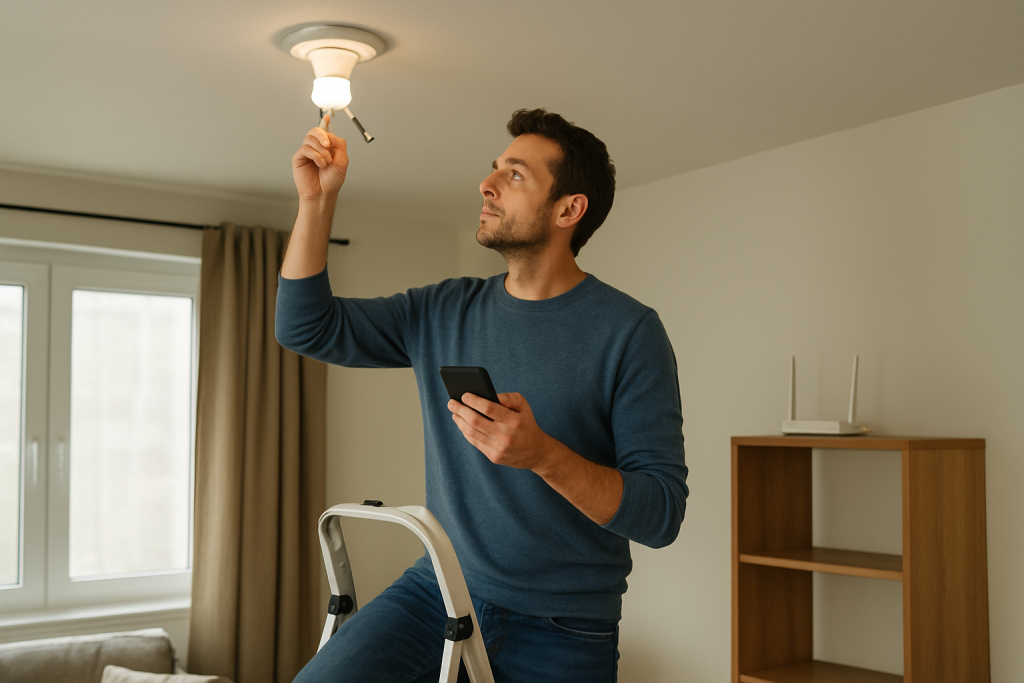
Do these three diagnostics first: (1) Check whether the bulb is actually powered (wall switch on, no loose socket) and whether it responds to a manual on/off from the app. (2) Check the bulb’s connection type and band: WiFi bulbs should be on 2.4 GHz; Zigbee/Thread bulbs should show a strong hub/mesh connection. (3) Run a quick isolation test by moving one problem bulb temporarily closer to the router or hub; if it stays online there, the issue is coverage/mesh behavior, not the bulb.
Why This Happens
Smart bulbs are designed to be “always available,” but they are also some of the most sensitive devices on a home network. They use low-power radios, often sit inside fixtures that block signal, and they depend on your network making consistent decisions about where and how they connect. When the network changes its mind—switching access points, changing channels, or briefly dropping the 2.4 GHz link—the bulb may not recover cleanly and appears offline until it reconnects.
Here are the most common technical causes that fit real homes:
1) Access point roaming and band steering confusion. If you have a mesh system or multiple access points, your network may “encourage” devices to roam. Phones handle this well; many bulbs do not. If a bulb keeps getting pushed between nodes or between 2.4 GHz and 5 GHz (or attempts 5 GHz and fails), it can drop offline intermittently.
2) Weak 2.4 GHz signal at the fixture, not in the room. A bulb in a ceiling can, recessed can, metal shade, or outdoor fixture may have a much weaker signal than your phone shows at eye level. If the bulb is near the edge of coverage, small changes—doors closing, people moving, a microwave running—can be enough to break the connection.
3) Zigbee/Thread mesh gaps (hub-based systems). Zigbee and Thread/Matter rely on a mesh. If you have too few mains-powered repeaters (like smart plugs or in-wall devices) between the hub and the bulbs, or if a key repeater is unplugged, the mesh can become unstable. Bulbs may “fall off” and rejoin later.
4) Router features that disrupt low-power clients. Some router settings intended to improve performance can break IoT stability: aggressive client steering, “Airtime Fairness,” “802.11ax only” modes, WPA3-only security, or scheduled WiFi pauses. The result is brief disconnects that look random.
5) Cloud/account sync delays. Some ecosystems show “offline” when the cloud can’t reach your home, even if local control might still work. If the internet connection is unstable, or if the app is signed into the wrong home/location, bulbs can appear offline inconsistently.
Real-world scenario: A homeowner adds a mesh node in a hallway to improve streaming. After that, a bedroom lamp bulb goes offline every evening. What changed is not the bulb—it’s that the bulb now alternates between two mesh nodes with similar signal, and it doesn’t roam cleanly. The app reports it offline until it settles back onto one node.
Common user mistake: Turning bulbs off at the wall switch “sometimes,” then expecting them to stay online. Even brief power loss can cause missed updates, partial reconnects, or automation confusion, especially if multiple bulbs lose power at different times.
Overlooked technical cause: Channel overlap between 2.4 GHz WiFi and Zigbee. Zigbee lives in the 2.4 GHz range too. If your WiFi is on a congested channel and your Zigbee hub is effectively competing in the same space, you can see intermittent dropouts that look like random offline events.
Most Likely Causes in Real Homes
1) Bulb is at the edge of signal (fixture blocks it). The room seems covered, but the bulb’s radio is shielded by metal, glass, or distance.
2) Mesh WiFi steering/roaming issues. Bulb bounces between nodes or fails to stay on 2.4 GHz consistently.
3) Router settings that don’t play well with IoT. WPA3-only, aggressive steering, or “smart” optimizations cause brief disconnects.
4) Zigbee/Thread mesh has weak routing. Not enough repeaters, or a key repeater was unplugged or moved.
5) Cloud/app home selection or account sync glitch. App points to the wrong home/location, or cloud reachability is inconsistent.
Step-by-Step Fix
Confirm the bulb is continuously powered. Leave the wall switch on for the affected bulb(s) and use only the app/voice to control them for a day. If the bulb is in a lamp, ensure the socket is snug and the lamp’s inline switch is not loose.
What the result means: If offline events stop, the “random” issue was actually power interruption (switch use, loose socket, power strip, or a flaky lamp switch).
If it fails, try next: Go to step 2 and focus on how the bulb is connecting.
Identify the connection type and check status in the app. In your lighting app, open the device details and note whether it’s WiFi, Zigbee via a hub, or Matter over WiFi/Thread. Also check whether the app shows “unreachable,” “offline,” or “no response,” and whether other devices in the same room are affected.
What the result means: If only WiFi bulbs are affected, suspect 2.4 GHz WiFi behavior. If only hub-based bulbs are affected, suspect mesh routing or hub placement. If everything across brands goes offline at the same time, suspect the router/internet.
If it fails, try next: Go to step 3 to do a quick placement/isolation test.
Run a “move closer” isolation test (fastest way to confirm signal/mesh). Temporarily move one problem bulb to a lamp closer to the router (for WiFi bulbs) or closer to the hub (for Zigbee/Thread). Leave it there for several hours.
What the result means: If it stays online when closer, the bulb is likely fine and the problem is coverage, interference, or mesh routing at the original fixture.
If it fails, try next: Go to step 4 and check WiFi band/mesh behavior and router settings.
For WiFi bulbs: confirm they are on 2.4 GHz and not being steered. In your router app, find the bulb in the client list and confirm it’s connected on 2.4 GHz. If your router uses a single network name for 2.4/5 GHz, look for a setting like “Smart Connect,” “Band Steering,” or “Client Steering.” If possible, temporarily disable steering or create a dedicated 2.4 GHz network for smart devices.
What the result means: If the bulb stabilizes on 2.4 GHz, the offline issue was caused by roaming/steering decisions or the bulb attempting to use an unsuitable band.
If it fails, try next: Go to step 5 and test mesh node behavior.
Mesh behavior test: lock down which node the bulb prefers (or simplify coverage). If you use mesh WiFi, temporarily power off the closest mesh node for 10–15 minutes and see if the bulb stays online by attaching to a different node. Then reverse: turn the node back on and power off another node. Some systems also allow “bind device to node” or “preferred AP.” Use it if available.
What the result means: If the bulb drops when a specific node is involved, that node’s placement, backhaul quality, or settings are causing instability.
If it fails, try next: Go to step 6 and check for interference and channel conflicts.
Reduce 2.4 GHz interference and channel overlap. Reboot the router once (not repeatedly) and then set a fixed 2.4 GHz channel if your router allows it. Avoid “auto” if it keeps changing channels. Keep the router away from cordless phone bases, baby monitors, and microwave-heavy areas. For Zigbee hubs, consider changing the Zigbee channel in the hub settings (if your ecosystem supports it) to reduce overlap with your WiFi channel.
What the result means: If offline events become less frequent or stop, interference or channel hopping was the trigger.
If it fails, try next: Go to step 7 and verify automations, groups, and schedules aren’t creating false “offline” symptoms.
Group sync test and schedule verification. Check whether the bulb is part of a group/room and whether the group is failing while individual control works. Then check schedules/automations that might be turning the bulb off, changing scenes, or disabling it at certain times. Also verify “away mode,” “vacation mode,” or “do not disturb” features.
What the result means: If individual control works but group control fails, the issue is likely configuration or a controller (hub/bridge/app) sync problem, not the bulb radio. If the problem happens at the same time daily, it’s usually an automation, routine, or network schedule.
If it fails, try next: Go to step 8 and check account/home selection and cloud reachability.
Account sync and home/location check (common with multiple homes). Confirm you are signed into the correct account and controlling the correct “home” or “location” in the app. If multiple family members control the lights, verify everyone is using the same home and that permissions are intact. If the app offers a “sync devices” or “refresh” option, run it once.
What the result means: If devices suddenly reappear or stop showing offline, the problem was app-side selection, permissions, or cloud sync rather than connectivity.
If it fails, try next: Go to step 9 and separate internet problems from local network problems.
Hotspot isolation test (separates bulb issues from router issues). If the bulb is WiFi-based and supports changing networks, temporarily connect one bulb to a phone hotspot (2.4 GHz if available) for a short test window. Keep it near the phone and see if it stays online.
What the result means: If it is stable on the hotspot, your home router/mesh configuration is the likely cause. If it still drops offline, the bulb firmware or the bulb itself is more suspect.
If it fails, try next: Go to step 10 and check firmware/software updates and controlled reboots.
Update firmware and do a clean power cycle sequence. Update the bulb firmware, hub/bridge firmware (if used), and the controlling app. Then power cycle in this order: (1) router/mesh, wait until fully online; (2) hub/bridge, wait until ready; (3) bulbs (turn power off for 15 seconds, then on). Do not rapid-toggle power repeatedly.
What the result means: If stability returns, the issue was a stuck network state, a firmware bug already fixed, or a hub/router that needed a clean restart order.
If it fails, try next: Proceed to Advanced Troubleshooting.
Advanced Troubleshooting
This section is only needed if basic fixes fail.
Account or cloud issue: If bulbs work locally sometimes but show offline when you are away from home, the problem may be internet reachability or cloud authentication. Check whether other cloud-dependent devices in your home also become unreachable at the same times. If your router has logs, look for frequent WAN disconnects. If the lighting app has a “remote access” toggle, sign out/in once rather than repeatedly reinstalling.
Network issue (relevant when many IoT devices drop): If multiple smart devices go offline together, look for DHCP/IP address churn. A common pattern is a router running out of available IP addresses or having a very short DHCP lease time, causing devices to lose their address and appear offline. If your router allows it, ensure the DHCP pool is large enough and avoid extremely short lease times.
Firmware/software cause: Some bulbs become unstable after a partial update or when the hub/router updated and changed compatibility (security mode changes are a big one). If the ecosystem supports it, check release notes and confirm your router security is compatible (many IoT devices prefer WPA2). If you recently enabled WPA3-only or “WPA3 required,” try WPA2/WPA3 mixed mode as a test.
Configuration conflict (groups, scenes, automations, permissions): Duplicate devices, leftover scenes, or multiple controllers can fight each other. For example, a bulb added to both a manufacturer app and a separate platform can receive conflicting commands, and the platform may mark it offline when it misses acknowledgments. If X happens (bulb goes offline right after a scene runs) it usually means Y (an automation is triggering a state change the bulb can’t confirm). Temporarily disable automations for one evening and see if the problem stops; if it does, re-enable them one by one to find the trigger.
When to Reset or Replace the Device
Soft restart vs. factory reset: A soft restart is simply removing power briefly (about 15 seconds) and restoring it, or using an in-app “restart device” option if available. A factory reset wipes the bulb’s pairing and returns it to setup mode.
What you lose after a factory reset: Expect to lose the bulb’s name, room assignment, scenes, schedules tied directly to that bulb, and any integrations that referenced the old device entry. You will need to re-add it to the app and re-assign it to rooms/groups.
When reset is justified: Reset if the bulb stays offline even when placed close to the router/hub, after firmware updates, and after a clean power cycle sequence. Also reset if the app shows the bulb as duplicated, stuck “updating,” or permanently “unreachable” while other devices are fine.
When to replace: Replace the bulb if it repeatedly overheats, flickers unusually, has a burnt smell, shows visible damage, or becomes too hot to touch. Also consider replacement if only that bulb drops offline across multiple networks or after a factory reset and re-pair.
How to Prevent This in the Future
Keep the network predictable for IoT. Avoid frequent changes to WiFi names, passwords, and security modes. If your router supports it, keep a stable 2.4 GHz setup for smart devices and avoid aggressive steering features that constantly move clients around.
Place hubs and routers for the bulbs, not for phones. A hub in a cabinet or behind a TV often “works” for a phone test but fails for bulbs in fixtures. Keep the hub/router in a more open, central spot when possible. For hub-based meshes, ensure you have enough always-powered devices that can act as repeaters, and avoid unplugging them casually.
Manage automations carefully. If you create multiple routines across different apps, document what controls the lights. If the same bulb is controlled by multiple platforms, keep the logic simple and avoid overlapping schedules that fire at the same minute.
Plan for power outages. After an outage, give the router/mesh time to fully stabilize before turning lights on/off rapidly. If your bulbs have a “power-on behavior” setting, set it intentionally so they don’t create confusing states after power returns.
Stay current, but update deliberately. Keep firmware updated on bulbs and hubs, but avoid updating everything at once right before an event. If a new update coincides with offline issues, note the timing and roll back settings changes (like security mode) before assuming hardware failure.
FAQ
Why do my bulbs show “offline” but the wall switch is on?
“Offline” usually means the app can’t communicate with the bulb, not that the bulb has no power. If the bulb is powered but can’t maintain a stable connection (WiFi 2.4 GHz drops, mesh routing changes, hub is unreachable), it will appear offline even though it could still turn on manually if it’s a basic lamp circuit.
My phone has strong WiFi in the room. Why would the bulb still disconnect?
The bulb’s antenna is smaller and often sits inside a fixture that blocks signal. A recessed can, metal shade, or outdoor enclosure can weaken the signal dramatically compared to what your phone shows at standing height. If moving the bulb closer to the router/hub stabilizes it, the issue is location-specific coverage.
Do smart bulbs “wear out” and start going offline?
It’s less common than network causes. Random offline behavior is usually connectivity, steering, interference, or mesh routing. A bulb is more suspect if it drops offline even when very close to the router/hub, after a factory reset, and while other devices remain stable.
Is it true that 5 GHz WiFi is always better for smart bulbs?
No. Many smart bulbs are designed for 2.4 GHz only, and even those that support 5 GHz may be less stable on it due to range and wall penetration. For bulbs, a stable 2.4 GHz connection is often more reliable than a faster 5 GHz connection.
Why do only some bulbs in the same room go offline?
If X happens (only one or two bulbs drop while others stay online), it usually means Y (those bulbs are in a worse RF spot, connected to a different mesh node, or are routed through a weaker Zigbee/Thread path). Test by swapping bulb positions or moving one bulb to a nearby lamp to see if the problem follows the bulb or the fixture location.
The noise fades in a way that feels almost unfair—like the world finally puts down its megaphone and goes back to normal volume. You can’t unsee how simple it was to recognize, which makes the whole thing oddly satisfying.
There’s no grand ending, just that steady click into place. The rest of the day continues, only with fewer unnecessary knots in it, and that’s more peace than it sounds like.