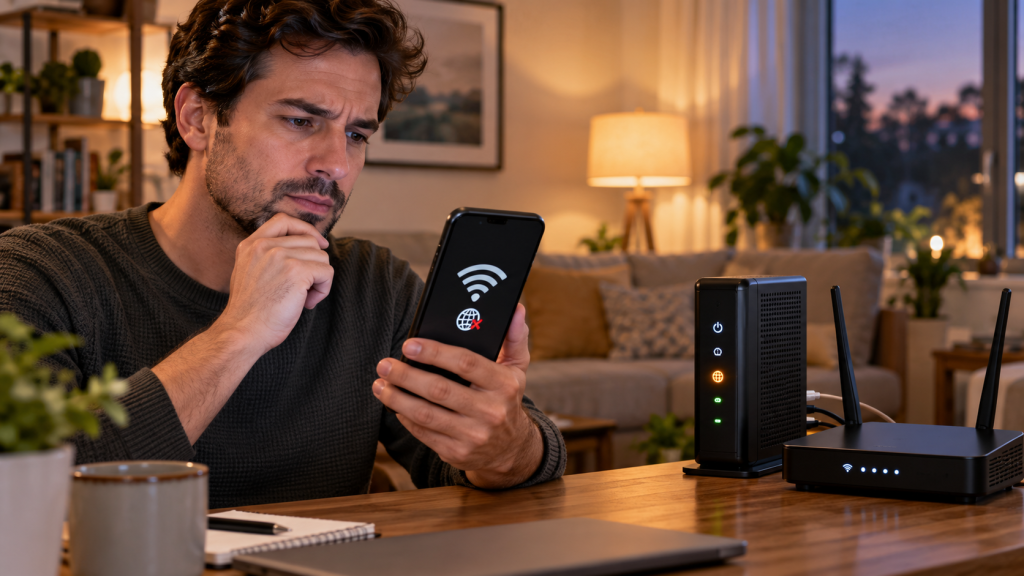
Why Guest WiFi Works but Smart Devices Wont Connect
Quick Answer
If your phone and laptop work on Guest WiFi but smart devices (plugs, bulbs, cameras, thermostats) won’t connect or won’t finish setup, the most common cause is network isolation. Many routers isolate the guest network from the main network and sometimes isolate wireless clients from each other, which breaks device discovery and setup steps that rely on local network communication.
Smart home apps often need your phone and the device to “see” each other on the same local network using broadcast or multicast traffic (common with mDNS/Bonjour, SSDP/UPnP, and vendor discovery protocols). When guest isolation, AP/client isolation, or “block LAN access” is enabled, the device may join WiFi but fail pairing, appear offline, or never show up in the app.
Why This Happens
Guest WiFi is designed for visitors: it provides internet access but limits access to your home network for security. To achieve that, routers often enable one or more isolation features that are great for safety but bad for smart device onboarding.
Network isolation (dominant cause): On many routers, the guest SSID is placed on a separate network (often a different VLAN/subnet) and is blocked from reaching your main LAN. Some routers also block device-to-device traffic even within the guest network. Smart device setup frequently requires local communication between your phone and the device, not just internet access. If isolation blocks that local traffic, setup fails.
Client/AP isolation on the main WiFi: Even if you are not using Guest WiFi, some routers have a “Wireless isolation,” “AP isolation,” or “Client isolation” option on the main SSID. When enabled, devices can reach the internet but cannot talk to each other locally. That can look like “WiFi works” while smart devices won’t connect or won’t be discovered.
2.4 GHz vs 5 GHz differences: Many smart devices only support 2.4 GHz. If your guest network is 2.4 GHz and your main network is 5 GHz (or your phone is on 5 GHz while the device is on 2.4 GHz), certain routers and apps struggle with discovery across bands, especially when isolation features are enabled. Band steering and “Smart Connect” can also cause your phone to hop bands mid-setup.
Real-world scenario: In an apartment with thick walls and lots of neighboring networks, you might place an ISP modem-router combo in a closet near the entry. Your phone still gets usable internet on the guest network near the router, but a smart camera at the far end of the unit may only see a weak 2.4 GHz signal. You try setup on Guest WiFi because it seems “more reliable,” but the guest isolation prevents the app from finding the camera locally, so it never completes pairing.
Common user mistake: Joining the phone to one network (often the guest SSID) while trying to add the device to a different network (the main SSID), or vice versa. Many apps assume the phone is on the same SSID as the device during onboarding. If they differ, discovery and provisioning often fail.
Overlooked technical cause: Some routers disable multicast/broadcast forwarding on guest networks or when “IGMP snooping,” “Multicast enhancement,” or “mDNS/Bonjour gateway” settings are misconfigured. Smart device discovery heavily depends on multicast; blocking it can make devices appear invisible even when they are connected.
DHCP/IP issues (less common but relevant): If the router’s DHCP server is misbehaving, running out of addresses, or there’s an IP conflict (two devices trying to use the same local IP), a smart device may connect to WiFi but fail to get a valid network configuration. This can be more visible on guest networks with smaller DHCP pools.
Firmware/software causes: Router firmware updates can reset guest isolation defaults, change band steering behavior, or introduce bugs affecting IoT onboarding. Similarly, smart device apps may require local network permissions on your phone (especially iOS/Android privacy settings). If the app can’t access local network discovery, it may look like the device “won’t connect,” even though the real problem is local communication being blocked.
Step-by-Step Fix
Confirm which network the phone and device are using. On your phone, open WiFi settings and note the exact SSID. During setup, ensure the phone stays on the same SSID you intend the smart device to join. If the device is 2.4 GHz-only, prefer a 2.4 GHz SSID (or temporarily split your bands so you can choose 2.4 GHz explicitly).
Disable guest network isolation (or stop using Guest WiFi for smart devices). Log into your router and find Guest WiFi settings. Look for options like “Guest network isolation,” “Allow guests to access local network,” “Block LAN access,” or “Access intranet.” For smart devices, either:
Option A: Put smart devices on the main WiFi (recommended), leaving guest isolation enabled for visitors.
Option B: If you must use guest WiFi, enable local access for that guest SSID and disable client isolation for it.
Check for AP/client isolation on the main WiFi. In wireless advanced settings, disable “AP isolation,” “Wireless isolation,” or “Client isolation” for the SSID used by your smart devices. This is a frequent reason devices can reach the internet but can’t be discovered or controlled locally.
Temporarily split 2.4 GHz and 5 GHz into separate SSIDs. If your router uses a single “Smart Connect” name for both bands, temporarily separate them (for example, “HomeWiFi-2G” and “HomeWiFi-5G”). Connect your phone to the 2.4 GHz SSID and add the smart device there. After setup, you can re-enable Smart Connect if desired, but many homes keep separate SSIDs for more predictable IoT behavior.
Reduce interference and test closer to the router. For onboarding, move the smart device within 10–15 feet of the router (or bring the router temporarily closer if practical). Avoid placing the device behind thick walls, metal appliances, or near microwaves and cordless phones. A practical test: watch the device’s RSSI/signal indicator in the app (if available) or use your phone’s WiFi signal where the device is installed to estimate coverage. If setup only works near the router, you likely have a coverage/interference problem that needs a mesh node, better placement, or a 2.4 GHz channel change.
Verify DHCP is working and avoid IP conflicts. In the router’s LAN/DHCP settings, confirm DHCP is enabled and the address pool is large enough (for example, 192.168.1.100–192.168.1.250). If you have many devices, a small pool can run out. If devices randomly go offline, check the router’s client list for duplicate IPs. A simple fix is to reboot the router, then reserve IP addresses for key smart devices (DHCP reservations) so they don’t collide.
Update router firmware and the smart device app. Install the latest router firmware from the router’s admin page or the ISP app for modem-router combos. Then update the smart home app and your phone OS. Firmware fixes often address multicast handling, band steering bugs, and stability issues that show up as IoT onboarding failures.
Re-run setup with correct phone permissions. On iOS, ensure the app has “Local Network” permission enabled. On Android, ensure Nearby Devices/Location permissions are allowed if the app requires them for discovery. If permissions are blocked, the app may not find the device even though WiFi credentials are correct.
Advanced Troubleshooting
If the basic isolation and band steps don’t resolve it, focus on confirming whether the device is actually joining WiFi and whether local discovery traffic is being blocked.
Use a practical testing method: verify the device gets an IP address
Open your router’s connected devices/client list and look for the smart device after attempting setup. If it appears with an IP address, it joined WiFi and got DHCP. If it never appears, the issue is usually WiFi credentials, incompatible security settings, weak signal, or the device failing to associate on 2.4 GHz.
Check WiFi security and compatibility settings
Many smart devices struggle with WPA3-only mode or mixed WPA2/WPA3 transitions on some routers. For troubleshooting, set the 2.4 GHz band to WPA2-Personal (AES) temporarily. Avoid enterprise authentication, and avoid special characters that some older IoT devices can’t parse in SSIDs or passwords.
Inspect router settings that block discovery traffic
Look for settings such as “Block multicast,” “Filter multicast,” “IGMP proxy,” “IGMP snooping,” “mDNS/Bonjour,” “UPnP,” or “IoT device discovery.” You typically want multicast allowed on the SSID used for smart devices. If your router has an “IoT network” feature, read its description carefully: some implementations isolate devices from your main network by default and require an explicit “allow phone/IoT access” toggle.
ISP modem-router combo complications
With ISP gateways, it’s common to add a second router or mesh system. If both devices are routing (double NAT) or broadcasting similar SSIDs, your phone may join one network while the smart device joins the other. Ensure only one device is acting as the router (use bridge mode on the ISP gateway or access point mode on the added router/mesh). Double NAT can also interfere with device cloud registration and remote access, making devices appear to “connect” but remain offline.
Channel and width tuning for congested areas
In apartments, 2.4 GHz congestion is common. Set 2.4 GHz channel width to 20 MHz for stability and choose a cleaner channel (1, 6, or 11). If your router is on “auto” and constantly changing channels, some IoT devices become unstable. Stability matters more than peak speed for smart devices.
When to Reset or Replace the Device
Reset the smart device when you’ve confirmed the network is configured correctly (no isolation blocking, correct 2.4 GHz SSID, strong signal) but the device still won’t enter pairing mode or keeps reusing old credentials. Perform a factory reset using the manufacturer’s steps, then attempt setup again with your phone on the intended SSID.
Consider replacing the device if it repeatedly fails to connect across multiple known-good networks (for example, you tested it at a friend’s house on a basic WPA2 2.4 GHz network) or if it cannot stay connected even when placed near the router. Also consider replacement if the vendor has discontinued updates and the device cannot handle modern security requirements, or if the device frequently drops due to outdated WiFi chipsets.
If the device connects but becomes unreliable after a router firmware update, check for a device firmware update first. If none exists and the device is known to be incompatible with your router’s current WiFi features (WPA3 transitions, aggressive band steering, or certain mesh systems), replacement may be the most time-effective solution.
How to Prevent This in the Future
Keep Guest WiFi for guests and keep smart devices on a dedicated main SSID or a properly configured IoT SSID that still allows your phone to reach the devices locally. The key is to avoid isolation settings that block local discovery unless you also configure the necessary exceptions.
Design your WiFi for stability: use 2.4 GHz for most smart devices, keep the router in a central location, and reduce interference by avoiding placement near TVs, microwaves, and dense wiring closets. If thick walls or long distances are unavoidable, add a mesh node or access point rather than relying on a “strong enough” signal during setup.
Make configuration choices that favor compatibility: WPA2-Personal (AES) on 2.4 GHz, 20 MHz channel width, and a consistent SSID. Keep router firmware updated, but after updates, re-check guest isolation, client isolation, and band steering settings because defaults can change. Finally, prevent DHCP issues by using a sufficiently large DHCP pool and reserving IPs for critical smart devices like cameras and hubs.
FAQ
Can I use Guest WiFi for smart devices if I enable “allow local access”?
Sometimes, yes. If your router lets the guest SSID access the local network and does not isolate clients from each other, onboarding can work. However, it reduces the security value of Guest WiFi. A better approach is a dedicated IoT SSID with controlled access (or an IoT VLAN) that still allows your phone to communicate with devices during setup and control.
Why does the device connect to WiFi but still shows “offline” in the app?
It often means the device joined WiFi but can’t complete local discovery or cloud registration. Isolation settings can block local communication, while DNS, firewall rules, or double NAT can interfere with cloud connectivity. Check the router client list for an IP address, then verify isolation settings and that the device has internet access.
Do smart devices require 2.4 GHz, and does 5 GHz cause failures?
Many smart devices are 2.4 GHz-only for range and cost reasons. If your phone is on 5 GHz and the device is on 2.4 GHz, some routers handle cross-band discovery poorly, especially with isolation features enabled. Splitting SSIDs temporarily and keeping the phone on 2.4 GHz during setup is a reliable workaround.
What’s the quickest way to prove network isolation is the problem?
Connect your phone to the same SSID as the device (preferably the main 2.4 GHz SSID), disable guest isolation/client isolation, and try setup again near the router. If it immediately starts discovering and pairing, isolation was blocking local traffic. If it still fails and the device never appears in the router client list, focus on WiFi compatibility or signal issues instead.
Could DHCP or an IP conflict really stop a smart device from connecting?
Yes. If the device can join WiFi but can’t get a valid IP address, it won’t communicate reliably. A small DHCP pool, a stuck DHCP service, or two devices using the same IP can cause intermittent failures. Rebooting the router, enlarging the DHCP pool, and creating DHCP reservations for key devices are simple fixes.
When everything finally lines up, the noise in your head gets quieter. It’s almost a relief—like finding the missing sock and realizing it was never that deep.
There’s a strange calm that comes from seeing it clearly, even if nothing dramatic happens. The world keeps moving, and you do too, with fewer loose ends tugging at you.