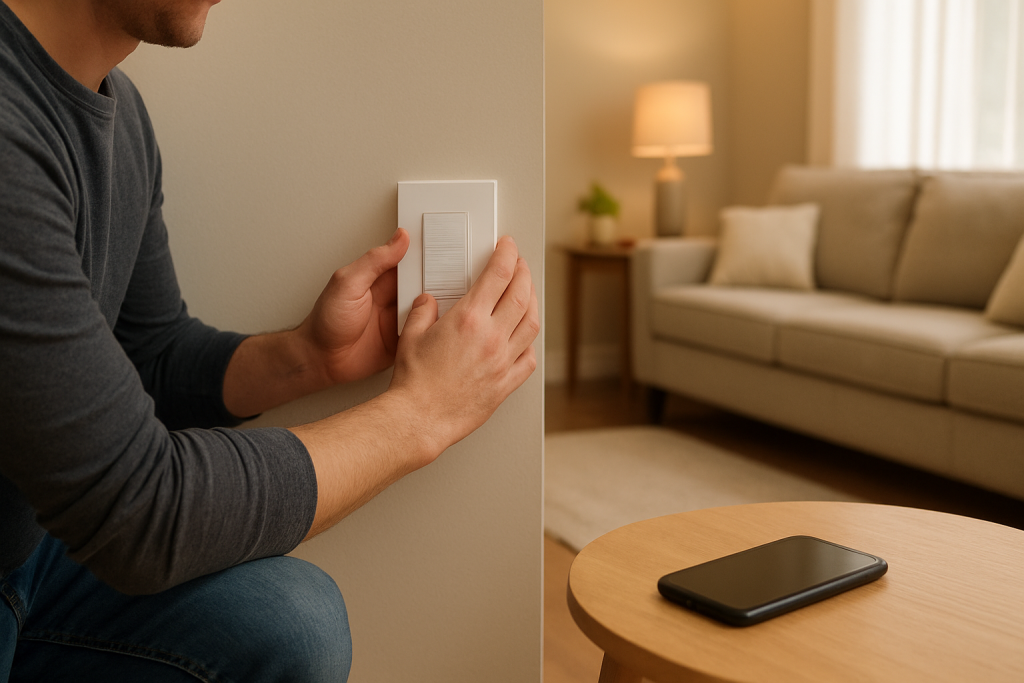
Smart Switch Works Manually but Not in the App? Fixes to Try
Quick Answer
If your smart switch (or smart plug) still turns the light or outlet on/off when you press it, the relay and power side are usually fine. The failure is typically happening in the “control path” between the app and the device—most often a cloud sync/session problem, an app account mismatch, or a hub/controller that isn’t updating the device’s online status.
This is especially common after router restarts, power outages, app updates, switching phones, or when the device is added to multiple ecosystems (manufacturer app plus Alexa/Google Home/Apple Home/SmartThings/Matter). The app may show “Offline,” “Unreachable,” or it may accept commands that never reach the switch.
Do these 3 quick checks first: 1) Pull down to refresh the device status in the app and confirm whether it flips to “Online.” 2) Toggle the switch manually once, then watch if the app updates the state within 5–10 seconds. 3) Sign out of the app and sign back in to force a fresh cloud session.
Why This Happens
When manual control works, the switch’s internal relay is responding locally. App control depends on at least one extra layer: the phone app, your account session, and either the vendor cloud (many WiFi switches/plugs) or a hub/controller (Zigbee, some Matter setups, Hue bridges, SmartThings, etc.). If that layer is out of sync, the app can’t reliably send commands or reflect the real on/off state.
Common causes tightly tied to this “app/cloud sync” path include:
1) Cloud session/token problems: an app update, password change, or long background time can leave your phone logged in but not actually authorized to control devices until you re-authenticate.
2) Device shows “Offline” due to stale cloud presence: after a power outage or router reboot, the switch may reconnect to WiFi but fail to re-register with the cloud right away, so the app thinks it’s gone.
3) Controller mismatch in multi-ecosystem homes: a device added via Matter may be controlled by one “primary” controller (Apple Home, Google Home, Alexa, SmartThings). If you’re using a different app than the active controller, commands can fail or status can lag.
4) Hub reachability issues (Zigbee/Hue bridge): manual toggle still works, but the hub can’t talk to the device or can’t sync that state back to its app or cloud.
Real-world scenario: the internet briefly drops overnight. In the morning, the wall switch still works by hand, but the app shows “Offline” because the device didn’t fully re-establish its cloud connection after your mesh system reshuffled nodes.
Common user mistake: controlling the device from a voice assistant app (or a second household member’s account) that isn’t actually linked to the same “home” or device instance anymore—so you’re sending commands to a duplicate entry.
Overlooked technical cause: time/location or permission sync problems—your app account is valid, but the home/room assignment or sharing permissions didn’t sync correctly, so the app can see the device but can’t control it.
Most Likely Causes in Real Homes
1) App account session is stale or corrupted (most common): the app opens, but commands time out or “spin” because the cloud token needs a fresh login.
2) Cloud sync delay or outage: the device works locally, but remote/app control fails because the vendor cloud or integration service is slow or temporarily down.
3) Router/mesh changes broke continuity: the switch reconnected to WiFi, but it’s on a different node/band and the cloud still marks it unreachable, or your phone is on a different network segment/guest WiFi.
4) Duplicate device entries across apps: the manufacturer app and Alexa/Google/Apple/SmartThings each show a device, but one is an old/ghost record; you’re controlling the wrong one.
5) Hub/controller is the bottleneck (Zigbee/Matter bridge/Hue/SmartThings): manual works, but the hub can’t reach the device or can’t update its state to the app.
Step-by-Step Fix
Confirm what exactly fails: status, control, or both. Open the manufacturer app (or the primary hub app), pull down to refresh, then press the physical switch once and watch whether the app state changes within 5–10 seconds.
What it means: If the app status updates but tapping “On/Off” doesn’t work, the issue is usually command delivery (cloud/controller control path). If neither status nor control updates, the app likely sees the device as offline or is pointed at the wrong device/home.
If it fails: Go to step 2 to fix the most common cause: app session/cloud re-authentication.
Force a clean cloud session: sign out/in and refresh permissions. Fully close the app, sign out (if available), sign back in, and accept any new permission prompts. If your home is shared, confirm you’re in the correct “Home/Location” inside the app.
What it means: If control returns immediately, your switch was fine—your app token or cloud session was the problem.
If it fails: Proceed to step 3 and verify you’re not controlling a duplicate or wrong integration instance.
Eliminate “ghost” devices and wrong-controller control. Check whether the same switch appears in multiple places (manufacturer app plus Alexa/Google Home/Apple Home/SmartThings). Pick one “source of truth” temporarily: use the manufacturer app for WiFi devices, or the hub/controller app for Zigbee/Matter. In voice assistant apps, look for duplicates (same name twice) and try controlling each entry.
What it means: If one entry works and another doesn’t, you’ve found a stale/duplicate record or an integration that lost sync.
If it fails: Go to step 4 and test whether the problem is network path vs cloud path.
Do a targeted network isolation test (without “resetting everything”). Make sure your phone is on the same home network (not cellular-only, not guest WiFi, not a VPN). If you have a mesh system, stand near the switch and temporarily connect your phone to the same WiFi name the switch uses. Then try control again.
What it means: If it starts working only when you’re near the device or on a different WiFi segment, your issue is likely local reachability: guest network isolation, mesh roaming, or band steering causing the switch and phone to be effectively separated for local control and discovery.
If it fails: Continue to step 5 to handle the most common post-outage/router restart cloud re-registration issue.
Use the right power-cycle sequence for cloud re-registration. Turn the switch off and on manually once, then power-cycle in this order: 1) modem (if separate) 2) router/mesh main node 3) hubs/bridges (Hue/SmartThings/Zigbee) 4) finally, the switch/plugs (by switching the circuit at the device’s normal power source, not by any wiring). Wait 2–3 minutes after the network is stable before testing app control.
What it means: If the app suddenly shows “Online,” the device likely needed a clean DHCP lease and a fresh cloud handshake after a network change.
If it fails: Go to step 6 to verify app/firmware versions and cloud service status.
Check app/firmware alignment and service health. Update the manufacturer app (and hub apps), then check for a device firmware update. If the app offers a “device health” page, run it. Also verify your phone’s date/time/time zone are set automatically.
What it means: Firmware/app mismatches can break cloud command handling even while manual control works. Incorrect time settings can break authentication and automation sync.
If it fails: Move to step 7 and isolate automation conflicts that can look like “app commands don’t work.”
Disable conflicting schedules, scenes, and automations temporarily. In the manufacturer app and any linked platforms (Alexa routines, Google automations, Apple Home automations, SmartThings routines), disable timers/schedules for this device for 10 minutes. Then try app control again.
What it means: If control “works” but immediately flips back, a schedule/automation is overriding you, creating the impression that app control is broken.
If it fails: Go to step 8 and repair the ecosystem link (Alexa/Google/Apple/SmartThings/Matter) that may be stuck.
Re-sync the ecosystem connection (without factory resetting the device). If the manufacturer app controls the switch but Alexa/Google/Apple/SmartThings doesn’t, use the platform’s re-sync steps: re-run device discovery, refresh the linked service/skill integration, and confirm the device is in the correct home/room. For Matter, confirm you are using the intended primary controller and that your phone is on the same home network during control.
What it means: If this fixes it, the device was fine—an integration layer was out of sync with the cloud/controller.
If it fails: Proceed to the “Advanced Troubleshooting” section for deeper cloud/account and hub checks.
Advanced Troubleshooting
This section is only needed if basic fixes fail.
Account/cloud issue: Verify you’re logged into the correct account (many homes accidentally create two accounts with similar emails). If your household uses sharing, confirm the owner account still has the device and that your user has control permission, not view-only access. If the app has a “home” selector, ensure the device is not stranded in a different home/location.
Network issue (specific to app control failures): If your switch supports local LAN control, guest WiFi/AP isolation can block local commands even when the cloud status looks fine. Also, some mesh systems move clients aggressively; if the switch is far from the nearest node, it may keep reconnecting and never complete a stable cloud session. A simple test is to keep the switch powered and stable, then move a mesh node closer (no rewiring) or reduce interference by avoiding placing nodes behind TVs or inside cabinets.
Firmware/software cause: If firmware updates repeatedly fail, the device may be stuck between versions. Try updating with your phone close to the device and keep the app in the foreground until completion. If your phone uses a VPN or private relay feature, temporarily disable it during pairing/control attempts because it can interfere with local discovery and cloud callbacks.
Configuration conflict: Groups and scenes can mask control. If the device is part of a group (for example, “Kitchen Lights”), try controlling it individually. If individual control works but group control fails, rebuild the group/scene in the same platform you use most often.
Ecosystem sync issue (Alexa/Google Home/Apple Home/SmartThings/Matter): If one platform works and another doesn’t, treat it as a sync problem, not a device failure. Remove only the integration link (skill/service/bridge exposure) and add it back—this often clears stale device IDs without forcing a factory reset of the switch itself.
When to Reset or Replace the Device
Soft restart vs factory reset: A soft restart is simply removing power briefly (or using an in-app “reboot” if available) to force a fresh network and cloud connection. A factory reset wipes pairing and identity so the device can be added again as new.
What you may lose after a factory reset: You’ll typically lose WiFi credentials, hub pairing, room assignment, custom names, schedules/timers, and automations tied to that device. If it’s a smart plug with energy monitoring, you may also lose historical energy data stored in the app or cloud.
When a reset is reasonable: If the device consistently shows offline in the manufacturer app while manual control works, and sign-in refresh + network isolation tests didn’t help, a factory reset can clear corrupted provisioning or a stuck cloud identity.
When replacement is reasonable: If the device cannot stay online for more than short periods, cannot complete firmware updates after multiple attempts, or shows unstable relay behavior (random clicking unrelated to automations), it may be failing. Stop using and replace immediately if you notice overheating, a burning smell, discoloration, buzzing, or visible damage.
How to Prevent This in the Future
Keep one “source of truth” for control. Use the manufacturer app (or a single hub app) for setup and maintenance, then link to assistants. Avoid creating automations for the same device in multiple places unless you’re very intentional about it.
Stabilize the device’s cloud handshake. After router changes, give the network a few minutes to settle before judging devices as “offline.” If you use a mesh system, place nodes so switches/plugs aren’t at the edge of coverage where they reconnect repeatedly.
Be consistent with naming and rooms. Duplicate names across ecosystems can produce “ghost” devices and misdirected commands. Keep one clear name per device and match room assignments across apps when possible.
Practice clean outage recovery. If you’ve had a power outage, reboot order matters: network first, hubs/bridges second, end devices last. This reduces “device connected but cloud doesn’t know it” situations.
Maintain apps and permissions. Update smart home apps periodically, and after major updates, open them once to re-accept permissions and refresh sessions. In shared homes, review sharing permissions when someone changes phones or emails.
FAQ
If the switch works manually, doesn’t that prove WiFi is fine?
No. Manual control only proves the relay and local button work. App control still depends on the switch’s connection path (cloud registration or hub/controller reachability). A switch can be powered and working locally while its app identity is offline or out of sync.
The app shows the correct on/off status, but tapping On/Off does nothing. What does that mean?
That usually points to a command path problem rather than a status/reporting problem—often a stale login token, a cloud command routing issue, or you’re controlling a duplicate/old device entry while the real device is reporting status elsewhere.
My manufacturer app works, but Alexa/Google Home/Apple Home won’t control it. Is the switch bad?
Usually not. That pattern strongly suggests an ecosystem sync or linking issue. Re-sync device discovery, refresh the linked service/skill, and confirm the device is in the correct home/room and not duplicated.
Do I need to factory reset right away?
Not typically. Most “manual works, app doesn’t” cases are solved by refreshing the app session, removing duplicates, and fixing cloud/controller sync after outages or updates. Reset is best saved for persistent offline behavior in the primary control app after the targeted steps above.
Relief comes in odd little moments—like the silence after you stop checking for the next problem, or the ease of reading the same sentence twice without it turning into a task. The work is already done on the reader’s side; what’s left is letting the noise fade out.
Some problems linger because they keep their shape. This one doesn’t; it loosens, and then you notice your day moving again, unbothered. That shift is quieter than people expect, but it’s real.