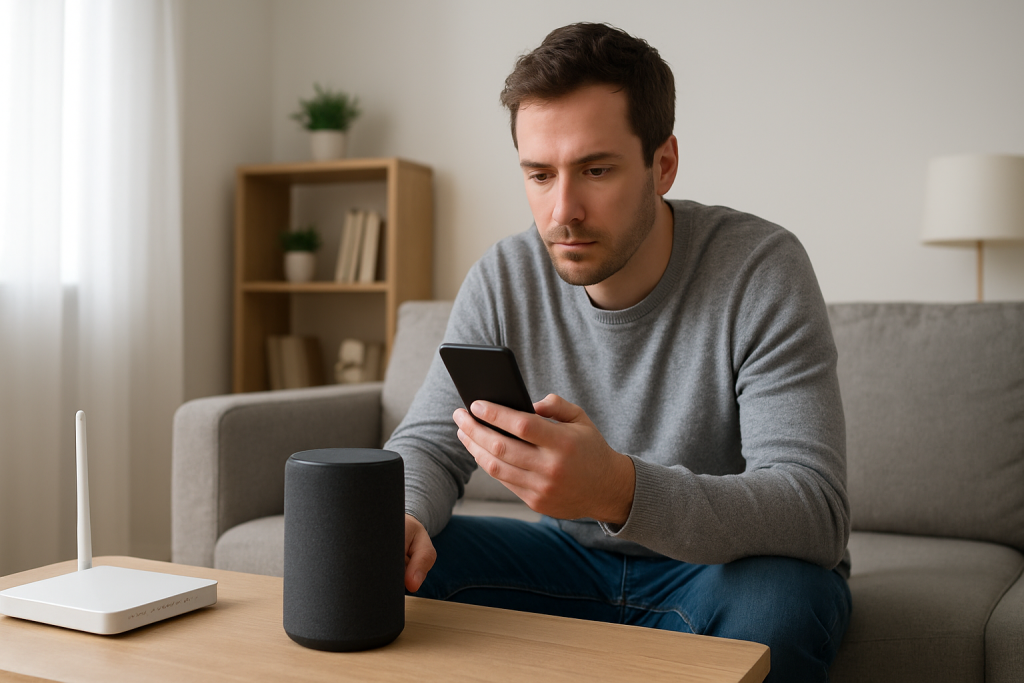
Alexa Setup Stuck on Connecting to WiFi: How to Fix It
Quick Answer
When Alexa setup hangs on “Connecting to Wi‑Fi,” the most common reason is that your phone and the Echo are not negotiating the same Wi‑Fi conditions during onboarding. In most homes this comes down to the phone being on the wrong band (5 GHz instead of 2.4 GHz), the router using a Wi‑Fi security mode Alexa can’t join cleanly (certain WPA3-only or enterprise modes), or the network requiring a sign-in step (captive portal) that Alexa can’t complete.
Start by forcing your phone onto the 2.4 GHz network name (or temporarily separating 2.4/5 GHz), then try setup again. If that doesn’t work, test with a simple network: a phone hotspot without a captive portal and with standard WPA2 security. Those two checks quickly tell you whether you’re dealing with band steering/security settings versus an Alexa device issue.
Why This Happens
During setup, your phone acts as the “bridge” between the Alexa app, your Amazon account, and your Wi‑Fi network. The app first connects to the Echo’s temporary setup network, then hands the Echo your Wi‑Fi name and password. If the phone is connected to a Wi‑Fi band or network type that doesn’t match what the Echo can reliably join, the handoff can stall at “Connecting to Wi‑Fi.”
Here are the most common causes that fit this pattern:
1) Phone on 5 GHz while the Echo needs 2.4 GHz for onboarding. Many Echo models support both bands, but setup is often most reliable on 2.4 GHz. If your router uses band steering (one network name for both bands), your phone may jump to 5 GHz even when the Echo is attempting 2.4 GHz.
2) Band steering or mesh “smart connect” interferes with setup. Mesh systems and modern routers try to move clients between bands automatically. During onboarding, that can break the moment when the app is passing Wi‑Fi details and the Echo is trying to join.
3) WPA mode mismatch. Networks set to WPA3-only, WPA2/WPA3 transition modes that behave inconsistently, or enterprise authentication (802.1X) can cause the Echo to fail at the exact “Connecting” stage. Most homeowners see this after changing router security settings.
4) Captive portals. If your Wi‑Fi requires a web login (common in apartments, guest networks, and some ISP-provided “community Wi‑Fi”), Alexa can’t open a sign-in page. Setup may look like it’s connecting, but it never gets full internet access.
5) Network isolation or blocked onboarding traffic. Guest networks and some “IoT isolation” settings prevent devices from talking locally. During setup, the app may not be able to complete discovery/hand-off steps even if the password is correct.
6) An overlooked technical cause: special characters or saved credentials mismatch. If your Wi‑Fi password was changed recently, the Alexa app may keep trying an old saved password. Also, some routers behave poorly with certain punctuation in SSIDs or passwords during device onboarding.
Real-world scenario: After a power outage, a mesh system comes back online and automatically enables “Smart Connect” again. Your phone reconnects on 5 GHz, but the Echo tries to join 2.4 GHz. The Alexa app shows “Connecting to Wi‑Fi” indefinitely because the handoff is happening while the phone is being steered between bands.
Common user mistake: Selecting the “Guest” Wi‑Fi because it has a stronger signal. Guest networks often use isolation or captive portals, both of which are common reasons setup stalls.
Step-by-Step Fix
Confirm you’re setting up on a normal home Wi‑Fi (not guest/community).
What to do: In the Alexa app, when it asks you to choose a Wi‑Fi network, pick your main home network (the one your phone normally uses inside the home). Avoid any network labeled Guest, Community, Apartment, Public, or one that usually opens a sign-in page.
What the result means: If switching from a guest/community network fixes it, the original network likely uses captive portal sign-in or isolation that blocks onboarding.
If it fails: Continue to the next step and focus on band/security settings.
Force your phone onto 2.4 GHz (or temporarily split the bands).
What to do: If your router has separate names for 2.4 GHz and 5 GHz (for example, HomeWiFi and HomeWiFi-5G), connect your phone to the 2.4 GHz one before starting Alexa setup. If you only have one Wi‑Fi name, look in your router/mesh app for a setting like “Smart Connect,” “Band Steering,” or “Use one name for both bands,” and temporarily disable it so 2.4 GHz and 5 GHz are separate during setup.
What the result means: If setup completes after forcing 2.4 GHz, the issue was band steering or the phone being on 5 GHz during onboarding.
If it fails: Keep the phone on 2.4 GHz and move to the next step to check security mode and captive portal behavior.
Check the Wi‑Fi security mode (aim for WPA2-Personal during setup).
What to do: In your router settings, find Wireless Security for the 2.4 GHz network. If it’s set to WPA3-only or an enterprise mode, change it temporarily to WPA2-Personal (sometimes called WPA2-PSK, AES). If your router offers WPA2/WPA3 mixed mode, and setup is failing, try WPA2-only for the onboarding attempt.
What the result means: If Alexa connects after switching to WPA2-Personal, the previous security mode was blocking the Echo from joining reliably.
If it fails: Move to the next step to rule out captive portals and confirm the Echo can join a “simple” network.
Run a quick hotspot test (practical “yes/no” diagnosis).
What to do: Turn on your phone’s personal hotspot (use a simple name and password). Connect the Echo to that hotspot using the Alexa app. If possible, use a second phone for the Alexa app so the hotspot phone can stay dedicated to sharing internet.
What the result means: If the Echo sets up successfully on the hotspot, the Echo is fine. Your home network settings (band steering, WPA mode, captive portal, isolation) are the problem.
If it fails: If the Echo can’t connect even to a hotspot, the issue is more likely with the setup process, the Alexa app/account, or the Echo itself. Continue with the next steps.
Verify the Alexa app is using the right Amazon account and has local network permission.
What to do: In the Alexa app, go to Settings and confirm you’re signed into the Amazon account that owns the device (or the household account you intend to use). On your phone, ensure the Alexa app has permission for Local Network (iPhone) or Nearby devices/Location (Android—requirements vary by version). Then try setup again.
What the result means: If permissions or account mismatch was the issue, setup will usually move past “Connecting” quickly once corrected.
If it fails: Continue to the next step to check whether the router is even seeing the Echo attempt to join.
Check whether the router sees the Echo (client list test).
What to do: Open your router/mesh app and look at the connected devices list while attempting setup. You may see an “Amazon” device, “Echo,” or a device with a new MAC address briefly appear.
What the result means: If the Echo appears briefly and then disappears, that usually points to authentication/security issues (wrong password saved, WPA mode mismatch) or band steering instability. If it never appears at all, the Echo may not be receiving the credentials correctly from the app, or the network is blocking onboarding traffic.
If it fails: If it appears/disappears, re-check WPA mode and password accuracy. If it never appears, proceed to the next step to stabilize the setup environment.
Stabilize the setup environment: move closer and reduce “smart” network features temporarily.
What to do: Place the Echo within a few feet of the router (or the main mesh node) for setup. Temporarily disable VPN on your phone. If your router has options like “AP Isolation,” “Client Isolation,” “Protected Management Frames required,” or strict IoT isolation, turn those off for the onboarding attempt (you can re-enable after).
What the result means: If setup works only when close to the router or with isolation features disabled, the original failure was caused by weak 2.4 GHz signal at the setup spot or local traffic being blocked during onboarding.
If it fails: Continue to Advanced Troubleshooting to address account-side and firmware/app issues that can look like Wi‑Fi failures.
Advanced Troubleshooting
Account and cloud issues that can look like Wi‑Fi problems
Device registered to a different account: If the Echo was previously owned or set up under another Amazon account, onboarding may stall or loop. In the Alexa app, check whether the device appears under Devices. If it does but won’t connect, deregistration may be required (see reset section). If it does not appear, confirm you’re signed into the intended Amazon account and that you’re not switching between personal and household profiles mid-setup.
Amazon Household/profile confusion: If you have multiple adult profiles, the Alexa app can show different device visibility depending on which profile is active. If setup works on one phone but not another, compare which Amazon account/profile each phone is signed into.
Network issues tied to the primary causes
Captive portal confirmation: If your Wi‑Fi ever opens a “Sign in to Wi‑Fi” page on phones, it’s a captive portal. Alexa devices generally cannot complete that web sign-in. The fix is to use a standard home SSID without a portal, or ask the network administrator/ISP to provide a non-portal SSID for smart devices.
WPA3 transition quirks: Some routers advertise WPA2/WPA3 mixed mode but handle certain clients poorly. If your hotspot test worked and your home network fails, try WPA2-only on 2.4 GHz during setup. After the Echo is online, you can test switching back to mixed mode; if it breaks again, keep WPA2 for that band.
DNS or filtering services: Aggressive parental controls or DNS filtering can block the Echo from reaching Amazon setup services, which can present as “Connecting.” If you have a “safe browsing” or device-level filtering feature, temporarily disable it for the onboarding attempt or allow the Echo in the router’s device profile.
Firmware/software causes
Alexa app cache/state issues: If the app repeatedly fails at the same point even after band/security changes, the app may be stuck with old onboarding state. Force close the Alexa app, reopen it, and start setup fresh. If your phone offers it, clear the Alexa app cache (Android) or reinstall the app (iPhone/Android). The goal is to remove saved Wi‑Fi attempts and stale permissions prompts.
Echo firmware not updating because it can’t get online: If the Echo is on very old firmware, it may be pickier about certain Wi‑Fi settings. The hotspot test is useful here: if it can connect to a hotspot, leave it connected for 15–30 minutes so it can update, then move it back to your home Wi‑Fi.
Configuration conflicts
Saved networks and wrong credentials: If you recently changed the Wi‑Fi password, the Echo may be trying the old one. In the Alexa app, remove the saved Wi‑Fi network for the device (where available) and re-enter the password carefully. If you use a password manager, verify it’s inserting the correct characters.
Permissions on the phone blocking discovery: On some phones, denying local network access prevents the app from completing the handoff to the Echo even though Bluetooth is on. If setup succeeds on a different phone, that strongly suggests a phone permission/configuration issue rather than the router.
When to Reset or Replace the Device
Try a soft restart first if the Echo is responsive (lights behave normally, it speaks, or it shows signs of entering setup mode). A restart is appropriate when setup is stuck but you’ve changed Wi‑Fi settings and want a clean attempt. Power the Echo off, wait about 20 seconds, and power it back on. This clears temporary network state without erasing your device registration.
Factory reset when one of these is true: the Echo won’t enter setup mode, it keeps reappearing as “offline” after successful Wi‑Fi entry, it was previously registered to another account, or the hotspot test fails even though your hotspot works for other devices. Factory reset removes the device from its current configuration and forces a fresh onboarding.
What you lose with a factory reset: The Echo forgets saved Wi‑Fi networks, device-specific settings, and any local configuration on the unit. You will need to add it back in the Alexa app and reapply preferences (like device location, speaker groups, and some smart home assignments). Your Amazon account content and most skills remain in your account, but the device must be re-associated.
Safety note: If the device is unusually hot, has a burning smell, makes crackling sounds, or the power adapter shows damage, stop using it and unplug it. Do not attempt hardware repair. In those cases, replacement is safer than continued troubleshooting.
How to Prevent This in the Future
Keep a stable 2.4 GHz option available. Even if you prefer one combined Wi‑Fi name, it helps to know how to temporarily split bands for onboarding. Many smart devices are most reliable on 2.4 GHz, especially during initial setup.
Avoid captive portals for smart devices. If your home internet setup includes a portal login, ask for a standard private SSID or use your own router behind the service (without changing wiring yourself). Smart speakers need automatic internet access without a browser sign-in step.
Be cautious with Wi‑Fi security changes. WPA3 is useful, but if you enable WPA3-only and older devices stop connecting, use WPA2-Personal for the 2.4 GHz band or a dedicated IoT network that stays compatible. Make one change at a time so you know what caused the break.
Plan mesh Wi‑Fi onboarding. If you use mesh, do setup near the main node and consider temporarily disabling band steering during onboarding. After the device is connected, you can re-enable steering and confirm it stays online.
Keep account ownership clear. Use one primary Amazon account for device ownership in the home, and be careful when switching profiles in Amazon Household. When devices “disappear” or won’t set up, it’s often an account/profile mismatch rather than a Wi‑Fi failure.
Review routines and permissions after changes. If you change Wi‑Fi names, router settings, or phone privacy settings, expect to re-check Alexa app permissions and device connectivity before you need it (for example, before guests arrive or before travel).
FAQ
Does Alexa require 2.4 GHz Wi‑Fi to set up?
Not always, but setup is most reliable on 2.4 GHz. If your phone is on 5 GHz and your router is steering devices between bands, the onboarding handoff can stall. Forcing the phone onto 2.4 GHz or temporarily splitting the bands fixes a large percentage of “Connecting to Wi‑Fi” setup loops.
My Wi‑Fi password is correct. Why does it still hang on “Connecting”?
A correct password doesn’t guarantee the network is compatible during onboarding. WPA3-only security, captive portals, or guest network isolation can block the Echo after it receives the password. The hotspot test is the fastest way to prove whether the issue is your home network settings versus the Echo itself.
Is it true that a stronger Wi‑Fi signal always fixes setup?
No. A strong signal helps, but many “Connecting” failures are caused by band steering, WPA mode mismatch, or captive portals, not weak coverage. Moving closer to the router is a good test because it reduces variables, but if the underlying issue is security mode or a portal login, signal strength won’t solve it.
Why does setup work on a hotspot but not on my home Wi‑Fi?
That result usually means the Echo is fine and your home Wi‑Fi is the blocker. Focus on: forcing 2.4 GHz, disabling band steering temporarily, switching to WPA2-Personal during setup, and avoiding guest/community networks that use captive portals or isolation.
Can a guest network prevent Alexa from connecting even if other devices work?
Yes. Many guest networks are designed to keep devices separated for privacy, which can interfere with discovery and onboarding. Some also require a sign-in page. Phones and laptops can handle those conditions, but Alexa devices typically need a standard home SSID with normal internet access and without client isolation during setup.
Relief settles in the way it does after the last annoying checkbox is finally done—quiet, almost anticlimactic, but undeniably real. The noise has less to cling to now, and the page feels lighter even if the world doesn’t instantly change.
There’s still plenty to live through, of course, but it stops feeling like you’re chasing your tail. Some problems don’t vanish; they just lose their grip, and that’s enough to breathe easier.