Range Extender Made Things Worse: How to Fix Smart Devices After Adding One
Quick Answer
If your smart devices started dropping offline, lagging, or refusing to reconnect after you added a WiFi range extender, the most common cause is extender misconfiguration. Typical problems include the extender creating a second network name (SSID), using the wrong security settings, running its own DHCP, or being placed where it repeats a weak signal, which leads to unstable connections and constant device roaming.
Fix it by confirming the extender is in the correct mode (usually Access Point mode if you can wire it, otherwise Extender/Repeater mode), matching SSID/security correctly, disabling DHCP on the extender (when applicable), and ensuring your smart devices stay on 2.4GHz if they don’t support 5GHz. Then reconnect devices to the intended SSID and verify stability with a simple ping/latency test or by checking your router’s client list.
Why This Happens
A range extender can improve coverage, but it can also amplify misconfiguration. Smart devices (bulbs, plugs, thermostats, cameras, speakers) are especially sensitive because many use low-power radios, prefer 2.4GHz, and don’t handle roaming decisions well. When an extender is added incorrectly, devices may bounce between the router and extender, get stuck on an SSID that isn’t actually reaching the internet, or receive an incorrect IP address.
The dominant issue is how the extender is configured and integrated into your network. Many extenders ship with default settings that don’t match your router, and “quick setup” often results in a second SSID like HomeWiFi_EXT. That sounds harmless, but it changes how devices authenticate and roam. Some devices will cling to the weaker network they learned first, while others repeatedly attempt to switch, causing delays and disconnects.
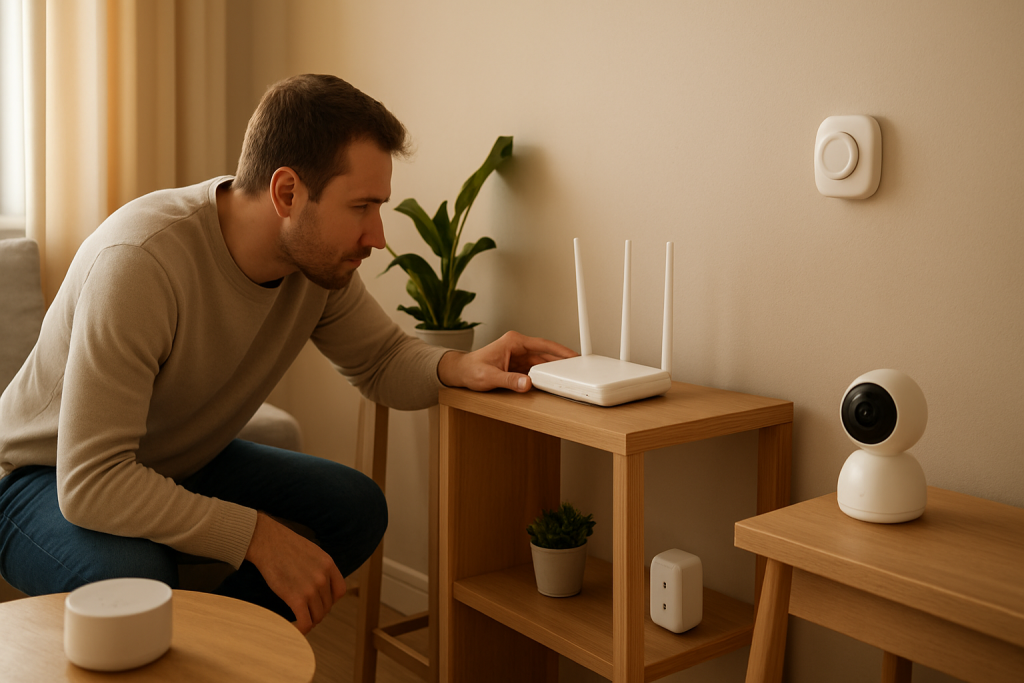
Here’s a real-world scenario: in an apartment with thick plaster walls and neighboring networks on every channel, you install an extender in the bedroom. During setup, it creates a new SSID and defaults to “Auto” band steering. Your phone seamlessly switches between networks, but your smart plugs on 2.4GHz keep trying to join the extender SSID with slightly different security settings, and your camera starts buffering because it’s connected to a repeater that’s only receiving a marginal signal from the main router.
A common user mistake is placing the extender at the far edge of the home where the signal is already poor. An extender doesn’t “create” bandwidth; it repeats what it receives. If it receives a weak, noisy signal, it repeats a weak, noisy signal—often worse because repeaters also add airtime overhead.
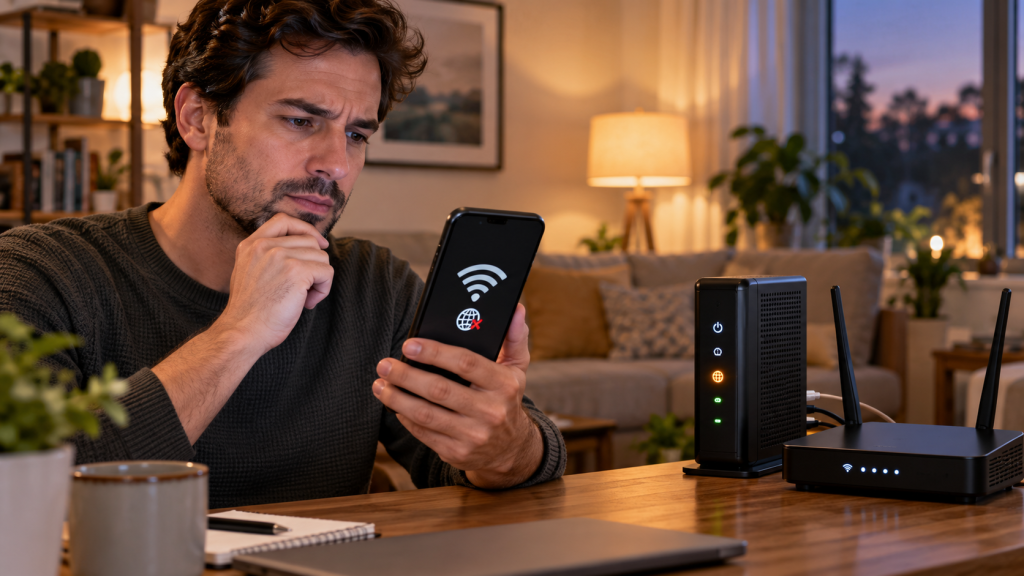
An overlooked technical cause is DHCP/IP conflicts. If the extender is accidentally running its own DHCP server (or is in router mode instead of extender/access point mode), devices may get an IP address from the extender that doesn’t match your main router’s network. The result can look like “connected but no internet,” random offline events, or devices that work for a while and then disappear from your app.
Firmware and software also matter. Extenders and ISP modem-router combos frequently ship with older firmware that has roaming, band steering, or WPA3 compatibility bugs. A mismatch—such as the router using WPA3-only while the extender or smart device only supports WPA2—can cause repeated authentication failures that look like instability.
Step-by-Step Fix
Identify what changed and which network your devices are using. Open your router’s admin page or app and check the client list. Note whether smart devices are connected to the router or the extender, and whether you now see two SSIDs (for example, HomeWiFi and HomeWiFi_EXT). If your extender has its own management page, check its connected clients as well.
Practical testing method: stand near a problem device and run a continuous ping from a computer to your router (for example, ping the router’s IP address). If you see frequent timeouts or spikes when the device is “online,” you likely have roaming or interference issues rather than a device failure.
Confirm the extender is in the correct operating mode. This is the most important configuration check. If you can connect the extender to the router with Ethernet, use Access Point (AP) mode. AP mode avoids the biggest repeater drawbacks and usually provides the most stable experience for smart devices.
If you cannot wire it, use Extender/Repeater mode but ensure it is not in Router mode. Router mode often enables NAT and DHCP, creating a second network behind the extender, which breaks device discovery and can cause “offline” status in smart home apps.
Disable DHCP on the extender (when applicable) and keep one network handing out IP addresses. Your main router should be the only DHCP server in most homes. DHCP is the service that assigns IP addresses. If both the router and extender assign addresses, devices can land on the wrong network settings, leading to intermittent connectivity or devices that can’t be controlled.
If your extender is truly an extender (not a router), it may not expose a DHCP toggle. If it does, turn it off. If it’s in router mode and you can’t disable DHCP, switch modes to AP/extender mode.
Fix SSID and security settings to reduce roaming confusion. You generally have two workable approaches:
Option A (simple control): Use a separate SSID for the extender, and connect smart devices only to the SSID you want them to use (usually the main router’s 2.4GHz). This reduces “bouncing” for devices that roam poorly.
Option B (single network name): Use the same SSID and password on router and extender, but only if the extender supports proper roaming behavior and you can keep settings consistent. If you choose this, ensure security mode matches exactly (prefer WPA2-Personal or WPA2/WPA3 mixed if all devices support it). Avoid WPA3-only if you have older smart devices.
Separate 2.4GHz and 5GHz (or at least ensure smart devices stay on 2.4GHz). Many smart devices are 2.4GHz-only. If your router uses a single SSID for both bands (band steering), setup apps may fail because your phone joins 5GHz while the device requires 2.4GHz. If your extender is also steering bands differently, devices may connect unpredictably.
If possible, create distinct names like HomeWiFi-2G and HomeWiFi-5G. Connect smart devices to the 2.4GHz SSID. Keep 5GHz for phones, laptops, and streaming devices where speed matters and range is shorter.
Reposition the extender for a strong “backhaul” signal. Place it roughly halfway between the router and the dead zone, not inside the dead zone. A good rule: put it where your phone still shows a strong connection to the main router. If your extender has a signal quality indicator, aim for “good” or “excellent” for the link to the router.
Also consider interference: microwaves, cordless phones, baby monitors, and dense apartment WiFi can degrade 2.4GHz. Moving the extender a few feet away from TVs, metal shelves, and electrical panels can materially improve stability.
Reconnect or re-pair smart devices to the intended SSID. After you correct mode/SSID/security, power-cycle the extender and router, then reconnect devices. For devices that won’t migrate cleanly, remove them from the smart home app and re-add them while your phone is connected to the correct 2.4GHz SSID.
Common mistake to avoid: leaving the old extender SSID saved on your phone. During onboarding, your phone may silently rejoin the wrong SSID, causing setup to fail or devices to bind to the wrong network credentials.
Update firmware on both router and extender, then retest. Update the router first, then the extender. Firmware fixes often address roaming, WPA compatibility, and stability under load. After updates, reboot both devices and verify that smart devices remain online for at least 30–60 minutes.
Advanced Troubleshooting
If basic configuration fixes helped but you still see random dropouts, focus on confirming network topology and reducing variables. Smart home instability often comes from a “mostly working” setup that fails under congestion or during roaming events.
Check for double NAT or a hidden second subnet
If your ISP provided a modem-router combo and you added your own router plus an extender, you may have layered routing without realizing it. If the extender is in router mode, you can end up with multiple subnets. Symptoms include devices that appear offline in apps, casting/airplay discovery failures, and inconsistent control when your phone is on a different segment.
Quick check: look at the IP address of your phone and a smart device in the router’s client list. If your phone is on something like 192.168.1.x but devices are on 192.168.0.x (or 10.0.0.x), you likely have an extra router/DHCP somewhere. The fix is to put the ISP unit in bridge mode (if you use your own router) or ensure only one router is doing NAT/DHCP, with the extender in AP/extender mode.
Adjust WiFi channels to reduce interference
In crowded areas (apartments, condos), “Auto” channel selection can bounce channels after reboots, which can confuse extenders and destabilize clients. For 2.4GHz, manually try channels 1, 6, or 11. For 5GHz, choose a non-DFS channel if you see periodic disconnects (some devices handle DFS channel changes poorly).
Disable features that can break older smart devices
Some smart devices struggle with advanced features. If you’re troubleshooting, temporarily disable:
WPA3-only mode (use WPA2 or WPA2/WPA3 mixed), 802.11r fast roaming (if your extender/router exposes it and devices drop), and overly aggressive band steering. Re-enable features one at a time after stability returns.
Validate signal quality and stability, not just “bars”
Signal strength alone isn’t enough; noise and retransmissions matter. If your extender supports it, check the link rate or quality between router and extender. If that backhaul link is unstable, every smart device behind the extender will be unstable too. If possible, switch to wired Ethernet backhaul (AP mode) or consider a mesh system designed for coordinated roaming.
When to Reset or Replace the Device
Reset a smart device when it refuses to rejoin after you correct SSID/security/mode, or when it’s clearly holding old network credentials. A factory reset is also appropriate if the device was originally paired to the extender’s SSID and you are moving it back to the main router’s 2.4GHz network.
Reset or replace the extender if you cannot set the correct mode, cannot disable router/DHCP behavior, or firmware updates fail. If the extender frequently reboots, drops its uplink, or cannot maintain a “good” connection to the main router even when placed closer, replacement is often faster than continued tuning.
Consider replacing a traditional repeater with a wired access point or a mesh system if your home has challenging construction (thick brick, plaster with lath, radiant barriers) or if your router is far away and you need reliable coverage for cameras and doorbells. Repeaters can be workable, but they are less forgiving of misconfiguration and placement.
How to Prevent This in the Future
Plan the extender as part of a single, consistent network design. Decide up front whether you want a separate SSID for smart devices (often best for stability) or a unified SSID for convenience (best when using coordinated mesh or properly configured APs).
Keep one device in charge of routing and DHCP. If you have an ISP modem-router combo and you add your own router, set the ISP unit to bridge mode (if supported) or put your router in AP mode—avoid stacking routers. Then ensure your extender is in AP mode (wired) or true extender mode (wireless), not router mode.
Use 2.4GHz intentionally for smart devices and 5GHz for performance devices. If you must keep a single SSID, verify your onboarding process: connect your phone to 2.4GHz during setup, or temporarily disable 5GHz while pairing stubborn devices. Afterward, restore normal settings.
Finally, keep firmware current and document your settings. A quick note of SSIDs, passwords, security mode, and IP range can save hours later. If you change anything—SSID name, security type, or router—expect to rejoin or reset some smart devices, especially older models.
FAQ
Should my extender have the same WiFi name as my router?
It depends on your goal and the extender’s capabilities. Using the same SSID can be convenient, but if the extender isn’t coordinating roaming well, smart devices may bounce between signals or stick to the wrong access point. A separate SSID often improves stability for smart devices because you can force them onto the router’s 2.4GHz (or onto the extender only when necessary).
Why do my smart devices say “connected” but they’re offline in the app?
This commonly happens when the extender is in router mode or running DHCP, creating a separate network segment. The device may have WiFi, but your phone and the cloud/app can’t reliably reach it. Put the extender into AP/extender mode, ensure only the main router provides DHCP, then reboot and reconnect the devices.
Does a range extender reduce speed or reliability?
Many wireless extenders reduce effective throughput because they must receive and retransmit traffic, using extra airtime. Even when speed seems fine, reliability can suffer if the extender’s connection back to the router is weak or noisy. If reliability is the priority (especially for cameras), using Ethernet backhaul (AP mode) is usually the best fix.
What’s the best way to test if the extender is causing the drops?
Temporarily unplug the extender and see if devices near the router become stable again. Then plug it back in and watch for the return of symptoms. You can also run a continuous ping to the router from a computer while monitoring device behavior; frequent spikes/timeouts often point to roaming or interference issues tied to extender placement or configuration.
Will switching to 2.4GHz fix most smart device problems?
It fixes many onboarding and stability issues because 2.4GHz travels farther and most smart devices support it. However, if the extender is misconfigured (wrong mode, DHCP enabled, mismatched security), switching bands won’t fully solve the problem. Correct the extender configuration first, then keep smart devices on a stable 2.4GHz SSID.
It’s one of those problems that never really disappears, it just fades when the right pieces click into place. The background noise drops, and suddenly the page feels calmer.
That shift is quiet but real—like taking a wrong turn and realizing you’re already back on track. Not everything changes at once, but the direction does, and you feel it.