Smart Switch Not Responding to Touch? What to Check First
Quick Answer
If your smart wall switch (touch panel style) suddenly won’t respond to taps, the most common cause is not the wiring—it’s the touch interface being disabled, misreading input, or the switch software being “alive” but not accepting touch events. In real homes, this often happens after a power outage, a firmware/app update, a stuck automation, or a child-lock/touch-lock setting being turned on without realizing it.
Start by proving whether the issue is touch input failure versus a power/connection problem. Do these three actions in order: (1) check in the device app whether a “lock/child lock/touch disable” setting is enabled, (2) test control from the app and a voice assistant to see if the relay still responds, and (3) perform a safe power-cycle from the breaker for the circuit (off for 30 seconds, then on) to clear a frozen touch controller. These three checks usually tell you what category you’re dealing with in under five minutes.
Once you know whether the switch still toggles from the app/voice, you can focus on the right fix instead of chasing WiFi problems that won’t affect touch input.
Why This Happens
Touch smart switches aren’t just a “button.” They use a touch sensor and a small controller that decides whether a tap is valid. The relay that turns the lights on/off can still be working even when the touch layer stops accepting input. That’s why a touch problem can look like “the switch died,” even though the app can still control it.
Common root causes (focused on touch input vs lock mode and power categories) include:
1) Touch lock or child lock enabled: Many models include a lock mode that ignores taps to prevent accidental presses. This can be enabled in the manufacturer app, sometimes in Alexa/Google Home as a device setting, or triggered by a long-press gesture.
2) Frozen touch controller after an outage or brownout: A brief voltage dip can leave the touch sensor in a bad state even though the switch still has power. Real-world scenario: after a storm, the light works from automations, but the glass panel ignores all taps.
3) Touch calibration/false touch rejection: Some touch panels reject input when they detect moisture, residue, or certain grounding/noise conditions. Overlooked technical cause: high electrical noise from nearby loads (fans, LED drivers) can make the sensor overly sensitive or overly “defensive,” causing taps to be ignored.
4) App/firmware setting mismatch: After an app update or firmware update, some switches revert to default behaviors (including disabling touch, changing indicator behavior, or enabling “safe mode”).
5) Power/wiring category issues (without inspecting wiring): If the switch is not powered correctly, the touch layer may not have stable power even if the relay sometimes clicks. A common user mistake is assuming “the screen is lit, so power is fine,” but touch controllers can still crash if supply is unstable.
Most Likely Causes in Real Homes
1) Lock/Child Lock/Touch Disable is on: Highest probability because it perfectly matches “touch does nothing” while the switch still appears normal in the app.
2) Touch interface froze after a power event: Very common after a short outage, breaker trip, or generator transfer; the touch layer hangs until power is fully removed and restored.
3) Automation or multi-app conflict masking your test: A routine may be instantly turning the light back on/off, making it seem like touch isn’t working or isn’t “taking.”
4) Local touch works intermittently due to moisture/contamination: Kitchen/bathroom humidity or cleaning spray can make capacitive touch unreliable for hours.
5) Device is partly online but in a degraded state: The switch may show “online” in one ecosystem (Matter/SmartThings/Alexa) but be out of sync in the manufacturer app, leaving lock settings or modes stuck.
Step-by-Step Fix
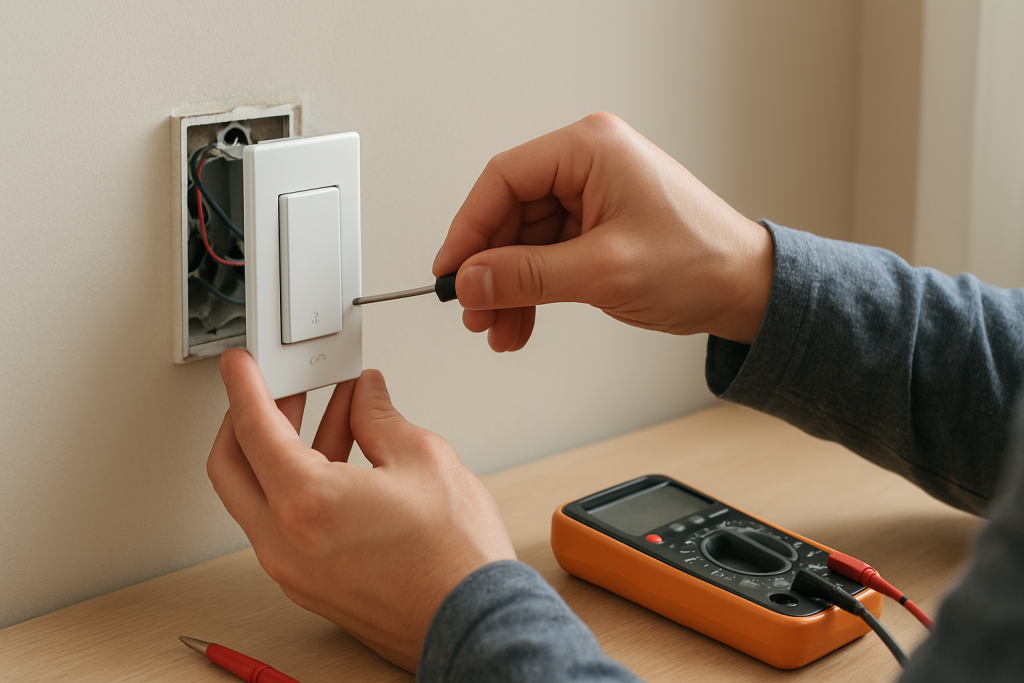
Check whether the switch is physically powered and responsive in any way (LED indicator, backlight, relay click). What the result means: if there’s no indicator and no relay sound, you may have a power/circuit issue rather than touch input failure. What to try next if it fails: check whether other lights/outlets on the same circuit work and look for a tripped breaker; if the circuit seems affected, stop here and use normal household breaker safety (no device disassembly).
Test control from the manufacturer app first (Kasa/Tapo, Meross, Hue integration path, SmartThings device tile, etc.). What to do: open the device and toggle it ON/OFF from the app while standing near the switch. What the result means: if app control works but touch doesn’t, this strongly points to touch lock mode, a frozen touch controller, or touch-sensing issues (not WiFi). What to try next if it fails: if the app shows offline/unreachable or the toggle fails, skip ahead to steps focused on connectivity and ecosystem sync.
Check for “Child Lock,” “Lock,” “Touch Lock,” “Disable local control,” or similar settings. What to do: in the manufacturer app, look in device settings and safety/lock sections; also check if Alexa/Google Home has a “disable local control” style option or a routine that changes it. What the result means: if lock is enabled, touch will be ignored by design. What to try next if it fails: if you can’t find a lock setting, try step 4 to rule out automation conflicts and step 5 to clear a frozen touch state.
Rule out automation conflicts that make touch seem broken. What to do: temporarily disable schedules/timers in the manufacturer app and pause relevant routines in Alexa/Google Home/SmartThings/HomeKit (especially “when switch turns on, turn off after X minutes” or presence-based automations). What the result means: if touch starts “working” once automations are paused, the touch input was fine—your automation was immediately overriding it. What to try next if it fails: if touch still does nothing, continue to step 5.
Perform a full power-cycle of the switch (to reset the touch controller). What to do: turn the breaker for that lighting circuit OFF for 30 seconds, then ON (leave the wall switch untouched for another 30–60 seconds to finish booting). What the result means: if touch works again, the touch controller was likely frozen after a power event or a software hiccup. What to try next if it fails: proceed to step 6 to determine whether you have a touch-sensing environment issue or a deeper software/account sync problem.
Check for touch-sensing environmental interference. What to do: ensure the panel is clean and dry; avoid recently sprayed cleaners; dry hands; wait 10–20 minutes if the room is humid (bath/kitchen). What the result means: if touch starts responding after drying/cleaning, the issue is capacitive sensing interference rather than power or connectivity. What to try next if it fails: move to step 7 to verify firmware/app state and platform sync.
Confirm firmware/app state and re-authentication (without resetting yet). What to do: update the manufacturer app, confirm you’re logged in, and check for a pending firmware update for the switch. If you use Matter, verify the controller app (Apple Home/Google Home/SmartThings/Alexa) is also updated. What the result means: if a firmware update completes and touch returns, the issue was a software bug or corrupted state. What to try next if it fails: continue to step 8 to isolate ecosystem sync and account linking problems.
Isolate ecosystem sync issues (Alexa/Google Home/Apple Home/SmartThings/Matter bridge). What to do: test touch again, then test app control in the manufacturer app, then test voice control. If voice fails but the manufacturer app works, re-sync devices (Discover devices in Alexa, “Sync devices” in Google Home, refresh HomeKit/Matter accessories, or run SmartThings device discovery). What the result means: if only the ecosystem is out of sync, touch is not your root problem; you’re dealing with discovery/account linkage. What to try next if it fails: go to Advanced Troubleshooting for cloud/account and network isolation steps.
Advanced Troubleshooting
This section is only needed if basic fixes fail.
Account/cloud session issues: If the device works locally (touch sometimes works, or relay responds) but apps show inconsistent status across platforms, log out and back into the manufacturer app. Then confirm the device is bound to the correct “home” and region in that app. If the manufacturer cloud thinks the device belongs to a different home/account, lock settings and device state can appear stuck.
Network issue that indirectly affects touch diagnosis: While WiFi doesn’t control touch input, it can confuse troubleshooting if the app can’t reliably reach the device. If the app shows offline, check whether the switch is a WiFi model on 2.4 GHz and whether your router uses band steering with the same network name for 2.4/5 GHz. If possible, temporarily connect your phone to the 2.4 GHz band (or a dedicated 2.4 GHz SSID) and refresh device status. In mesh WiFi homes, try standing near the main router node; some devices “stick” to a weak node after a reboot.
Hotspot isolation test (WiFi switches only): If your switch is offline and you suspect the network is the blocker, create a temporary 2.4 GHz hotspot (if your phone supports it) with the same SSID/password as the usual WiFi, then reboot the router for a minute so the switch attempts to join the hotspot. If it comes online there, your home WiFi/mesh is the culprit (roaming, WPA mode, or DHCP behavior), not the switch’s touch sensor.
Firmware/software mode stuck: If touch is dead but app control works, look for “local control,” “touch disable,” “scene mode,” or “guard mode” settings that can change how the panel behaves. Some ecosystems also support disabling physical control for safety or tamper prevention; if multiple household members manage the home, another user may have enabled it.
Configuration conflicts (groups/scenes/duplicate devices): If your voice assistant shows two versions of the same switch (common with Matter plus manufacturer cloud, or Hue/SmartThings integrations), commands and status can bounce between them. Remove or hide the duplicate in the voice assistant, then re-test. A duplicated device can make it seem like “nothing works,” even though the switch is responding to a different logical entry.
Ecosystem sync issue (Matter/HomeKit/SmartThings): If the switch is added via Matter, ensure your primary controller (Apple Home hub, Google Home hub, SmartThings hub, or Alexa hub device) is online. If the controller is down, the device may still function locally by touch, but app controls and settings (like lock state) may not update correctly between apps.
When to Reset or Replace the Device
Soft restart vs factory reset: A soft restart is a power-cycle at the breaker (off briefly, then on). It clears temporary firmware hangs and is the first choice for touch panels that freeze. A factory reset wipes the device configuration and forces a fresh pairing; it’s more disruptive and should be used only after you’ve confirmed lock settings, automation conflicts, and app/ecosystem sync problems.
What you may lose after a factory reset: You’ll typically lose pairing to the manufacturer app and any ecosystems (Alexa/Google Home/Apple Home/SmartThings/Matter), room assignments, custom names, schedules/timers, and automations tied to that device. If the switch or app tracks usage history (more common for plugs than switches), that history may also be cleared or split.
When reset is reasonable: Reset if (a) the switch responds in the app but touch never works after a full power-cycle and lock checks, (b) the device is stuck in a “half-online” state across apps, or (c) firmware updates repeatedly fail and the device won’t stabilize.
When replacement is reasonable: Replace if the switch repeatedly drops offline even after stable network fixes, cannot complete firmware updates across multiple attempts, or shows unstable on/off behavior that isn’t explained by automations. Also replace immediately if you notice overheating, a burning smell, discoloration, crackling, or any visible damage—stop using the switch and treat it as a safety issue.
How to Prevent This in the Future
Keep touch switches stable by reducing the situations that freeze touch controllers or accidentally disable local input. After power outages, give devices a minute to fully boot before rapidly tapping them; repeated quick taps during startup can sometimes leave the panel in an odd state.
Use consistent organization: keep one clear device name, one room assignment, and avoid adding the same switch through multiple paths (for example, both the manufacturer cloud integration and Matter) unless you have a specific reason. Duplicates are a common source of “it works here but not there” confusion.
Avoid duplicate automations across apps. If you set a schedule in the manufacturer app, don’t set a second schedule for the same behavior in Alexa/Google Home/SmartThings/HomeKit—choose one system to be the “source of truth.” This prevents instant overrides that make touch presses look ignored.
Maintain app and firmware health: update the manufacturer app and your hub/controller apps periodically, and check firmware when you notice odd behavior after an update season. In shared homes, keep permissions tidy—know who can change device settings like lock mode, and remove old household accounts that might still have control.
For WiFi switches, keep the network predictable: stable 2.4 GHz coverage near the switch location, minimal band-steering surprises, and a mesh setup that doesn’t force the device onto a distant node. These steps won’t “fix” touch directly, but they prevent misleading offline states that make touch troubleshooting harder.
FAQ
If the app can turn the light on/off, does that prove the switch isn’t a wiring problem?
It strongly suggests the switch has power and the relay is functioning. In that case, the most likely issue is touch input being disabled (lock mode) or the touch controller being frozen, not the circuit wiring. It doesn’t rule out every electrical compatibility issue, but it moves wiring far down the list.
Can WiFi problems make the touch panel stop working?
No—touch control is local and should work even if the device is offline. The misconception happens because people test the app first; if the app is offline and touch is also unresponsive, it feels like one cause. Treat them as two separate symptoms and use the app-vs-touch test to separate touch failure from connectivity.
Why did this start right after a power outage or breaker trip?
Short outages and voltage dips can leave the touch sensor firmware in a stuck state while the rest of the switch still boots. A full power-cycle (breaker off for 30 seconds, then on) often clears it, especially if you wait a minute after restoring power before tapping.
My switch works by touch, but voice assistants say “device is unresponsive.” What should I check?
That usually indicates an ecosystem sync or account link issue rather than a touch problem. Confirm the device is online in the manufacturer app, then re-sync in Alexa/Google Home/SmartThings/HomeKit, check for duplicates, and verify you’re controlling the correct “version” of the device (especially if Matter is involved).
There’s a peculiar kind of relief in seeing the fix laid out plainly, like someone finally turning the light on after fumbling with the switch. The noise fades, and the world feels a little more usable again.
Not dramatic, not cinematic—just steadier. The best part is how quickly everything stops feeling like a problem and starts feeling like background, the way it should.