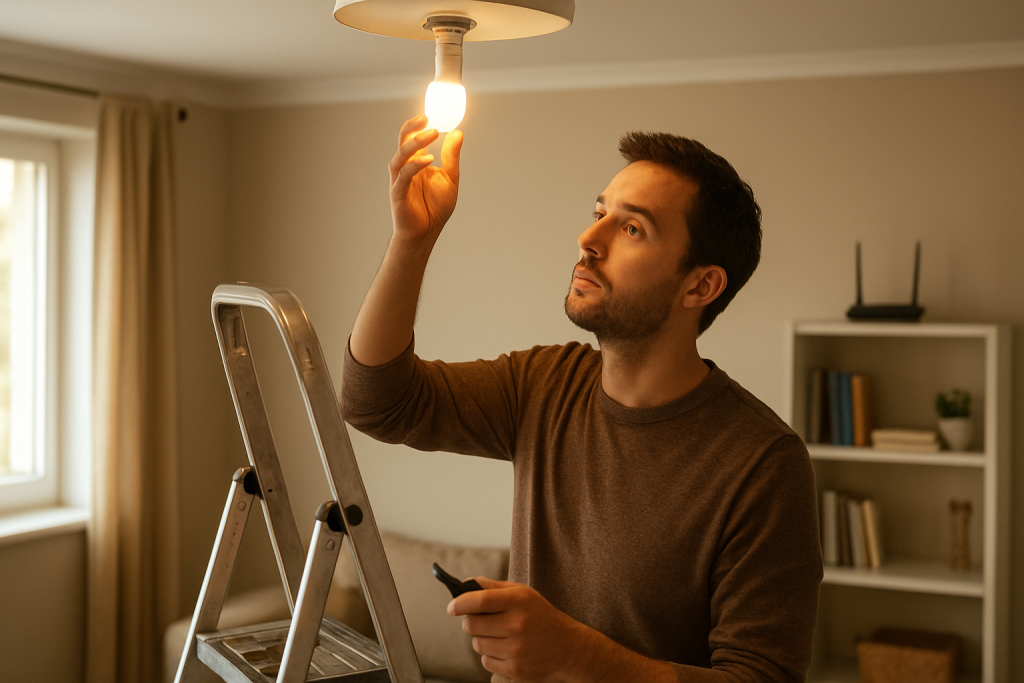
Most “choppy” or jumpy dimming in smart bulbs is caused by control-path issues rather than the LED itself: the bulb is receiving dimming updates late, out of order, or in batches. In real homes this usually comes from wireless congestion (Wi‑Fi or Zigbee), group/scene transitions that send multiple commands at once, or a mismatch between the dimming method (app fade vs. automation vs. voice) and what the ecosystem can smoothly deliver.
If the bulb dims smoothly when you drag the slider slowly but stutters during scenes, routines, or voice commands, it usually means the network or automation is delivering step changes instead of a continuous fade. If it stutters even from a single-bulb slider in the app, it more often points to firmware, a weak signal path to that bulb, or a bulb model that uses coarse dimming steps at low brightness.
Do these three checks first: (1) test dimming one bulb at a time from the manufacturer app (not a third-party app), (2) temporarily disable any routines/scenes that change brightness and retry, and (3) move your phone close to the hub/router and repeat the dim test to see if command delivery improves.
Why This Happens
Smooth dimming requires frequent, evenly timed brightness updates. Many smart lighting systems do not send a true “analog” dim signal; they send a series of digital brightness levels. If those level updates arrive inconsistently, the bulb appears to jump, pause, or “stair-step” instead of fading.
Here are the most common technical causes that directly affect smooth dimming across major ecosystems (Wi‑Fi bulbs, Zigbee hubs, Matter controllers, and mixed setups):
1) Command batching and rate limits. Some platforms limit how many brightness updates can be sent per second, especially to groups. If the app or automation tries to fade over 1–2 seconds, the system may compress the fade into fewer steps, causing visible jumps.
2) Group synchronization behavior. Dimming a group/room often sends separate commands to each bulb. If one bulb receives updates later (weak signal, busy network), it will lag and then “catch up,” which looks like uneven dimming.
3) Wireless congestion or weak signal at the bulb. Wi‑Fi bulbs can suffer when the 2.4 GHz band is crowded (neighbors, cameras, streaming devices). Zigbee bulbs can stutter if the mesh is thin, if the hub is poorly placed, or if there are few powered Zigbee routers (like smart plugs) to relay messages.
4) Automation conflicts. Two automations can fight: one routine is fading down while another is enforcing a minimum brightness, a circadian schedule is adjusting color temperature, or a motion rule is repeatedly setting brightness. The result is a “tug-of-war” that looks like flicker or stepping.
5) Firmware/app translation issues (including Matter bridges). When a bulb is controlled through a bridge or multi-platform setup (for example, a hub exposing bulbs to another ecosystem), the fade command may be translated into discrete steps, or the controller may not support smooth transition times for that device.
Real-world scenario: You say “dim the living room to 10%” and the lights jump in chunks. The same lights dim smoothly when you adjust a single bulb in its native app. That pattern usually means the voice assistant or room group is issuing a small number of brightness steps (or sending them to multiple bulbs sequentially), not a continuous fade.
Common user mistake: Dimming from a room/group tile and assuming it behaves the same as a single-bulb slider. Group dimming is often less smooth because it’s coordinating multiple devices over the air.
Overlooked technical cause: Some bulbs intentionally use larger brightness steps at the very low end (1–10%) to avoid LED instability or color shift. If the “stutter” only happens near the bottom of the range, it may be normal for that bulb model, but you can often reduce how noticeable it is by changing the fade duration or avoiding ultra-low levels in automations.
Most Likely Causes in Real Homes
1) Group/scene dimming limitations. Rooms and scenes often dim in steps, especially with multiple bulbs or mixed bulb models.
2) Competing automations or schedules. Two rules adjusting brightness at the same time makes dimming look uneven or jittery.
3) Weak Wi‑Fi 2.4 GHz or weak Zigbee mesh to that fixture. Delayed commands create pauses and catch-up jumps.
4) Firmware/controller mismatch (including Matter/bridge control). Smooth transitions may not be supported through the path you’re using.
5) Low-end dimming behavior of the bulb. Some bulbs step more noticeably below 10–15% brightness.
Step-by-Step Fix
Test a single bulb using the manufacturer’s app (not a group). Pick one bulb that shows the problem. In the native app, open that bulb’s device page and slowly drag the brightness slider from 100% down to 1% and back up.
What the result means: If it’s smooth here but not in rooms/scenes/voice, the bulb is likely fine and the issue is group control, automation, or the controller path. If it’s choppy even here, focus on signal strength, firmware, or the bulb’s low-end behavior.
If it fails, try next: Continue to step 2 to rule out automation conflicts before changing network or device settings.
Disable automations and schedules that touch brightness, then retest. Temporarily turn off routines for motion, time-of-day, circadian lighting, “adaptive lighting,” and any scenes that activate automatically. Also check for “power restore” behaviors that set brightness when power returns.
What the result means: If dimming becomes smooth, you likely had competing rules or repeated brightness enforcement. If it’s still choppy, the problem is more likely command delivery (network/mesh) or a controller translation issue.
If it fails, try next: Go to step 3 and test whether the problem is tied to group behavior or a specific control method (room vs. single device).
Compare three control methods: single device, room/group, and scene. Dim the same bulb three ways: (a) single-bulb slider, (b) room/group slider, (c) activate a scene that includes a fade/transition if your app supports it.
What the result means: If only group/scene control is choppy, the ecosystem is likely sending fewer updates or sequential commands to multiple bulbs. If all methods are choppy, suspect signal/firmware/device behavior.
If it fails, try next: Proceed to step 4 to isolate whether the controller path (voice assistant, Matter controller, third-party app) is causing the stepping.
Isolate the controller path (native app vs. voice vs. third-party vs. Matter). Perform the same dim test from: the native app, your voice assistant, and any third-party platform you use. If you use Matter, also try controlling from the original ecosystem and from the Matter controller.
What the result means: If native app is smooth but voice/Matter/third-party is not, the issue is usually command translation or rate limiting in that controller. If everything is equally choppy, it’s more likely signal quality or device behavior.
If it fails, try next: Go to step 5 and check device status and firmware, since controller differences have been ruled out.
Check device status and update firmware/app versions. In the app, look for the bulb’s connectivity status (online/offline), signal indicators (if available), and pending firmware updates. Update the smart lighting app and hub firmware too.
What the result means: Firmware updates often fix transition timing, group behavior, and stability. If updates improve smoothness, the issue was likely software timing or compatibility.
If it fails, try next: Continue to step 6 to test whether the problem is caused by weak wireless coverage at that bulb.
Do a placement test: move the controller closer and retest. For Wi‑Fi bulbs, stand near the router or access point while dimming. For Zigbee systems, move the hub a few feet (higher and more central is usually better) if possible without rewiring anything, or temporarily relocate it using an existing long Ethernet cable if the hub supports it.
What the result means: If dimming becomes smoother when the controller is closer or better placed, delayed commands were the cause. That points to Wi‑Fi congestion/coverage or a weak Zigbee mesh path.
If it fails, try next: Go to step 7 to check the Wi‑Fi band and mesh behavior for Wi‑Fi bulbs, or step 8 for Zigbee mesh checks.
Wi‑Fi bulbs: verify 2.4 GHz behavior and mesh steering. Confirm the bulb is on 2.4 GHz (most Wi‑Fi bulbs are). If you have a mesh system, check whether the phone and bulbs are hopping between nodes or if the bulb is connected to a distant node. If your router offers separate 2.4 GHz and 5 GHz names, connect your phone to the same intended network during setup and testing.
What the result means: If dimming is worse when you’re far from the router or when the mesh is steering devices, the bulb may be dealing with variable latency. Smooth fades are sensitive to timing.
If it fails, try next: Proceed to step 9 for a hotspot isolation test to confirm whether your home Wi‑Fi is the bottleneck.
Zigbee bulbs: run a mesh behavior test by changing one variable. Turn off (not unplug) any Zigbee-powered devices you can easily control (like smart plugs) one at a time if you suspect a bad repeater, then retest dimming. Also check whether the problem bulb is far from the hub or separated by dense materials (brick, tile, metal fixtures).
What the result means: If dimming improves after removing one repeater from the path, that repeater may be causing routing issues. If dimming improves when the hub is closer, the mesh is too thin for reliable rapid updates.
If it fails, try next: Continue to step 9 to isolate the network path (Wi‑Fi) or controller behavior (cloud/account) depending on your ecosystem.
Hotspot isolation test (for Wi‑Fi bulbs) or “local-only” test (for hubs). Wi‑Fi bulbs: temporarily connect the bulb to a phone hotspot (only for testing) and test dimming with the phone near the bulb. Hub-based systems: disconnect the internet briefly (leave local network up) and test dimming from the local app if it supports local control.
What the result means: If the hotspot makes dimming smooth, your home Wi‑Fi environment is the main issue (congestion, interference, or mesh steering). If local control is smooth but cloud-based control is choppy, the issue is likely account/cloud latency.
If it fails, try next: Go to step 10 to check group configuration, room assignments, and mixed-device scenes.
Verify room/location, group sync, and mixed-bulb scenes. Confirm the bulb is in the correct room and not duplicated in multiple groups. Check whether the scene includes different bulb types (color + white-only, different generations) or includes plugs/switches that also change state. Retest with a simplified group containing only identical bulbs if possible.
What the result means: If simplified groups dim smoothly, the original group/scene is too complex or includes a device that slows the command sequence.
If it fails, try next: Continue to step 11 to perform a clean power cycle sequence to clear stuck states.
Do a clean power cycle sequence (bulb and hub/router). Turn the light off using the wall switch for 10 seconds, then on. If you have a hub, power it off for 30 seconds and back on. For Wi‑Fi bulbs, also reboot the router/access point once (avoid repeated rapid reboots).
What the result means: If smooth dimming returns, the issue was likely a temporary state problem: stale group membership, a stuck connection, or a hub/router timing issue.
If it fails, try next: Proceed to Advanced Troubleshooting to check account/cloud sync and deeper configuration conflicts.
Advanced Troubleshooting
This section is only needed if basic fixes fail.
Account or cloud issue: If dimming is choppy only when you are away from home, only through voice assistants, or only at certain times of day, cloud latency or account sync is a realistic cause. Log out and back into the lighting app, confirm the correct home/location is selected, and verify the bulbs are not shared across multiple homes/accounts in a way that creates duplicate control paths. If the app shows delayed status updates (brightness level lags behind what you see), that strongly suggests cloud or controller sync delays rather than a bulb hardware problem.
Network issue (only as it relates to dimming smoothness): Smooth fades require consistent low-latency delivery of many small updates. If other devices are saturating your 2.4 GHz band (wireless cameras, older streaming devices, heavy downloads), dimming can become “bursty.” If your router has a setting to keep IoT devices on a stable access point (disabling aggressive band steering for 2.4 GHz-only devices), enabling stability can help. If you notice the problem only in one area of the home, it’s more likely coverage/mesh path quality than “internet speed.”
Firmware/software cause: If the issue started after an update, check for a newer patch or release notes mentioning dimming, transitions, or group reliability. Also check whether your controller app is applying “adaptive lighting” features that constantly adjust brightness or color temperature; those background adjustments can interrupt a fade.
Configuration conflict (groups, scenes, automation, permissions): Look for overlapping rules: for example, a bedtime routine fades lights down while a nightlight automation forces 15% brightness, or a motion sensor repeatedly re-applies a scene every time it detects movement. If dimming stutters in a very specific pattern (drops, rises slightly, drops again), it often means two automations are alternating control. Temporarily remove one automation at a time until the fade becomes smooth, then rebuild the remaining automation with fewer brightness changes or longer transition times.
When to Reset or Replace the Device
Soft restart vs. factory reset: A soft restart is simply power-cycling the bulb (off for 10 seconds, then on) and rebooting the hub/router once. A factory reset removes the bulb from its network and forces a full re-pairing in the app. Use a factory reset when the bulb frequently goes “unresponsive,” shows incorrect brightness status, or behaves differently than identical bulbs in the same room after you’ve already checked automations and signal.
What you lose after a reset: You will typically lose the bulb’s pairing, room assignment, scenes, and automations that reference it. You may need to re-add it to groups, re-run any calibration or power-loss settings, and re-authorize it in any connected ecosystems (voice assistants, Matter controllers, or home platforms).
When to replace: Replace the bulb if it consistently stutters even in a single-bulb test from the native app, after firmware updates, in good signal conditions, and after a factory reset. Also replace if it cannot hold a stable connection or shows visible defects (buzzing from the fixture, discoloration, or erratic brightness unrelated to commands).
Safety note: If the bulb or fixture is unusually hot to the touch, smells like hot plastic, or shows scorch marks, stop using it and let it cool. Dimming issues are usually software or signal-related, but overheating or physical damage should be treated as a stop-use condition.
How to Prevent This in the Future
Keep the control path simple for fades. For smooth dimming, prefer controlling fewer bulbs at once and avoid stacking multiple platforms for the same action (for example, one automation in the lighting app and another in a separate home platform doing similar things).
Maintain stable wireless conditions where the bulbs live. Place hubs and routers centrally and avoid hiding them behind TVs or inside cabinets. For Zigbee systems, keep a healthy mesh by ensuring there are enough always-powered Zigbee devices to relay messages in larger homes. For Wi‑Fi bulbs, avoid frequent router changes and keep the 2.4 GHz environment stable so bulbs don’t constantly reconnect.
Manage automations deliberately. Use longer transition times for bedtime fades and avoid automations that re-apply brightness repeatedly (for example, motion rules that trigger every minute). If you use circadian/adaptive lighting, check whether it adjusts brightness as well as color temperature, and limit brightness adjustments if you notice interference with fades.
Plan for power outages. After an outage, bulbs may reconnect slowly and groups may temporarily desync. Give the system a few minutes to stabilize before judging dimming performance, and avoid rapid on/off toggling at the wall switch.
Keep firmware and apps current, but watch for conflicts after updates. Updates often improve transitions and group behavior. If smooth dimming suddenly becomes choppy after an update, re-check automations and group definitions first; updates can re-enable features like adaptive lighting or change default transition behavior.
FAQ
Why does the bulb dim smoothly alone but not in a room or group?
That usually means the system is coordinating multiple bulbs with separate commands. If one bulb receives updates late (weak signal or busy network), the group looks uneven. A quick test is to dim a simplified group with only two bulbs; if that’s smoother, the original group is too large or includes a device that slows command delivery.
Is choppy dimming a sign the bulb is defective?
Not usually. If the bulb is smooth in a single-device test from the native app, the bulb hardware is likely fine. Choppy dimming more often points to group/scene behavior, automation conflicts, or wireless timing issues.
Why is the problem worse at very low brightness (like 1–10%)?
Many LED smart bulbs use larger brightness steps at the low end to keep the light stable and avoid flicker or color shift. If the stepping only happens near the bottom, try setting automations to stop at 10–15% instead of 1–5%, or use longer fade durations so the steps are less noticeable.
Misconception: “If my internet is fast, dimming should be smooth.” Is that true?
No. Smooth dimming depends more on local timing than on internet speed. Even with fast internet, a crowded 2.4 GHz environment, mesh steering, or a weak Zigbee route can delay brightness updates and make fades look jumpy.
Why does voice dimming feel more “steppy” than the app?
Voice assistants often translate a dim request into a small number of brightness changes or a direct jump to a target level, especially for rooms. If app dimming is smooth but voice dimming is not, use the app for fades, adjust routines to include explicit transition times (if supported), or simplify the room group so the assistant can update devices more consistently.
So much of this problem has been loud enough to fill the room, even when nothing else was happening. The fix doesn’t feel flashy—more like the air settling after a storm.
What lingers is the strange relief of seeing it clearly at last. You move on with fewer mental bookmarks, and the day keeps its rhythm.