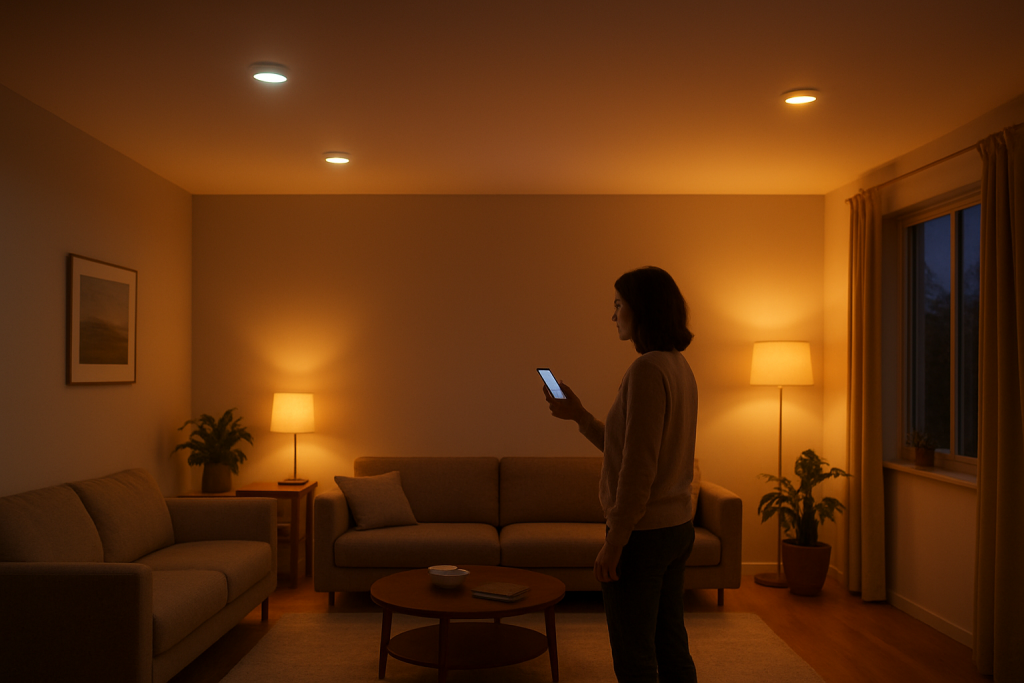
Smart Lights Out of Sync in the Same Room: How to Fix It
Quick Answer
When smart lights in the same room don’t change together (one turns on late, misses a color change, or ignores a scene), the most common real-world cause is that they are not actually being controlled as one synchronized group. Instead, they’re being triggered by multiple automations, mixed ecosystems (WiFi + Zigbee + Matter), or separate “rooms” across different apps, which introduces timing differences and missed commands.
This is especially common when some bulbs are connected directly to WiFi while others are on a hub (Zigbee/Thread), or when you control the same lights from more than one platform (manufacturer app plus Apple Home/Google Home/Alexa). The lights look like “one room,” but the control path is split.
Do these three quick checks first: (1) In your main control app, verify all bulbs are in the same room/group and that you’re using that group control (not selecting bulbs individually). (2) Temporarily disable schedules/automations for that room to see if the sync problem disappears. (3) Check whether some bulbs are paired to a different controller (a different hub, a different Matter fabric, or a different account) by comparing device names and “connected via” details in the app.
Why This Happens
Smart lighting “sync” is mostly a control and coordination problem, not a brightness problem. When you tap a scene, a controller sends commands to multiple devices. If those commands are issued from different places (multiple apps, multiple hubs, cloud routines, or separate groups), the bulbs won’t receive the same instruction at the same moment. Some will respond instantly; others will lag, ignore the command, or apply an older state.
In real homes, this often happens after adding new bulbs, switching routers, enabling Matter, or linking accounts to voice assistants. The room looks correct on your phone, but behind the scenes the lights may be split across different control paths.
Common tightly related causes include:
1) Split grouping across apps: A “Living Room” in the manufacturer app is not automatically the same as “Living Room” in Apple Home/Google Home/Alexa. If you trigger scenes from different apps, you may be controlling different group definitions.
2) Competing automations: If one automation sets “Warm White 50%” at sunset while another sets “Cool White 100%” at the same time, bulbs can appear out of sync because they’re receiving conflicting commands in quick succession.
3) Mixed ecosystems and bridges: Some lights may be on a Zigbee hub (for example, a bridge-based system), while others are WiFi bulbs controlled by a cloud service. Group commands may be executed differently (hub-local vs cloud), causing timing differences.
4) Overlooked technical cause: Duplicate device instances. After a migration (new hub, Matter pairing, or account relink), the same physical bulb can appear twice in a platform. You may be controlling the “ghost” entry while the real one continues to follow a different group or automation.
Real-world scenario: You add two new bulbs and put them in the same room in your voice assistant. In the manufacturer app, they stayed in “Default Room,” and a manufacturer schedule still runs on them. When you say “Turn on the living room lights,” most bulbs follow the assistant’s group, but the two new bulbs follow the manufacturer schedule and drift out of sync.
Common user mistake: Creating a scene by selecting individual bulbs instead of creating a room/group scene. It works initially, but later you add a bulb and it never follows because it wasn’t included in the original selection.
Most Likely Causes in Real Homes
1) Lights are not in the same true group in the app you’re using to control them (room names match, but grouping does not).
2) Two different automations/scenes are fighting each other (especially at sunrise/sunset or bedtime).
3) Some bulbs are controlled locally (hub/Thread) and others through cloud/WiFi, causing delays and missed state updates.
4) Device duplicates or “ghost” devices exist after a migration (Matter pairing, hub replacement, or account relink).
5) One bulb has poor connectivity (farther from hub/router, behind dense walls, or on the edge of a mesh), so it reacts late or drops commands.
Step-by-Step Fix
-
Control the room using one app only for this test. Pick the app you normally use (manufacturer app, hub app, or Apple Home/Google Home/Alexa) and use only that app for the next 10 minutes.
What the result means: If sync improves immediately, the issue is usually split control (multiple apps/platforms sending commands) or conflicting automations.
If it fails, try next: Continue to Step 2 to verify grouping inside that same app.
-
Verify true group/room membership and use group control (not individual selection). In the chosen app, open the room/group and confirm every light in the physical room is listed there. Then trigger a built-in group action (room on/off) rather than selecting bulbs one by one.
What the result means: If group control works but selecting bulbs individually does not, your issue is usually scene setup or automation targeting (some bulbs are excluded or targeted differently).
If it fails, try next: Rename the room/group temporarily (for example “Living Room TEST”) to force you to target the correct group, then proceed to Step 3.
-
Disable schedules and automations for that room, then retest. In your main platform and the manufacturer/hub app, temporarily turn off automations, routines, adaptive lighting, and any time-based schedules affecting those bulbs. Then run a simple test: turn the room off, wait 10 seconds, turn it on, then apply one scene.
What the result means: If the lights become synchronized with automations disabled, the problem is competing rules (two systems trying to “help” at the same time).
If it fails, try next: Proceed to Step 4 to check for duplicates and split ownership.
-
Check for duplicate devices and split pairing (especially after Matter or hub changes). In each app you use (manufacturer app, hub app, and your voice assistant/home platform), look for duplicated bulb names or multiple entries that seem to represent the same physical light. Also check device details such as “connected via,” hub name, or controller/fabric information if shown.
What the result means: If you find duplicates, out-of-sync behavior often comes from controlling the wrong instance or having one automation target the duplicate while another targets the real device.
If it fails, try next: Remove the duplicate from the platform where it doesn’t belong (do not factory reset yet), then go to Step 5.
-
Run a power-cycle sequence to clear stuck state and refresh routing. Turn the room off in the app. Then switch power off at the wall switch or lamp switch for 20 seconds, and turn it back on. Wait 2 minutes for all bulbs to reconnect, then apply a single room scene.
What the result means: If one bulb returns late or shows “unreachable” longer than others, it’s likely a connectivity or routing problem for that device, not a scene problem.
If it fails, try next: Continue to Step 6 to isolate whether it’s WiFi band/mesh behavior or hub mesh behavior.
-
Do a connectivity isolation test (WiFi bulbs vs hub-based bulbs). Identify which bulbs are WiFi and which are hub/Thread/Zigbee. For WiFi bulbs: confirm your phone and bulbs are on the same home network and that bulbs are not on a “guest” network. For hub-based bulbs: confirm the hub is online and not reporting weak signal for that device.
What the result means: If only WiFi bulbs lag, it usually points to router band steering, AP roaming, or cloud delays. If only Zigbee/Thread bulbs lag, it usually points to mesh routing (distance, interference, or a weak repeater path).
If it fails, try next: Proceed to Step 7 to test mesh behavior and placement without changing wiring or opening devices.
-
Test mesh behavior by temporarily changing device placement or controller location. For hub-based systems, move the hub a short distance (for example, away from a TV, speaker, or router) and retest. For WiFi mesh systems, temporarily keep your phone near the router and retest group commands to reduce roaming variables.
What the result means: If sync improves, interference or poor routing is likely (the “out-of-sync” bulb is taking a weaker path).
If it fails, try next: Continue to Step 8 to verify WiFi band behavior and device reassociation.
-
Check WiFi band behavior (2.4 GHz vs 5 GHz) and roaming. Many WiFi bulbs prefer 2.4 GHz. If your router uses one combined network name for both bands, bulbs can behave inconsistently if the network steers devices aggressively or if you have multiple access points. In your router/app, confirm bulbs are connected and stable (not constantly reconnecting). If your system allows it, temporarily pause extra access points or mesh nodes and retest.
What the result means: If bulbs stabilize when the network is simplified, the issue is usually roaming/steering rather than the bulbs themselves.
If it fails, try next: Proceed to Step 9 to verify group sync and scene definitions.
-
Rebuild the room scene/group once, cleanly. Create a new test scene that sets a very obvious state (for example, all lights to 100% brightness and a distinct color temperature). Apply it using the room/group button. Avoid mixing individual bulb selections and avoid importing scenes from multiple apps.
What the result means: If the new scene works reliably, the old scene or automation was mis-targeted or corrupted.
If it fails, try next: Continue to Step 10 to check account sync and cloud status.
-
Verify account sync and cloud status, then relink if needed. If you use cloud-linked control (common with WiFi bulbs and voice assistants), sign out and back into the lighting service in the controlling platform, or run the platform’s “sync devices” function. Confirm the service status in the app if it provides an online/offline indicator.
What the result means: If devices suddenly reappear correctly or stop showing stale states, the issue was account sync or a cloud token problem.
If it fails, try next: Move to Advanced Troubleshooting for deeper conflicts and firmware issues.
Advanced Troubleshooting
This section is only needed if basic fixes fail.
Account or cloud issue: If lights respond correctly inside the manufacturer/hub app but not in your home platform (or vice versa), the link between accounts is likely stale. Remove the integration from the home platform and add it again, then re-check room assignments. If X works in the native app but fails in the aggregated platform, it usually means the integration layer is the problem, not the bulbs.
Network issue (relevant when WiFi bulbs are involved): If only some bulbs lag and they are all WiFi, check whether they are split across different access points with weak signal. If your router supports client history, look for frequent reconnects. If this test works when you temporarily run a phone hotspot and connect one bulb to it (only for isolation), the issue is likely your home WiFi behavior rather than the bulb. If hotspot control is also inconsistent, the issue is more likely device-side or cloud-side.
Firmware/software cause: Out-of-sync behavior can appear after partial updates: one bulb updates, another doesn’t, and group transitions become inconsistent. Check for updates for bulbs, hubs/bridges, and the controlling app. If X bulb is always the one lagging and it’s on older firmware, that usually means it’s failed to update or is struggling to stay connected long enough to complete an update.
Configuration conflict (groups, scenes, automation, permissions): If multiple household members have control, permissions can create “shadow setups” where one person’s app has a different room definition. Also check for duplicated automations across platforms (for example, the same “Sunset” routine in both a voice assistant and a manufacturer app). If disabling one platform’s automations fixes it, keep automations in one place to avoid conflicts.
When to Reset or Replace the Device
Soft restart vs factory reset: A soft restart is simply power off/on and waiting for the bulb to reconnect; it clears temporary state and is low risk. A factory reset removes the bulb from its pairing, clears network credentials, and forces you to set it up again.
What you lose after a factory reset: You typically lose the bulb’s name, room assignment, scenes that reference that specific device, and any platform-specific bindings (including Matter pairing/fabric membership). You may need to re-add it to the manufacturer app, hub, and any home platform, then re-include it in groups and automations.
When reset is justified: Reset is appropriate if one bulb repeatedly becomes unreachable, refuses firmware updates, or consistently ignores group commands while others behave normally. If the same bulb is always out of sync even after regrouping and automation cleanup, it’s a strong sign the device pairing or configuration is corrupted.
Safety note: If a bulb or switch area is unusually hot, smells like melting plastic, flickers rapidly, or shows visible damage, stop using it and replace the bulb. Do not attempt to open devices or modify wiring.
How to Prevent This in the Future
Keep control centralized: Choose one “source of truth” for automations (either the manufacturer/hub app or your home platform). If you split automations across multiple apps, out-of-sync behavior is much more likely.
Use room/group scenes, not individual-bulb scenes: Build scenes that target the room/group so new bulbs can be added cleanly and so commands are issued as a coordinated action.
Maintain stable connectivity where it matters: Place hubs/bridges in open areas away from dense electronics, and avoid burying them behind TVs or inside cabinets. For WiFi bulbs, aim for consistent coverage in the room rather than relying on a distant access point.
Plan for power outages: After an outage, check that all bulbs came back online and that their “power-on behavior” is consistent. If one bulb defaults to a different state, it will appear out of sync even though it is technically responding.
Stay current on firmware, but update deliberately: Periodically check for updates for bulbs, hubs, and apps. If you update a hub or enable a new protocol feature (such as Matter), verify that device duplicates did not appear and that room assignments stayed intact.
FAQ
Why does one bulb always change a second later than the others?
If one specific bulb is consistently late, it usually means that bulb has weaker connectivity than the rest (farther from the hub/router, worse signal path, or more interference). If a full room power cycle doesn’t change the behavior and regrouping doesn’t help, focus on that bulb’s connection details in the app and consider a factory reset of that single device.
Is this a WiFi problem even if the lights are in the same room?
Not always. Many “same room” sync issues are actually grouping and automation conflicts. WiFi becomes the main suspect when WiFi bulbs show frequent disconnects, when only cloud-controlled actions are delayed, or when bulbs are split across access points and roam. If local hub-controlled lights stay synchronized while WiFi bulbs don’t, that points to the WiFi/control path rather than the room setup.
Do smart lights synchronize automatically when I put them in the same room?
No. A room name is just an organization label unless you are using a true group action or a scene that targets the group. If you created a scene by selecting individual bulbs, it will not automatically include new bulbs later, and it may behave differently than a room/group command.
Can Matter fix lights being out of sync?
Matter can simplify control by letting one platform manage devices more consistently, but it can also introduce duplicates if you pair the same device multiple ways (native app plus Matter). If out-of-sync behavior starts after adding Matter, check for duplicate device entries and confirm you are controlling the same set of devices from one platform.
Why do the lights look correct in one app but wrong in another?
That usually means the apps are not using the same device list or the same group definition. One app may be controlling the bulbs directly, while another relies on a cloud integration that is delayed or partially synced. If X works in the manufacturer/hub app but not in the home platform, the integration link, permissions, or device sync is the likely issue.
There’s a strange calm that comes after the arguing, after the noise fades and the choice becomes ordinary. You notice it in the small moments, where life stops feeling like a puzzle with missing edges.
Not everything has to be dramatic to matter. The rest is just living with less drag, and somehow that feels like progress.