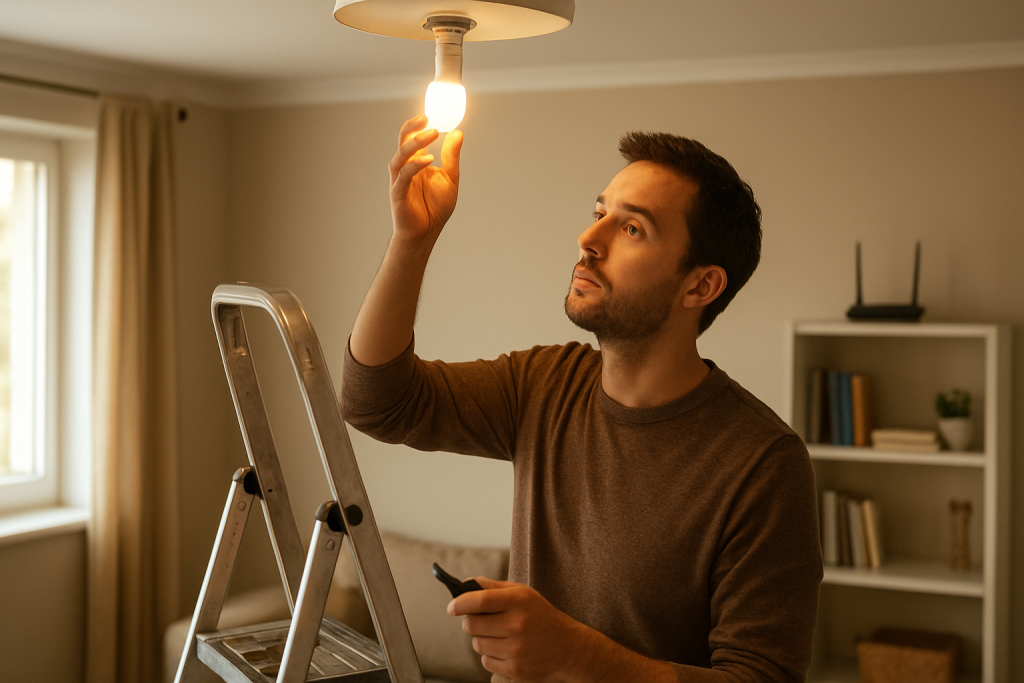
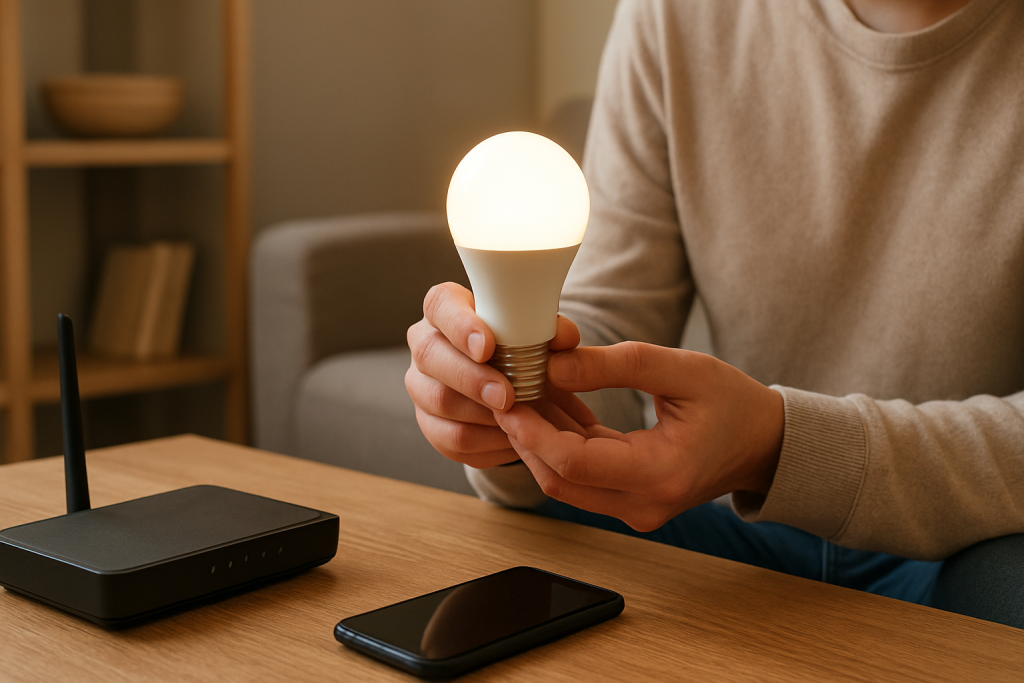
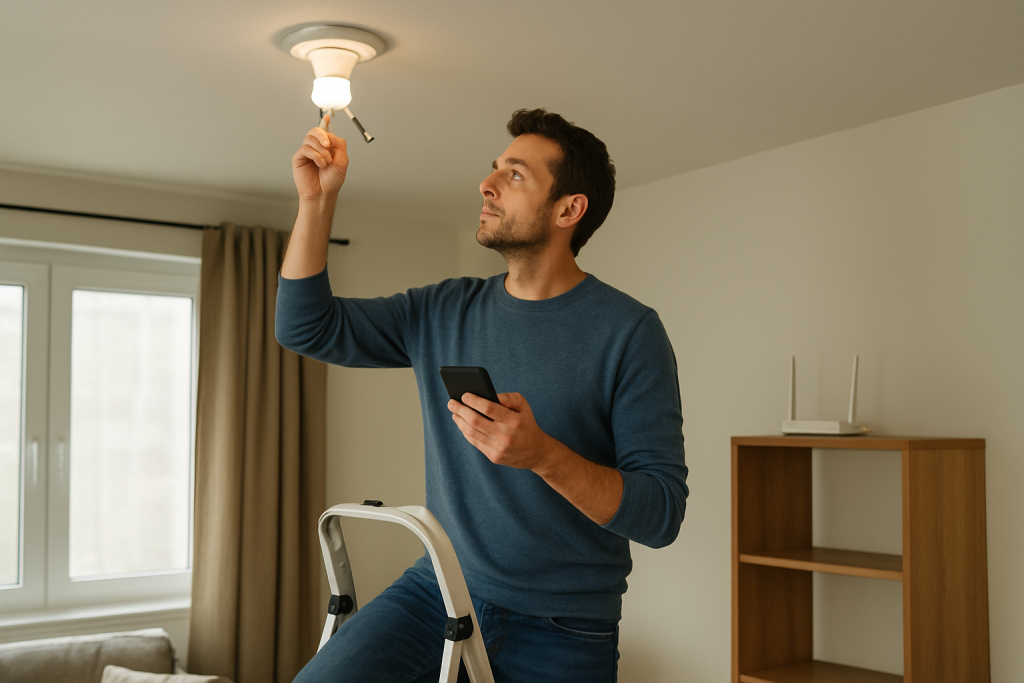
“Device unreachable” almost always means the bulb is powered on but the control path to it is broken. In real homes, the most common reason is a network path change: the phone is on a different Wi-Fi band or guest network than the bulb, the router or mesh moved the bulb to a different node, or the hub/bridge (Zigbee/Matter/Thread) is offline even though the internet still works.
This can affect Wi-Fi bulbs (direct to router), hub-based bulbs (Zigbee via a bridge like Hue), and Matter devices (over Wi-Fi or Thread through a border router). The app may still show the bulb in your room, but commands can’t reach it.
Do these three checks first: (1) Confirm the bulb is physically on (switch on, bulb lit or briefly flashes when toggled). (2) Check whether your phone is on the same home network as usual (not guest, not a different router, not cellular-only). (3) Restart the control point in the middle: the smart hub/bridge if you have one, or the router/mesh if it’s a Wi-Fi bulb.
Why This Happens
The primary cause behind “unreachable” is a broken local connection between your controller (phone/app/voice assistant), the network layer (Wi-Fi/mesh or Zigbee/Thread), and the device. Smart lighting depends on a reliable local route, not just “having internet.” If any part of that route changes, the app often keeps the old record and reports the bulb as unreachable.
Common technical causes tightly tied to this local route include:
1) Wi-Fi band or network mismatch: Many Wi-Fi bulbs are 2.4 GHz only. If your phone is on 5 GHz, it can still work, but problems appear when the router uses client isolation, separate SSIDs, or a guest network. If your phone is on guest Wi-Fi, it often cannot talk to devices on the main network.
2) Mesh roaming and node placement: In mesh systems, bulbs may “stick” to a far node with weak signal. The bulb stays connected, but commands time out. This is common after moving a mesh node, adding a new node, or after a power outage when devices reconnect in a different order.
3) Hub/bridge not reachable on the LAN: Zigbee bulbs (and many Matter-over-Thread setups) rely on a hub or border router. If the hub is unplugged, stuck, on the wrong Ethernet port, or connected to a different network segment, every bulb behind it looks unreachable even though the bulbs themselves are fine.
4) App/account state out of sync: Some ecosystems cache device status. If you changed your password, enabled a new permission, switched phones, or the cloud service is having a partial outage, the app may show devices but fail to send control commands.
5) Overlooked technical cause: “AP/client isolation” or “IoT network isolation” enabled on the router. This setting can block phone-to-device traffic while still allowing internet access. Everything looks connected, but local control fails.
Real-world scenario: A homeowner replaces a router or enables a new mesh system. The phone reconnects quickly, but the bulbs remain tied to the old SSID or a different band/segment. The app shows the bulbs, but every command returns “unreachable.”
Common user mistake: Turning off the wall switch to the lamp. The bulb loses power and goes offline, but the app error looks like a network problem. Another frequent mistake is using the guest Wi-Fi for the phone while devices are on the main network.
Most Likely Causes in Real Homes
1) The bulb has no power (wall switch off, loose socket, switched outlet off), so it cannot respond.
2) Phone is on the wrong network (guest Wi-Fi, different SSID, VPN, or cellular), so the app can’t reach the bulb locally.
3) Router/mesh changed the route (bulb connected to a weak mesh node or got a new IP), causing timeouts.
4) Hub/bridge/border router is offline (Zigbee bridge unplugged, Ethernet issue, Thread border router down), making all linked bulbs unreachable.
5) Automation or group state conflict (a scene, schedule, or group is overriding control or the app is targeting the wrong “copy” of the device).
Step-by-Step Fix
Confirm the bulb has steady power. Turn the wall switch on and leave it on. If it’s a lamp, confirm the lamp’s inline switch is on and the bulb is seated firmly.
What the result means: If the bulb is off because power is cut, it will always show as unreachable. If the bulb turns on normally, it has power and you can move to network checks.
If it fails, try next: Move the bulb to a different known-working socket or lamp (no rewiring, just swap locations). If it still won’t power on, skip to “When to Reset or Replace the Device.”
Check whether your phone is on the same home network the bulb uses. On your phone, open Wi-Fi settings and confirm you are connected to your main home SSID (not “Guest”). If you use a VPN on your phone, disable it temporarily.
What the result means: If switching to the correct SSID immediately makes the bulb controllable, the issue was network separation (guest network, VPN, or a different router).
If it fails, try next: Turn off Wi-Fi and turn it back on, then reopen the lighting app. If still unreachable, continue.
Force the app to refresh device status. Fully close the smart lighting app (remove it from recent apps), reopen it, and pull to refresh if available. Also check the device’s room/location in the app to ensure you’re controlling the correct home.
What the result means: If the bulb changes from “unreachable” to “online,” the problem was stale app state or you were viewing the wrong home/location.
If it fails, try next: Sign out and back in to the app (if it supports accounts), then try again. If it still fails, proceed.
Do the correct power-cycle sequence (bulb + network). First, power the bulb off for 10 seconds using the wall switch, then on. Next, restart the middle device: restart the hub/bridge (for Zigbee/Matter/Thread) or restart the router/mesh (for Wi-Fi bulbs). Wait 2–5 minutes after restarts.
What the result means: If the bulb comes back, the issue was a temporary lockup or a broken route after an outage/roaming event.
If it fails, try next: Continue to Wi-Fi band and mesh tests below.
Wi-Fi bulbs: verify 2.4 GHz compatibility and band behavior. If your router has separate names for 2.4 GHz and 5 GHz, ensure the bulb is on the 2.4 GHz SSID. If your router uses one combined SSID, temporarily stand near the router and try controlling the bulb again.
What the result means: If control works near the router, the bulb likely has weak signal where it’s installed, or it’s clinging to a distant mesh node. If the bulb never comes online, it may be on the wrong SSID or blocked by isolation settings.
If it fails, try next: Temporarily create or enable a dedicated 2.4 GHz IoT SSID (same home network, not guest) and rejoin the bulb if your ecosystem supports it. If you can’t change Wi-Fi settings, proceed to the hotspot isolation test.
Mesh behavior test: identify a “bad node” connection. If you have a mesh system, unplug the mesh node closest to the bulb for 2 minutes, then plug it back in. Alternatively, move the bulb (or a lamp with the bulb) closer to the main router for a quick test.
What the result means: If the bulb becomes reachable when a node is unplugged or when closer to the main router, the issue is mesh routing/roaming rather than the bulb itself.
If it fails, try next: Reposition mesh nodes to reduce dead zones, or keep the bulb on a more stable node by improving signal (shorter distance, fewer walls). Then retest. If still unreachable, continue.
Zigbee hub / Philips Hue-style bridge: check hub connectivity and lights. Confirm the bridge is powered and, if it uses Ethernet, that the Ethernet cable is firmly connected to the router. Look for normal status lights on the bridge (power and network). Then reopen the app and try controlling a different bulb.
What the result means: If all bulbs are unreachable, the bridge or its network connection is the problem. If only one bulb is unreachable, it’s likely that bulb’s Zigbee connection or power state.
If it fails, try next: Restart the bridge and router. If only one bulb is affected, move to the group/sync and schedule checks.
Matter/Thread: verify the border router/controller path. Matter devices often rely on a “controller” (phone/home hub) and sometimes a Thread border router. Ensure your home hub/controller device is powered and on the same home. If you have multiple controllers, try controlling from a second phone or a voice assistant app.
What the result means: If one controller works and another doesn’t, the issue is permissions or controller sync. If none work, the border router/home hub path is likely down.
If it fails, try next: Restart the home hub/border router device and your router. Then wait a few minutes for Thread/Matter to rebuild routes.
Group sync test: control the bulb individually, not through a room/group. In the app, find the bulb as a single device and toggle it. Then try the same command to the room/group.
What the result means: If individual control works but group control fails, the group is out of sync or includes a missing device that causes timeouts.
If it fails, try next: Remove the bulb from the group and add it back. If scenes are involved, recreate the scene after confirming the bulb works alone.
Schedule/automation verification: check for an override. Look for schedules like “turn off at midnight,” adaptive lighting, vacation mode, or motion routines. Temporarily disable automations and test manual control.
What the result means: If manual control starts working after disabling automations, the bulb was reachable but being immediately overridden, which can look like “unreachable” in some apps.
If it fails, try next: Re-enable automations one at a time until the problem returns, then fix or delete the conflicting one.
Hotspot isolation test (quick way to prove it’s your home network). If your bulb supports Wi-Fi and you can safely do so, temporarily set up a phone hotspot with a simple SSID/password and attempt to connect the bulb to it (only as a test). Alternatively, bring the bulb closer to the router and retry setup there.
What the result means: If the bulb works on the hotspot but not on your home Wi-Fi, your router settings (isolation, band steering, firewall rules) or mesh behavior are the root cause.
If it fails, try next: If it won’t work even on a simple hotspot, the bulb may be stuck, misconfigured, or failing. Continue to Advanced Troubleshooting and then reset guidance.
Advanced Troubleshooting
This section is only needed if basic fixes fail.
Account or cloud issue: If the app shows “unreachable” only when you are away from home, but works on your home Wi-Fi, the problem may be remote access rather than the bulb. Confirm the app is logged into the correct account and that your “home” is selected. If you recently changed your password, re-authenticate any linked services (voice assistants, home platforms) so they can send commands again.
Network issue (relevant when hotspot test succeeds): Check router settings for guest network isolation, “AP isolation,” “client isolation,” or an “IoT network” that cannot talk to phones. Also look for a setting that blocks local network discovery. If you use a combined SSID, band steering can sometimes push phones and bulbs into different segments depending on the router. Keeping smart devices on a stable 2.4 GHz SSID on the main LAN often reduces “unreachable” events.
Firmware/software cause: Update the lighting app, hub firmware, and router firmware if updates are available. A partial update can cause devices to appear present but fail to accept commands. After updating, restart the phone and the hub/router to clear old sessions.
Configuration conflict (groups, scenes, automations, permissions): Duplicate devices can appear after migrations (for example, a bulb appears in two rooms or two homes). If the app shows two entries with similar names, remove the offline duplicate. For shared homes, confirm you still have permission to control devices; a permission change can show devices but block control. If voice control works but the app doesn’t (or the reverse), the controller integrations are out of sync—unlink and relink the integration in the home platform settings.
When to Reset or Replace the Device
Soft restart vs. factory reset: A soft restart is simply cutting power to the bulb for 10–20 seconds and restoring it, or restarting the hub/router. A factory reset wipes the bulb’s pairing and network credentials so it must be added again like new.
What you lose after a factory reset: Expect to lose the bulb’s name, room assignment, scenes, automations that reference it, and in some ecosystems its history or custom settings. You will need to re-add it to groups and rebuild any routines that included it.
When a reset is justified: Reset if the bulb stays unreachable after you have confirmed power, confirmed correct network, restarted hub/router, and proven the home network is not the only issue (or the bulb won’t rejoin reliably). Reset is also appropriate if the bulb appears twice, is stuck in “updating,” or cannot be controlled by any controller.
Safety note: If the bulb, socket, or lamp base is unusually hot, smells like burning, flickers rapidly, or shows visible damage, stop using it and replace it. Do not try to open the bulb or fixture.
How to Prevent This in the Future
Keep the control path stable: Avoid frequently changing SSIDs, passwords, or moving mesh nodes without planning for device reconnections. If you must change Wi-Fi details, expect Wi-Fi bulbs to need rejoining.
Place hubs and routers with lighting in mind: Keep a Zigbee hub/bridge and Wi-Fi router in a central, open area when possible. For Zigbee, powered devices (like smart plugs) can help strengthen the mesh; for Wi-Fi, reduce dead zones by improving router placement and avoiding enclosing it in cabinets.
Manage automations carefully: Name automations clearly and avoid overlapping schedules that fight each other (for example, one routine turning lights off while another sets a scene). After adding new scenes, test manual control to ensure nothing is overriding it.
Plan for power outages: After an outage, give the router/mesh and hubs a few minutes to fully come back before judging bulbs as “unreachable.” If outages are common, consider using a consistent power-on behavior in your app settings so bulbs don’t end up in unexpected states.
Maintain firmware and app updates: Update hubs/bridges and apps periodically, not all at once during a crisis. When you do update, restart the hub/router afterward to clear stale connections.
FAQ
Why does the bulb say “unreachable” but it still turns on at the wall switch?
The wall switch only provides power. “Unreachable” means the bulb has power but cannot receive network commands. This usually points to a network path issue (wrong Wi-Fi network, hub offline, or mesh routing problems), not a burned-out bulb.
Does “device unreachable” mean my internet is down?
No. Many smart bulbs are controlled locally on your home network. You can have working internet for phones and streaming while local device-to-phone traffic is blocked by guest Wi-Fi, isolation settings, or a hub that’s offline.
Only one bulb is unreachable. What does that usually indicate?
Most of the time it’s a local signal or power issue for that specific bulb: it’s on a switched outlet, it’s at the edge of Wi-Fi coverage, or (for Zigbee/Thread) it lost its mesh route. Test by controlling other bulbs and by moving the bulb closer to the router/hub temporarily.
My bulbs work individually, but the room/group says unreachable. Is the bulb broken?
Usually not. That pattern points to a group or scene sync problem. A group can fail if it includes an offline device, a duplicate entry, or a controller that’s out of sync. Remove and re-add the bulb to the group, and rebuild the scene if needed.
Misconception: “If I rename the Wi-Fi network to the old name, everything will reconnect automatically.” Is that true?
Sometimes, but not reliably. Matching the old SSID and password can help Wi-Fi bulbs reconnect, but differences in router security settings, band behavior, or isolation features can still prevent control. If devices remain unreachable after restoring the SSID, focus on isolation settings, 2.4 GHz behavior, and hub/router restarts.
What stays with you isn’t the drama—it’s the quiet click of things lining up as they should. The noise fades, and the page feels less like a debate and more like a doorway.
Nothing miraculous happens, but it’s still a little satisfying. You can finally move on without dragging the same thought behind you.