Smart Bulb Buzzing or Humming Sound: What It Means
Quick Answer
A smart bulb that buzzes or hums is most often reacting to the way it’s being powered and controlled, not to WiFi or your hub directly. In real homes, the top trigger is a dimmer switch, “smart” wall switch, or fixture electronics that chop or smooth AC power in a way the bulb’s internal driver doesn’t like. The bulb still turns on and responds in the app, but the power waveform is noisy, and the bulb’s electronics can vibrate audibly.
The next most common cause is a mismatch between how the bulb is being dimmed (in-app dimming versus wall dimming), especially when the bulb is in a group/scene that frequently changes brightness. Rapid brightness changes can make the driver work harder, which can increase coil noise (a faint electrical hum) even though everything appears “normal” in the app.
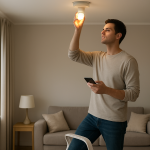
Do these three checks right away: (1) Set the wall switch fully ON (no dimming) and dim only in the app; (2) Move the bulb to a different lamp or socket that is not on a dimmer to see if the sound follows the bulb or stays with the fixture; (3) In the app, set brightness to 100% for a minute, then 30%, then 1% to see if the noise changes with brightness. This applies to common device types including WiFi bulbs, Zigbee bulbs on hubs, Matter bulbs, and bridge-based systems.
Why This Happens
A smart bulb contains a small power supply and LED driver that converts household AC power into a stable current for the LEDs. When the incoming power is “clean,” that driver typically runs silently. When the incoming power is altered by certain switches, fixtures, or control methods, the driver can produce audible vibration. This is often called coil whine or driver noise, and it becomes noticeable as a buzzing or humming sound.
Here are the most relevant real-world causes, tightly tied to how smart bulbs are powered and controlled in a home:
1) Wall dimmers and “smart dimmers” feeding a smart bulb. Many dimmers work by rapidly switching power on and off (phase-cut dimming). Smart bulbs are designed to receive full power and dim internally. When you combine the two, the bulb’s driver may buzz, flicker, or both. Even if the dimmer is set to “100%,” some dimmers still shape the waveform enough to create noise.
2) Incompatible fixture electronics. Some lamps and ceiling fixtures include their own dimming module, touch control, motion sensor, or electronic transformer (common in older low-voltage fixtures). These components can introduce electrical noise or uneven power that a smart bulb turns into audible hum.
3) Brightness level and PWM interaction. Smart bulbs often use high-frequency switching to control brightness. At certain dim levels, the switching pattern can land in a range where mechanical parts in the driver vibrate more. If the hum gets louder at 10–40% brightness and quieter at 100%, that points to driver behavior rather than a network issue.
4) Group/scene updates causing rapid changes. In some ecosystems, groups, adaptive lighting, circadian schedules, or motion automations can “chase” a target brightness or color temperature. If the bulb is being nudged every few seconds, you may hear a faint buzz that comes and goes, even though the light looks steady.
5) Power quality events in the home. Large appliances, HVAC systems, or a loose connection in a lamp socket can cause brief voltage dips or noise. The smart bulb’s driver may respond audibly during those events. This is easy to confuse with “the bulb is failing,” but it’s often situational.
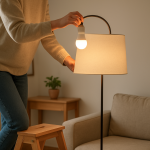
Real-world scenario: A homeowner replaces a normal LED bulb in a dining room chandelier controlled by a wall dimmer. The smart bulb pairs fine and responds instantly in the app, but it hums whenever the dimmer is below full. The hum disappears when the bulb is moved to a simple table lamp on a standard on/off switch. That points to the dimmer/fixture combination, not the bulb’s network connection.
Common user mistake: Using a wall dimmer (or a smart dimmer) to control a smart bulb’s brightness, then also dimming in the app. This “double dimming” is one of the most frequent causes of buzzing, flicker, and unreliable behavior.
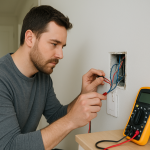
Overlooked technical cause: Some “smart” wall switches that claim to be on/off only still use electronic switching (triac/MOSFET) and may leak a tiny amount of current when off or shape the waveform when on. That can make certain smart bulbs hum or behave strangely even without a traditional dimmer knob.
Most Likely Causes in Real Homes
1) A dimmer switch on the circuit. The bulb is being fed phase-cut power that makes the driver buzz.
2) A lamp/fixture with built-in touch dimming or electronic control. The fixture electronics create noise the bulb amplifies audibly.
3) The hum changes with brightness (especially mid-level dimming). The bulb’s driver is noisier at specific dim ranges.
4) Automations or adaptive lighting repeatedly adjusting brightness/color. Frequent tiny changes keep the driver “busy” and can produce intermittent hum.
5) A socket or connection issue in the lamp/fixture. Slightly loose contact can create noise and heat, sometimes accompanied by buzzing.
Step-by-Step Fix
Confirm the bulb is on a standard on/off switch (not a dimmer) and set the switch fully ON. Then control brightness only in the bulb’s app.
If the buzzing stops or drops significantly, it usually means the wall control is shaping power in a way the bulb doesn’t like (most often a dimmer or electronic switch).
If it doesn’t change, leave the switch ON and continue to the next step to isolate whether the noise is the bulb or the fixture.
Move the bulb to a different socket you trust (a simple table lamp on a basic on/off switch is ideal). Use the same brightness level where the buzzing was obvious.
If the buzzing follows the bulb to the new lamp, the bulb’s driver is the likely source (either normal coil noise at certain levels or a bulb that’s developing a fault).
If the buzzing stays with the original fixture, the fixture, switch, or wiring on that circuit is the likely cause. Continue with fixture and configuration checks rather than network steps.
Run a brightness sweep test in the app: set 100% for 60 seconds, then 50%, then 20–30%, then 1–5%. Listen at each level.
If the hum is loudest at mid or low brightness and quieter at 100%, that points to driver behavior and power interaction rather than connectivity. Many bulbs are quietest at full brightness because the driver is operating in a steadier mode.
If the hum is equally loud at all levels, proceed to the next step to check for automation or group activity that may be repeatedly updating the bulb.
Check the bulb’s device status and recent activity in the app. Look for signs it’s being controlled frequently (adaptive lighting, “wake up” routines, motion triggers, or energy-saving schedules).
If you see frequent changes or a schedule that matches when the buzzing happens, it usually means the bulb is being repeatedly adjusted, which can make intermittent hum more noticeable.
If nothing obvious appears, temporarily disable automations for that bulb (or remove it from rooms/groups) and test again for 10 minutes.
Test group behavior: if the bulb is part of a group/room, temporarily control it as a single device (not via a group scene). Then test the same brightness levels.
If buzzing reduces when controlled individually, it suggests the group is issuing frequent sync commands or transitions that keep the driver in a “changing” state.
If there’s no difference, re-add it to the group later and continue troubleshooting the power/fixture side.
Verify the bulb’s location/room assignment and any time-based settings (time zone, sunrise/sunset, away mode). Then confirm schedules are not duplicated across apps (for example, both a platform app and a manufacturer app controlling the same bulb).
If you find duplicate schedules, that usually explains buzzing that appears “random” because two systems are fighting over brightness or color temperature.
If schedules are clean, continue to a controlled power cycle to clear temporary driver or firmware states.
Do a proper power cycle sequence: turn the light OFF for 30 seconds, ON for 2 minutes, then OFF for 10 seconds, then ON again. After it stabilizes, retest at the brightness level where the buzz was most noticeable.
If the buzzing changes after a power cycle, it can indicate the bulb’s driver or firmware state was stuck, or the bulb was repeatedly reconnecting and applying settings.
If it returns immediately and consistently, move on to firmware and network isolation tests (mainly to rule out repeated control updates).
Check for firmware/software updates in the bulb’s app and (if you use a hub/bridge) in the hub’s app. Apply updates, then retest.
If buzzing reduces after an update, the cause was likely related to dimming curves, driver control, or group transition behavior that was improved in software.
If there’s no change, continue with an isolation test to see if cloud/account control is repeatedly pushing settings.
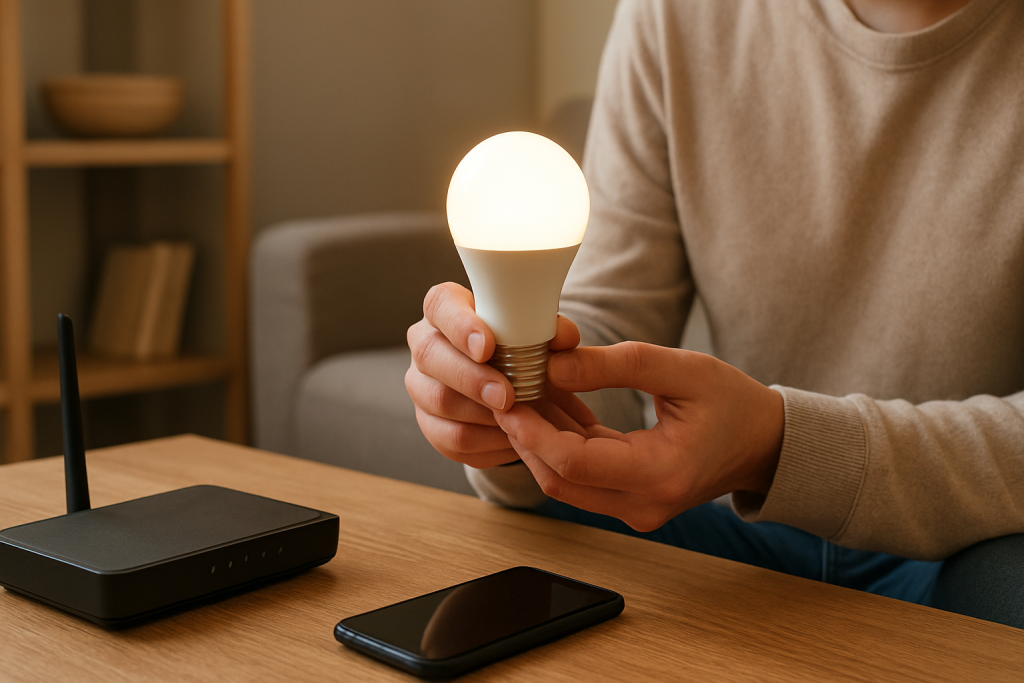
Run a hotspot isolation test (only for WiFi or Matter-over-WiFi bulbs): connect the bulb to a phone hotspot temporarily (same SSID/password method if supported, or re-onboard it to the hotspot network). Then test for buzzing with automations disabled.
If the buzzing pattern changes noticeably (especially if it stops being intermittent), it suggests the bulb was receiving repeated commands due to network instability, cloud retries, or app conflicts rather than purely electrical causes.
If the buzzing is unchanged on a clean isolated network, the issue is almost certainly power/fixture/driver related rather than WiFi behavior.
For Zigbee or hub-based bulbs: do a mesh behavior test by temporarily turning OFF (for 10 minutes) any smart plugs or repeaters near the bulb, or move the bulb to a closer fixture to the hub if possible. Then test again.
If the buzzing was intermittent and now becomes steady or disappears, it may have been tied to repeated reconnects or frequent state corrections from the hub due to a weak mesh route.
If there’s no change, focus on the physical environment: fixture electronics, switch type, and the bulb itself.
Advanced Troubleshooting
This section is only needed if basic fixes fail.
Account/cloud issue: If the bulb’s brightness or color temperature keeps “snapping back” after you set it, the buzzing may be a side effect of constant corrections. Log out of secondary control apps that also have access to the same ecosystem, then retest with one app only. If your platform supports household members, confirm no one else’s automations or permissions are applying scenes to that room.
Network issue (relevant when buzzing is intermittent and matches control glitches): For WiFi bulbs, verify the bulb is on the intended band (many prefer 2.4 GHz). If your router combines bands under one name, a bulb may reconnect repeatedly if the signal is marginal. A reconnect can trigger the bulb to re-apply its last known brightness or an automation, which can create brief bursts of hum. If possible, test with the bulb closer to the router or mesh node for one evening to see if the timing of the buzzing changes.
Firmware/software cause: Some ecosystems adjust dimming curves and transition behavior over time. If buzzing happens only during fades (for example, scene transitions or “gentle wake” routines), change the transition speed to instant or very short, then test. If the buzz disappears during instant changes but returns during slow fades, the driver is reacting to the control method used during transitions.
Configuration conflict: Check for duplicate control paths: a manufacturer app plus a platform app; a hub scene plus a voice assistant routine; or multiple rooms controlling the same bulb. Also check group sync: if one bulb in a group is slightly out of sync, the controller may keep sending corrections. Remove the buzzing bulb from the group, test it alone for a day, then add it back.
When to Reset or Replace the Device
A soft restart is simply a power cycle (off/on) that keeps your pairing and settings. Try this first when the buzzing is new, intermittent, or started after a power outage or software update.
A factory reset is appropriate when the bulb behaves unpredictably (random brightness changes, frequent reconnects, or it won’t hold settings) and you’ve already confirmed it’s not on a dimmer and not tied to automations. After a factory reset, you typically lose pairing, room/group membership, schedules stored in the bulb or app, and any custom scenes linked to that specific device entry. You’ll need to add it again and reassign it to rooms and automations.
Replace the bulb if the buzzing is loud, getting worse over time, or accompanied by visible flicker, discoloration, or a hot/burning smell. Safety note: if the bulb or fixture is unusually hot to the touch, if you see scorch marks, or if the sound is more like crackling than humming, turn the light off and stop using that socket. Do not continue troubleshooting on a potentially overheating device.
How to Prevent This in the Future
Keep smart bulbs on clean, steady power. Use a standard on/off switch for circuits with smart bulbs, and dim using the app or automation rather than a wall dimmer. If you need wall control, use a control method designed to keep power stable to the bulb (for example, a controller mode that doesn’t chop power) rather than traditional dimming behavior.
Place devices to reduce repeated command traffic. For hub-based systems, maintain a solid mesh by keeping powered repeaters in reasonable range so bulbs don’t constantly re-route. For WiFi bulbs, ensure the signal is stable in the room; intermittent reconnects can lead to repeated setting re-application that makes buzzing appear and disappear.
Manage automations carefully. Avoid stacking multiple schedules across different apps. If you use adaptive lighting or circadian modes, keep transitions reasonable and avoid rapid “micro-adjustments” from multiple controllers. When troubleshooting, document which app is the “source of truth” for that room.
Plan for power outages. After an outage, bulbs may default to a brightness or state that triggers noise at certain dim levels. Review power-on behavior settings if your ecosystem supports it, and keep firmware updated so recovery behavior is consistent.
Maintain firmware and app updates. Updates often improve dimming curves, group synchronization, and transition handling. Apply updates during a convenient time, then verify that key scenes (especially slow fades) still behave quietly.
FAQ
Is buzzing a sign my smart bulb is about to fail?
Not always. If the buzzing mainly happens at certain dim levels or only on one fixture, it usually points to a power/control mismatch (dimmer, fixture electronics, or automation behavior). It’s more concerning if the sound is loud, worsening, paired with flicker, or accompanied by overheating or odor.
My bulb buzzes only when dimmed. Is that normal?
It can be common, especially at mid-to-low brightness where the driver’s switching behavior can become audible. If the bulb is on a dimmer switch, fix that first by setting the wall control to full ON and dimming only in the app. If it’s on a standard switch and the buzz is still bothersome, try using higher brightness levels or adjusting scenes to avoid the noisiest range.
Can WiFi problems cause a humming sound?
WiFi itself does not create electrical hum. However, unstable connectivity can cause repeated reconnects and repeated application of brightness or scene settings, which can make a driver’s noise appear intermittent. If the buzzing comes and goes in sync with control glitches, isolation testing (single app control, hotspot test, or improved signal) can help confirm whether repeated commands are involved.
Misconception: “A smart bulb should be on a dimmer to work properly.” Is that true?
No. Most smart bulbs are designed to receive full power and handle dimming internally. A traditional dimmer often makes smart bulbs behave worse, not better, and is one of the most common reasons for buzzing, flicker, and unreliable operation.
Why does the buzzing stop when I move the bulb to a different lamp?
That usually means the original fixture or wall control is the trigger. Touch lamps, built-in dimmers, electronic transformers, and some smart switches can shape power in a way that makes a bulb’s driver audible. If the bulb is quiet in a simple lamp on a basic on/off switch, focus on the original fixture setup and automation/configuration rather than the bulb itself.
There’s a strange calm that comes when the noise stops, like your inbox finally catches up. The point lands cleanly, and the rest is just the world doing what it does—quietly, mostly okay.
Nothing dramatic, no fireworks, just the sense that things are less tangled than they used to be. You can feel yourself exhale, then get on with the day, which is honestly the best part.