Smart Lights Not Following Schedule: How to Fix It
Quick Answer
The most common reason smart lights stop following schedules is that the schedule is being evaluated in the wrong “context” (wrong home, room, time zone, location, hub, or automation owner), or the device that actually executes the schedule (hub/bridge, cloud account, or a phone acting as the automation controller) is not reliably available at the scheduled time. In real homes, this often happens after router changes, phone replacements, daylight saving time shifts, adding a second app/ecosystem, or moving devices between rooms.
Schedules can look correct in the app but still fail because they are attached to a different home/location, a different controller, or a scene/group that no longer contains the bulb. If the light works when you tap “On” in the app but not on schedule, that usually means the device is reachable but the automation engine is not running the schedule correctly.
Do these three quick checks first: (1) In the app, confirm the schedule’s time zone/location and that it is enabled. (2) Check the device status at the moment it should run (online vs offline) and whether it’s in the correct room/group. (3) Reboot in the right order: router first, then hub/bridge (if you have one), then the bulbs/switches, and re-test the next scheduled event.
Why This Happens
The dominant cause behind missed schedules is “automation context drift”: the schedule still exists, but the system that decides when and where it should run is no longer aligned with your current home setup. Smart lighting ecosystems split responsibilities between the app, a hub/bridge (common with Zigbee systems like Hue-style bridges), your router (for WiFi bulbs), and sometimes a cloud account. If any one of those parts changes, schedules can silently stop triggering or trigger in the wrong place.
Here are the most common technical causes tied to that primary issue:
(1) Time zone or location mismatch. If the app thinks your home is in a different time zone, schedules can fire at the wrong time or appear to “not run” because you aren’t watching at the expected moment. This is especially common after daylight saving time changes, travel, or restoring a phone backup.
(2) Schedule is attached to the wrong home/room/controller. Many apps support multiple “homes,” “locations,” or “houses,” and schedules can be created under one while you’re viewing devices under another. Similarly, if you have multiple phones or family accounts, the schedule may be owned by a different account/controller that is no longer signed in.
(3) Group/scene membership changed. A schedule that targets a group/scene will fail to affect a bulb if the bulb was moved to a different room, renamed, removed from a group, or replaced. The schedule still runs, but it runs against an empty or different target.
(4) Hub/bridge or cloud dependency not available at trigger time. Zigbee hubs, Matter controllers, and cloud-based WiFi bulbs rely on a controller being online. If the hub is powered off, stuck, or disconnected from the router, schedules won’t run even though manual control might work intermittently.
(5) Overlooked technical cause: conflicting automations. A second schedule, “away mode,” adaptive lighting, motion automation, or a voice assistant routine can immediately override the scheduled state. If the light turns on briefly and then changes, that usually means the schedule did run but was overwritten.
Real-world scenario: you upgraded your router and reused the same WiFi name and password. The bulbs reconnect, and manual control works, but schedules don’t. In many ecosystems, the automation engine is tied to a hub/controller that lost its network route, changed IP behavior, or is now blocked by a router security feature. The schedule exists, but the controller can’t reliably reach the device at the scheduled moment.
Common user mistake: creating schedules in two places (for example, in the bulb’s app and also in a voice assistant app) and forgetting about one. The result is “random” behavior that looks like a missed schedule.
Overlooked technical cause: the home’s location permissions are disabled on the phone that manages the smart home, causing sunrise/sunset or location-based schedules to fail or use stale data. Even time-based schedules can be affected if the ecosystem uses the phone for time/location validation.
Most Likely Causes in Real Homes
1) Time zone/daylight saving mismatch in the app or hub: schedule fires at the “wrong” time.
2) Schedule is saved under a different home/location or different account: you’re editing one schedule but the system is running another (or none).
3) Hub/bridge/controller offline at trigger time: manual control works sometimes, but scheduled triggers don’t.
4) Group/scene changed: schedule runs but targets the wrong group or an empty scene.
5) Conflicting automation overrides the schedule: the light changes state immediately after the scheduled event.
Step-by-Step Fix
Confirm what type of schedule you’re using (time vs sunrise/sunset vs “away”/adaptive). What to do: open the lighting app and locate the exact automation/schedule. Note whether it is time-based, sunrise/sunset-based, or part of a scene/routine. What the result means: if it’s sunrise/sunset or location-based, the system depends on correct location/time zone and often permissions. What to try next if it fails: if you can’t find the schedule where you expect, check if you have multiple apps controlling the same lights (manufacturer app, hub app, and voice assistant app) and search each for routines.
Verify time zone, daylight saving, and home location settings. What to do: in the app’s home/location settings, confirm the address or region, time zone, and that the phone’s date/time is set to automatic. If the schedule is sunrise/sunset, confirm the home location is correct and location permissions are allowed for the app. What the result means: if the time zone is wrong or location is missing, schedules can trigger at unexpected times or not compute sunrise/sunset correctly. What to try next if it fails: toggle location permissions off/on, reopen the app, and re-save the schedule (even without changing it) to force a refresh.
Check whether the light is actually online at the scheduled time. What to do: in the app, look at the device status (online/offline/unreachable). If you have a hub/bridge, check its status too. What the result means: if the light or hub shows offline, the schedule may be fine but cannot be delivered. If it shows online, the issue is more likely schedule context, conflict, or group targeting. What to try next if it fails: proceed to the reboot sequence in the next step and then run a “manual test” by turning the light on/off in the app to confirm connectivity.
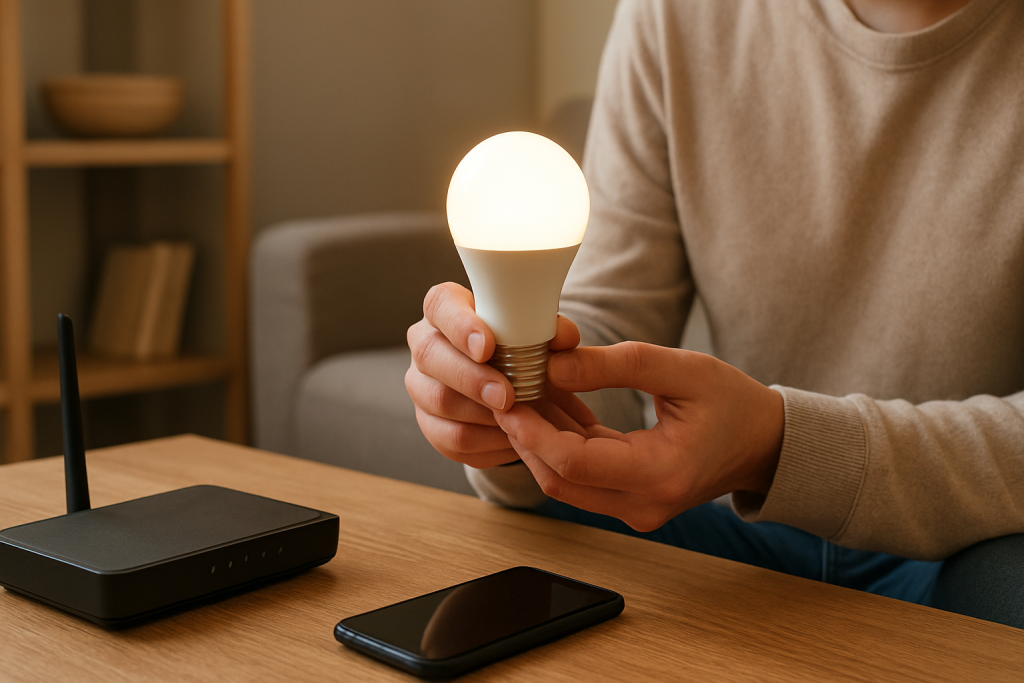
Reboot in the correct order to restore schedule execution. What to do: power cycle the network and controllers in this order: (1) reboot the router, wait for internet to fully return, (2) reboot the hub/bridge/controller (Zigbee hub, Hue-style bridge, Matter controller), (3) power cycle the bulbs/smart switches by turning the wall switch off for 10 seconds and back on (only if the bulb is designed to be wall-powered and you are not relying on that switch for daily control). What the result means: if schedules start working after this, the problem was likely a stuck controller, stale network route, or cloud reconnect issue. What to try next if it fails: continue to schedule targeting checks; the schedule may be running but aimed at the wrong group/scene.
Run a “group sync test” to confirm the schedule target still contains the right devices. What to do: open the schedule and check whether it targets a single bulb, a room, a group, or a scene. Then open that room/group/scene and confirm the intended bulbs are included and responsive. What the result means: if the group is missing bulbs or contains the wrong ones, the schedule will appear broken. If the group is correct but nothing changes, the schedule may not be firing or may be overridden. What to try next if it fails: edit the schedule to target a single bulb directly as a test; if that works, rebuild the group/scene and then re-target the schedule to it.
Check for conflicting automations that override the schedule. What to do: look for other routines in the same ecosystem and in any connected ecosystem (voice assistant routines, “adaptive lighting,” “away mode,” motion sensor rules, or “do not disturb” modes). Temporarily disable anything that changes the same lights around the same time. What the result means: if disabling another automation fixes it, the schedule was running but being overwritten. What to try next if it fails: change the schedule to set a distinctive state (for example, 10% brightness or a specific color) so you can tell whether it triggers at all.
Confirm the schedule is owned by the active account and saved to the correct home/location. What to do: if multiple household members manage the smart home, verify you are signed into the correct account. Check whether the app has multiple homes/locations and that you’re editing the one where the devices live. What the result means: if you find duplicate homes or the schedule exists under a different home, the controller may be running a different configuration than the one you’re viewing. What to try next if it fails: move to a single “source of truth” by choosing one app/ecosystem to own schedules, then delete or disable duplicates elsewhere.
WiFi band check for WiFi bulbs: confirm the bulbs are on the expected network. What to do: if your bulbs use WiFi, confirm your phone is on the same home WiFi when setting schedules. If your router uses combined 2.4 GHz and 5 GHz under one name, check whether the bulbs require 2.4 GHz and whether the router is steering devices aggressively. What the result means: if bulbs frequently show offline or delay responses, schedules may fail because the bulb drops connection. What to try next if it fails: temporarily separate 2.4 GHz and 5 GHz names (if your router allows) or create an IoT/2.4 GHz network and reconnect bulbs to it, then re-test scheduling.
Mesh behavior test for Zigbee/Matter/Thread-style setups: confirm the controller and repeaters are stable. What to do: if you use a hub/bridge, ensure it is placed away from the router (to reduce interference) and not tucked behind a TV or inside a cabinet. For Zigbee-style systems, make sure you have enough always-powered devices (like smart plugs or in-wall devices) that act as repeaters; battery sensors do not. What the result means: if devices work near the hub but miss schedules when farther away, the mesh is weak and scheduled commands aren’t reliably delivered. What to try next if it fails: relocate the hub to a more central spot and re-test; if the ecosystem supports it, run a network/mesh repair or allow 24 hours for the mesh to settle after changes.
Hotspot isolation test to separate “schedule engine” problems from “home network” problems. What to do: for WiFi bulbs that can join a different WiFi, temporarily connect one bulb to a phone hotspot and create a simple time-based schedule in the manufacturer app (not sunrise/sunset). What the result means: if it follows the schedule on the hotspot, your home network/router behavior is likely interfering (blocking, isolation, or unstable connectivity). If it still fails on the hotspot, the issue is more likely account/cloud, firmware, or app configuration. What to try next if it fails: proceed to Advanced Troubleshooting for account/cloud and firmware checks.
Recreate the schedule cleanly and test with a near-term trigger. What to do: delete (or disable) the problematic schedule, then create a new one that triggers 5–10 minutes from now and targets a single bulb directly. After it works, expand it to the intended group/scene. What the result means: if the new schedule works, the old schedule was corrupted, duplicated, or tied to a stale target. If the new schedule fails, the automation engine still isn’t reliably running. What to try next if it fails: move to the advanced section to check cloud status, firmware, and controller permissions.
Advanced Troubleshooting
This section is only needed if basic fixes fail.
Account or cloud issue: If schedules are cloud-managed (common for many WiFi bulb systems), a partial outage or a stuck account sync can prevent triggers even while manual control works. Check the app’s service status area (if available) and confirm you can log out and back in. If logging back in causes devices or schedules to “reappear,” the issue was account sync. If you use multiple phones, ensure the primary phone/controller is not signed out or restricted by privacy settings.
Network issue (relevant when devices go offline or respond slowly): If lights are online sometimes but miss scheduled events, look for features like client isolation, “IoT network” isolation from the phone, or aggressive firewall settings. Also check whether the router is rebooting overnight (some routers auto-update) exactly when schedules should run. If schedules fail only at night or early morning, that timing strongly suggests controller/router maintenance rather than a bad bulb.
Firmware/software cause: Outdated firmware on bulbs, hubs, or bridges can break scheduling after app updates or after daylight saving changes. Update the hub/bridge firmware first, then bulbs. If an update was installed right before the problem started, also check whether the app added a new automation feature (adaptive lighting, “smart scenes”) that may conflict with your existing schedules.
Configuration conflict (groups, scenes, permissions): If you control lights through multiple ecosystems (manufacturer app plus a hub platform plus a voice assistant), pick one place to own schedules. If you keep schedules in multiple places, you will eventually get conflicts. Also check permissions: some homes have “admin” and “member” roles. If the schedule was created by an admin account that later changed permissions, it may stop editing or running reliably.
When to Reset or Replace the Device
A soft restart is simply power cycling the bulb or rebooting the hub/bridge. This clears temporary connectivity issues without deleting configuration. A factory reset wipes the device from the ecosystem and removes it from rooms, groups, scenes, and schedules. After a factory reset, you usually need to re-add the device, rename it, and rebuild automations that referenced it.
Consider a factory reset when: the device frequently shows “offline” while other devices are stable, it will not accept firmware updates, it cannot stay joined to the hub/mesh, or schedules fail even after you recreate them and confirm correct time zone and targeting. Reset the controller/hub only if multiple devices fail together and you have already ruled out time zone and schedule ownership issues.
Replace the device when it shows signs of physical damage, intermittent power, or overheating. If a bulb or hub is unusually hot to the touch, smells like burning plastic, flickers abnormally, or has visible cracking, stop using it and replace it. Do not attempt to open devices or repair internal components.
How to Prevent This in the Future
Keep scheduling stable by reducing “moving parts.” Use one primary place to create schedules, and disable duplicate routines in other apps. When you change routers or WiFi names, plan to verify schedules the same day, because schedule failures often show up only at the next trigger time.
Maintain a stable controller environment: keep hubs/bridges on a reliable power source, avoid plugging them into switched outlets, and place them in an open, central location. For WiFi bulbs, keep them on a consistent 2.4 GHz-capable network and avoid frequent SSID/password changes.
After power outages, check that the hub/bridge is back online and that devices returned to their normal state. If your bulbs have a “power-on behavior” setting, configure it intentionally (return to previous state vs default on/off) so an outage doesn’t create confusing results that look like schedule problems.
Review automations every few months. Remove old scenes and unused groups, and rename rooms consistently. A clean configuration prevents schedules from pointing at “ghost” groups that no longer match your home.
Keep firmware and apps updated, but when you update, re-check time zone/location settings and verify one test schedule. Many scheduling issues are discovered right after an update or daylight saving change, and a quick validation prevents weeks of unreliable behavior.
FAQ
My lights work in the app, so why wouldn’t the schedule work?
If manual control works but schedules do not, the bulbs are reachable, but the automation engine is the problem. That usually points to time zone/location mismatch, the schedule being attached to the wrong home/account, or a controller (hub/bridge/cloud) that isn’t reliably running the schedule at trigger time.
Do schedules run locally or through the cloud?
It depends on the ecosystem and how the schedule was created. Some hub-based systems can run schedules locally on the hub/bridge, while many WiFi-bulb schedules rely on a cloud account. If schedules fail when the internet is down, that strongly suggests cloud dependency. If they fail even with internet working, focus on time zone, ownership, group targeting, and conflicts.
After daylight saving time, my schedule is off by exactly one hour. What does that mean?
An exact one-hour offset almost always indicates a time zone or daylight saving mismatch in the app, hub/bridge, or the phone that manages the home. Correct the home time zone/location settings, ensure automatic time is enabled on the phone, then re-save the schedule so the system recalculates the trigger time.
Is weak WiFi always the reason schedules fail?
No. Weak WiFi can cause devices to go offline, which can break schedules, but many missed-schedule cases are configuration problems: the schedule targets the wrong group, is saved under a different home, or is being overridden by another automation. Check targeting and conflicts before spending time on WiFi tuning.
Why do my lights follow the schedule sometimes, but not every day?
Intermittent behavior usually means something is changing in the background: the hub/controller is rebooting, the router is doing overnight maintenance, the device is dropping offline, or a second automation occasionally overrides the scheduled state. Look for patterns in timing (for example, failures only overnight) and temporarily disable other routines to identify conflicts.
So much of this story comes down to what happens when the noise stops and the shape of the problem becomes obvious. The rest feels almost disappointingly straightforward—in the best way.
From here, it’s less about wrestling and more about moving on with your day. There’s a small lift in realizing you weren’t stuck as long as you thought.