Smart Plug Firmware Update Failed? Try These Fixes First
Quick Answer
A smart plug or smart switch firmware update usually fails because the device temporarily loses the exact connection path it needs to download and verify the update. In real homes, that’s most often caused by WiFi band steering (2.4 GHz vs 5 GHz), mesh roaming to a weaker node mid-update, or an app/cloud session that has gone stale after a router restart, phone OS update, or password change.
The safest approach is to confirm the device is stable and reachable before retrying. Firmware updates are designed to be recoverable, but repeated retries while the device is “flapping” (online/offline) increases the chance of a partial update and a longer recovery process.
Do these three diagnostic actions first: (1) check in the device’s native app whether the plug/switch is “Online” and responsive to manual on/off, (2) confirm your phone is on the same home network (not cellular or a guest/VPN network) and that the device is on 2.4 GHz if it’s a WiFi model, and (3) delay and retry once after stabilizing power and network (no router reboot in progress, no ongoing ISP outage).
Why This Happens
Firmware updates aren’t just downloads. The device must maintain a stable connection long enough to fetch the file, verify it, write it to memory, and reboot into the new version. If anything interrupts that chain, the app may show “Update failed,” “Timed out,” “Device unreachable,” or it may appear stuck at a percentage.
Common tightly related causes include:
First, unstable reachability during the update window. A real-world scenario: your smart plug is near the edge of coverage and your mesh system moves it between nodes; the device drops for a few seconds and the update fails.
Second, a common user mistake is starting an update while away from home or while the phone is on a different network, then force-closing the app. Some ecosystems can update in the background, but many require the app session to remain valid and the device to stay online throughout key steps.
Third, an overlooked technical cause is account or cloud token issues. After a password change, app update, or enabling two-factor sign-in, the app may look normal but the device update request fails server-side until you re-authenticate.
Finally, platform bridges add extra points of failure. Matter devices, Zigbee plugs through a hub, or integrations via Alexa/Google Home/Apple Home/SmartThings can appear reachable for control but still fail firmware updates if the “updater” (native app, hub, or controller) isn’t the one currently authorized to manage firmware.
Most Likely Causes in Real Homes
1) Mesh roaming or weak signal during the update. Updates are sensitive to short dropouts, even if everyday on/off control seems fine.
2) 2.4 GHz mismatch or band steering. Many WiFi plugs/switches require 2.4 GHz; if your phone is on 5 GHz and the router steers aggressively, the update handshake can fail.
3) Cloud/account session expired. The device can be online, but the update command is rejected until the app signs in again or refreshes permissions.
4) Competing controllers or duplicate device entries. A device linked in multiple ecosystems (native app plus Matter plus SmartThings, etc.) can end up “owned” by one controller for updates, while another tries and fails.
5) Power instability or protective behavior. Brief outages, loose outlets, or a switch’s power recovery setting can interrupt the reboot stage and look like a failed update.
Step-by-Step Fix
-
Confirm the device is truly stable before updating: in the device’s native app, toggle it on/off twice and watch for quick response and an “Online” status. This result means the device is reachable enough for an update; if it lags, shows “offline,” or delays, the issue is likely connectivity stability rather than the firmware itself. If it’s not stable, move to the next step before retrying the update.
-
Stabilize the network path for the updater: put your phone on your main home WiFi (no guest network, no VPN), and for WiFi plugs/switches confirm the device is on 2.4 GHz. If the app shows the device connected to 2.4 GHz and control is reliable, that usually means band steering isn’t blocking the process. If you can’t confirm 2.4 GHz or the router merges bands, try temporarily moving the plug closer to the router (or the primary mesh node) and retry once.
-
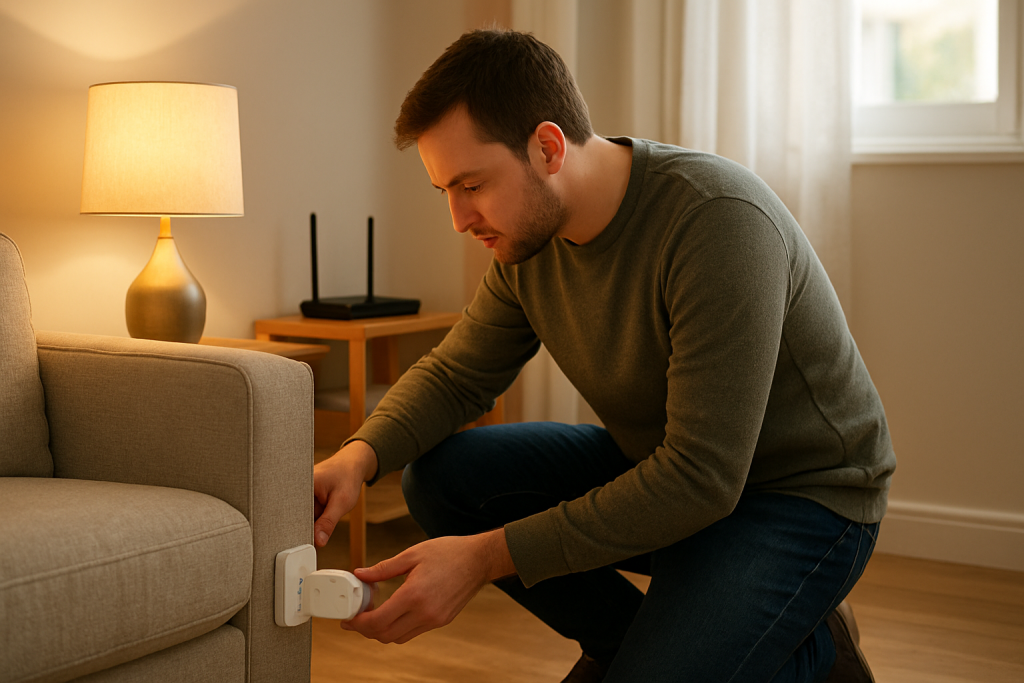
Run a “proximity test” to rule out mesh roaming: plug the smart plug (or the controlled load for a smart switch) into a location with strong coverage near the main router/primary node and attempt the update again. If the update works there, it usually means the original location has marginal signal or the mesh is steering the device between nodes. If it still fails in a strong-signal location, go to the next step.
-
Refresh the app session and permissions: fully sign out of the device’s native app, sign back in, then check for any prompts about new permissions, local network access (iPhone/Android), or updated terms. If the update now starts, the failure was likely an expired token or stale session after an app/OS/password change. If it still fails, continue.
-
Pause competing controllers and duplicate entries: in Alexa, Google Home, Apple Home, SmartThings, or Matter controllers, check whether the same plug/switch appears more than once (for example, one cloud version and one Matter version). If duplicates exist, disable one path temporarily (for example, remove the duplicate from a voice assistant) and attempt the firmware update only from the device’s native app or the hub app that normally handles updates. If this works, the issue was a controller ownership/sync conflict; if it fails, proceed.
-
Do a safe power-cycle sequence (without rapid toggling): turn the plug/switch off from the app, wait 10 seconds, then turn it back on; if it’s a smart plug, you can also unplug/replug once (avoid repeating rapidly). If the device returns online quickly, retry the update; this result means the device reboot stage is likely to complete. If it comes back “offline” or takes a long time, move to the next step to isolate network conditions.
-
Try a hotspot isolation test (WiFi devices only): create a 2.4 GHz hotspot on a phone and connect the smart plug/switch to it, then attempt the firmware update from the native app. If the update succeeds on the hotspot, it strongly suggests a home-network issue (band steering, mesh roaming, DNS filtering, or router security features) rather than the device. If it still fails on the hotspot, the issue is more likely the firmware service, the app, or the device’s firmware state—continue.
-
Check for app and platform version mismatches: update the device’s native app, and if it’s a hub-based device (Zigbee via a hub, or a bridge integration), confirm the hub/bridge firmware and app are current. If updating the app/hub enables the device update, the prior failure was likely a compatibility or migration issue. If everything is current and it still fails, try the next step.
-
Retry once at a “quiet” time with a stable window: choose a time when no one is gaming/streaming heavily, avoid router reboots, and keep the phone awake with the app open during the update. If the update completes now, the earlier failures were likely transient network drops or background app suspension. If it continues to fail with the same error, move to Advanced Troubleshooting.
Advanced Troubleshooting
This section is only needed if basic fixes fail.
Account/cloud issue: If multiple devices fail updates at the same time, it often points to an account, region, or cloud outage rather than one plug. Sign out/in again, verify the correct account is used in all linked ecosystems, and check whether the app shows service notices. If a shared home is involved, ensure the owner account (not a guest) is the one initiating firmware updates.
Network issue: Some routers block firmware domains or large downloads under “security,” “DNS filtering,” or “parental controls.” If the hotspot test worked, look for guest network isolation, DNS-based content filters, or aggressive firewall settings. Also watch for mesh systems that “optimize” by moving devices; temporarily pinning the device near the primary node during updates avoids mid-update roaming.
Firmware/software cause: If the device repeatedly fails at the same percentage, it can indicate a corrupted partial download, insufficient free space for the update package, or a staged rollout where your device is offered an update that’s later pulled. Waiting 24 hours and trying again after an app refresh often resolves staged rollout inconsistencies.
Configuration conflict: Automations that toggle the device (schedules, motion routines, energy-based rules) can interrupt the reboot stage. Temporarily disable schedules/routines for that device in the native app and in any linked platforms (Alexa routines, Google automations, Apple Home automations, SmartThings routines). If the update then succeeds, re-enable rules one at a time to avoid conflicts.
Ecosystem sync issue (Alexa/Google Home/Apple Home/Matter): Voice assistants can control devices even when the native app is the only supported updater. If the plug/switch was added via Matter, confirm which controller is the “admin” and try the update from that controller or the manufacturer’s app as appropriate. If the device appears in multiple homes/rooms across platforms, correct the home assignment so you’re not attempting to update a “ghost” entry that no longer maps to the physical device.
When to Reset or Replace the Device
A soft restart is a simple reboot (power-cycle once, or use the app to turn the device off/on). It’s low-risk and worth trying when updates fail due to temporary glitches.
A factory reset removes the device from your account and clears its local configuration. After a reset, you may lose pairing to your WiFi/hub, room and name assignments, schedules/timers, automation links in Alexa/Google Home/Apple Home/SmartThings, and (for energy-monitoring smart plugs) historical energy data stored in the app or cloud. Reset is reasonable if the device is stuck in an update loop, cannot stay online long enough to update even near the router, or fails the update consistently across multiple networks.
Replacement becomes reasonable when the plug/switch shows persistent offline behavior across different networks, repeatedly fails firmware updates over days with the same symptoms, or behaves unreliably (random on/off not explained by automations). Stop using the device and replace it if you notice overheating, a burning smell, crackling, discoloration, melting, or any visible damage.
How to Prevent This in the Future
Keep updates safe and predictable by making the update path stable before you start. Run firmware updates when the home network is quiet and you’re on the same WiFi as the device, and avoid starting an update right after a router firmware change or power outage.
Place WiFi plugs where they don’t hover on the edge of coverage, and be cautious with mesh roaming during updates: temporarily updating the device near the primary node prevents short disconnects that don’t matter for normal use but can break firmware writes.
Avoid duplicate control paths that can conflict. If you use a native app plus Alexa/Google Home/Apple Home/SmartThings/Matter, keep names and rooms consistent and remove duplicate “ghost” devices. Also, avoid creating the same schedule in multiple places (native app schedule plus voice assistant routine plus platform automation), because unexpected toggles during an update can interrupt the reboot stage.
After outages, let the network settle: router first, then mesh nodes/hubs, then wait a few minutes for devices to re-register before attempting updates. Maintain app health too—keep the manufacturer app and hub/controller apps updated, and periodically confirm you’re signed in with the correct owner account, especially in shared households.
FAQ
Is it safe to retry a failed firmware update on a smart plug or smart switch?
Usually yes, as long as the device is stable and online first. Retry only after you’ve improved connection stability (strong signal, correct network, no roaming) and you’re not power-cycling repeatedly. Repeated retries while the device is going offline/online can prolong recovery.
The app says “update failed,” but the plug still turns on and off. Does that mean it updated anyway?
Not necessarily. Basic on/off control can work even when the firmware didn’t apply, because the device may still be running the old version. Check the firmware version number in the native app; if the version didn’t change, the update likely failed even if control works.
Do I need to delete the device from Alexa/Google Home/Apple Home to update firmware?
Usually no. Firmware updates are typically handled by the manufacturer’s app or the hub/bridge that manages the device. However, if you have duplicate entries (cloud plus Matter, or multiple linked accounts), temporarily removing the duplicate can prevent controller conflicts during the update.
Common misconception: “Firmware fails only because the WiFi password is wrong.” Is that true?
No. If the password were wrong, the device would usually be offline all the time, not only during updates. Update failures are more often caused by brief disconnects, mesh roaming, 2.4 GHz/band steering issues, or an app/cloud session that needs re-authentication.
When the talking stops, the real feeling shows up: relief, plain and unglamorous. The pressure that used to linger in the background just… loosens.
It’s the kind of change you notice in small moments—less circling back, less frustration, more room to get on with the day. Not dramatic, not flashy, just finally right.