The most common reason a smart bulb firmware update gets stuck is that the bulb loses reliable communication with the system that delivers and verifies the update. In real homes, that usually means the bulb’s connection is marginal during the update window: weak Wi‑Fi signal, a mesh node switching, a Zigbee route changing, a hub that’s busy, or the phone/app losing cloud access mid-process. Firmware updates are less tolerant than normal on/off control; a brief dropout that you wouldn’t notice during daily use can stall an update.
This affects Wi‑Fi bulbs (direct to router), hub-based Zigbee/Z‑Wave bulbs (through a hub/bridge), and Matter devices (often still using Wi‑Fi or Thread underneath). It also commonly shows up with multi-bulb rooms or groups where several devices try to update at once and the hub or network gets overloaded.
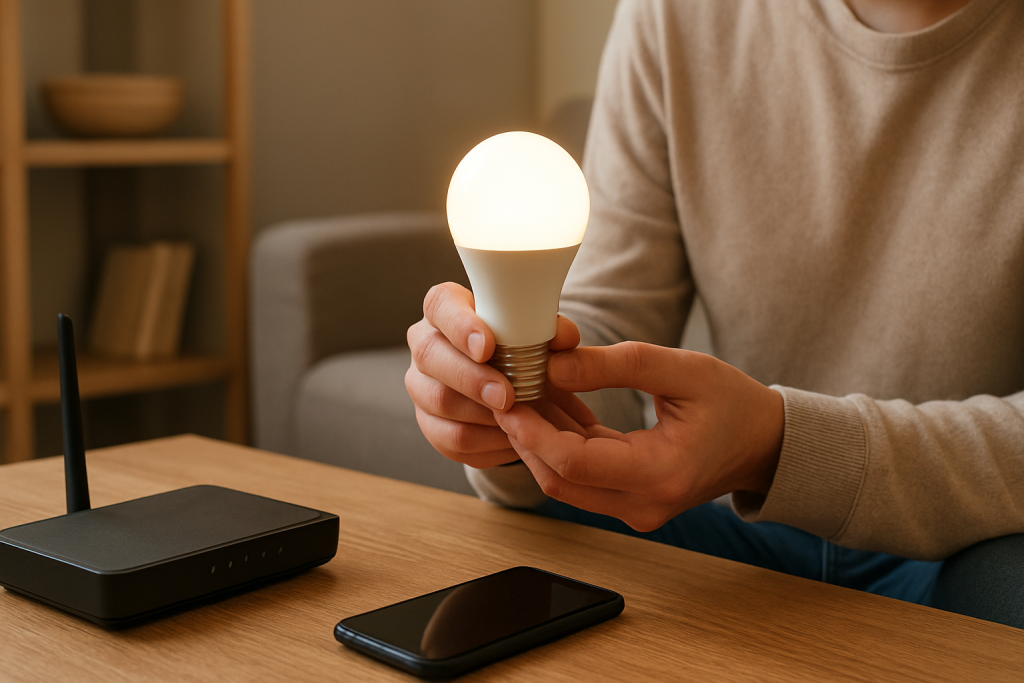
Immediate actions: (1) Keep the bulb powered on continuously and stop toggling the switch; (2) move the phone near the router/hub and keep the app open until the update completes; (3) temporarily improve the bulb’s path by moving the hub/router closer or by turning off other heavy network activity for 10–15 minutes.
Why This Happens
Firmware updates are a two-part conversation: the bulb must download the firmware and then report back that it installed correctly. If either part is interrupted, the app may show “stuck,” “downloading,” “installing,” or “verifying” indefinitely. The primary driver is connectivity stability between the bulb and its controller (router, hub/bridge, or Matter controller), not raw internet speed.
Common technical causes that closely match real home environments include:
1) Unstable device path during the update. A Wi‑Fi bulb may roam between access points or a mesh system may steer it to a different node. A Zigbee bulb may change its route through a different repeater. During normal control this is fine; during firmware transfer it can stall.
2) The bulb is powered through a wall switch or automation that interrupts power. If the bulb loses power even briefly (someone flips a switch, a schedule turns the circuit off, a motion routine toggles it), the update pauses or fails and may restart from the beginning.
3) Hub/bridge congestion or “too many updates at once.” Zigbee hubs and some Wi‑Fi ecosystems queue firmware transfers. If multiple bulbs start updating simultaneously, the hub can appear frozen, or one bulb can block others. This is common after adding several bulbs or after a large app update.
4) App/account state mismatch. If the app is logged into the wrong home, wrong location, or has stale permissions, it may show an update in progress that the hub is not actually performing. This is especially common when multiple phones manage the home, or when a device was moved between rooms/homes.
5) Overlooked technical cause: 2.4 GHz compatibility and isolation features. Many Wi‑Fi bulbs require 2.4 GHz. If the router uses a single SSID for 2.4/5 GHz and “band steering” is aggressive, the phone and bulb may end up on different bands or different network segments. Some routers also enable client isolation, “IoT network” separation, or AP isolation, which can break local discovery and stall update verification even though the bulb still turns on/off through the cloud.
Real-world scenario: a bulb in a porch fixture works fine day-to-day, but during an update the mesh system steers it to a farther node as someone walks around with a phone, or the bulb’s signal drops when the garage door closes. The update stalls at 10–30% repeatedly. The fix is usually to stabilize the path for one update session: bring the hub/router closer, reduce roaming, and keep power constant.
Common user mistake: starting the update and then leaving the house, closing the app, or letting the phone switch to cellular. Some ecosystems can update without the phone, but many require the app to stay connected for portions of the process, especially for verification and status refresh.
Most Likely Causes in Real Homes
1) Weak or shifting connection during the update. The bulb’s link is “good enough” for control but not stable enough for firmware transfer.
2) Power interruptions from a wall switch, timer, or automation. Any off/on during the update can freeze progress or cause looping retries.
3) Multiple bulbs updating at once. The hub/bridge or router gets overloaded; one device holds the queue.
4) Phone/app not on the same local network or has stale home/location selection. The app shows an update state that doesn’t match what the hub is doing.
5) Router features that isolate IoT devices. Guest networks, AP isolation, or VLAN/IoT separation can block the local handshake needed to finish.
Step-by-Step Fix
Confirm the bulb stays powered continuously for 20–30 minutes. Turn the wall switch on and leave it on; use only the app/voice to control it during troubleshooting. If the bulb is on a schedule, temporarily disable schedules/automations that could turn it off.
What the result means: If the update resumes or completes, the stall was caused by power interruptions or automation conflicts.
If it fails: Keep power steady and continue to the next step; do not rapidly toggle power because that can leave the bulb in a partial update state longer.
Check the app’s device status and refresh the home context. In the smart lighting app (or platform app), open the bulb’s device page and look for status such as “reachable/unreachable,” “last seen,” signal quality, or hub connection. Then force a refresh: close the app completely, reopen it, and confirm you are in the correct home/location and the bulb is in the expected room.
What the result means: If the bulb shows unreachable or “last seen” is old, the issue is connectivity to the hub/router. If the bulb appears in the wrong home/room, the app may be showing the wrong device state.
If it fails: Proceed to stabilize the network path and isolate the update to one device.
Run a “single-device update” test (avoid group updates). If several bulbs are pending updates, pause or cancel updates for all but one bulb (if the app allows). If the app only offers “Update All,” temporarily unplug or turn off power (not the target bulb) to the other bulbs so only the target bulb is online.
What the result means: If one bulb updates successfully when others are offline, the hub/bridge or network was congested and updates need to be done in smaller batches.
If it fails: Keep only the target bulb online and continue to connection checks.
Do a clean power cycle sequence (bulb + hub/router, in the right order). Leave the bulb switch on. Power-cycle the hub/bridge first (if you have one): unplug it for 20 seconds, plug it back in, wait until it is fully online. Then reboot the router/mesh system (use the router’s reboot option if available, or unplug for 20 seconds). Do not power-cycle the bulb repeatedly.
What the result means: If the update proceeds afterward, the stall was likely caused by a stuck hub queue, a stale network session, or a mesh node issue.
If it fails: Continue with band/mesh checks; the bulb may be on an unstable link.
Wi‑Fi bulbs: verify the bulb is on 2.4 GHz and the phone is on the same local network. In your router/mesh app, find the bulb in the client list and confirm it is connected to the expected SSID and band (most bulbs should be 2.4 GHz). On your phone, connect to the same home Wi‑Fi (not cellular) and disable any VPN temporarily.
What the result means: If the bulb is on a guest/IoT network and the phone is on the main network (or vice versa), local verification can fail. If the bulb is frequently changing nodes in a mesh, the update can stall.
If it fails: Temporarily turn off “smart connect/band steering” if your router allows, or create a dedicated 2.4 GHz SSID just for setup/update, then retry the update.
Mesh behavior test: stabilize the bulb’s connection for the duration of the update. If you use a mesh system, place the phone near the router/main node and keep it there. If possible, temporarily power down the farthest mesh node for 10 minutes so the bulb is less likely to roam. For hub-based systems, move the hub/bridge a few feet away from dense electronics and closer to the bulb (without changing wiring).
What the result means: If the update completes when roaming is reduced, the issue is not the bulb itself but a shifting path during firmware transfer.
If it fails: Try the hotspot isolation test next to separate bulb issues from home network issues.
Hotspot isolation test (Wi‑Fi bulbs only): use a phone hotspot briefly to test the bulb’s update behavior. Create a 2.4 GHz hotspot (if your phone supports it) with a simple SSID/password. Move the bulb close to the phone if possible (for a lamp). Reconnect the bulb to the hotspot using the manufacturer’s app and attempt the firmware update.
What the result means: If the update works on the hotspot, your home router settings (isolation, band steering, firewall rules) or mesh roaming are the likely cause.
If it fails: The issue is more likely the bulb firmware state, app/account sync, or a cloud-side problem.
Zigbee/bridge systems: check routing and repeaters by testing location and one-hop range. If the bulb is far from the hub/bridge, temporarily move the lamp closer to the hub for the update. If it’s a fixed ceiling bulb, temporarily move the hub closer (within reason) or ensure there is at least one powered Zigbee repeater device between the hub and the bulb (such as a powered plug or in-wall device that is designed to repeat).
What the result means: If the update completes only when closer, the bulb’s Zigbee route is weak or changing. Firmware transfer is sensitive to packet loss.
If it fails: Continue to configuration checks; the hub may be stuck on a queue or the device may be mis-associated.
Group sync test: remove the bulb from groups/scenes temporarily. In the lighting app, remove the bulb from rooms, groups, and scenes that control many bulbs at once. Also pause automations that target the group (wake-up routines, motion lighting, “away mode,” or sunrise/sunset schedules). Then retry the firmware update for the single bulb.
What the result means: If the update completes after removing group control, the bulb was being interrupted by group commands or the hub was overloaded by group traffic.
If it fails: Proceed to account sync and controller checks.
Account sync check: sign out/in and confirm permissions on the controlling platform. If you use a platform controller (such as a home app that links multiple ecosystems), confirm the bulb is controlled by the manufacturer’s app as well. Sign out and back into the manufacturer’s app, accept any updated permissions, and ensure the app is allowed local network access (phone settings). Then retry the update from the manufacturer’s app first.
What the result means: If the update works only from the manufacturer’s app, the platform controller was showing stale status or lacked the needed permission for update management.
If it fails: You are likely dealing with a firmware state issue, a cloud outage, or a device that needs a reset.
Wait for a clean retry window and try again once. If the update is stuck at the same percentage, stop interacting with the bulb for 10 minutes (no toggling, no scenes). Then trigger the update again during a quiet network period.
What the result means: Some ecosystems back off and retry; giving it time can clear a locked transfer session.
If it fails: Move to advanced troubleshooting and consider reset options.
Advanced Troubleshooting
This section is only needed if basic fixes fail.
Account or cloud issue: If multiple devices in the same ecosystem are stuck updating, check the service status (if provided) or try again later. A cloud-side rollout can pause, and the app may keep showing “in progress.” If the bulb still responds to basic on/off but firmware won’t complete across multiple attempts, waiting a few hours and retrying is often more effective than repeated power cycling.
Network issue (relevant when hotspot test succeeds): Review router settings that commonly break firmware verification: client/AP isolation, guest network separation, “IoT network” segmentation that blocks device-to-phone communication, and aggressive firewall rules. If your system supports it, ensure the phone and bulb are on the same LAN during the update. For mesh systems, reduce roaming features temporarily and avoid placing the bulb at the edge of coverage during updates.
Firmware/software cause: Update the controlling app itself and the hub/bridge firmware first. A hub running older firmware may mishandle newer device firmware packages. If the app offers a “repair,” “reconnect,” or “optimize network” function, run it once, then retry the bulb update.
Configuration conflict (groups, scenes, automation, permissions): Automations that repeatedly send commands (adaptive lighting, circadian scenes, frequent motion triggers) can interrupt an update. If the bulb is part of a platform-wide automation and a manufacturer app automation at the same time, temporarily disable one side. Also confirm the phone has local network permission enabled; without it, the app may not be able to complete local verification even though cloud control still works.
When to Reset or Replace the Device
Soft restart vs factory reset: A soft restart is simply leaving the bulb powered on, rebooting the hub/router, and restarting the app. A factory reset fully clears the bulb’s pairing and settings so it can be added again from scratch. Use a factory reset only after you have tried a stable network path and a single-device update attempt.
What you lose after a factory reset: Expect to lose the bulb’s name, room assignment, scenes, schedules tied directly to that bulb, and any platform links that depended on the old pairing. You will need to re-add it to groups and re-enable automations. If your home uses Matter, you may need to re-commission the device into the controller and re-share it to other platforms.
Safety note: If the bulb becomes unusually hot, flickers rapidly, smells like overheating plastic, or shows visible damage, stop trying to update it. Turn it off at the switch and let it cool. A bulb that overheats or behaves erratically should be replaced rather than repeatedly reset.
How to Prevent This in the Future
Keep the update path stable: When you see a pending firmware update, run it when the home network is quiet and the bulb is not at the edge of coverage. For mesh Wi‑Fi homes, avoid updating while moving nodes around or during heavy streaming/gaming sessions.
Place hubs and bridges thoughtfully: Put hubs in open air, away from dense electronics and metal enclosures, and closer to the center of the home. For Zigbee systems, ensure you have enough always-powered devices that act as repeaters so bulbs aren’t relying on a single weak route.
Manage automations during maintenance: Pause routines that frequently change brightness/color or toggle power. After updates, re-enable automations gradually so you can spot which rule causes trouble.
Plan for power outage recovery: If your bulbs are on switched circuits, consider leaving the switch on and using app/voice control so updates aren’t interrupted. After an outage, wait until the router/hub is fully online before triggering updates.
Maintain controller software: Keep the manufacturer app and hub/bridge firmware current. Many “stuck update” problems are fixed by controller updates that improve retry behavior and device compatibility.
FAQ
Should I keep turning the bulb off and on to “unstick” the update?
No. During firmware installation, repeated power cuts usually make the problem worse. If the app says updating, keep the bulb powered on and focus on stabilizing the connection (closer hub/router, fewer devices updating, fewer automations running).
The bulb works normally, so why can’t it update?
On/off commands are small and can tolerate brief dropouts. Firmware updates transfer much more data and require a clean confirmation step at the end. A connection that is “fine” for daily use can still be unreliable for updates, especially at the edge of Wi‑Fi coverage or on a weak Zigbee route.
Is this caused by slow internet?
Usually not. Many updates fail because of local stability between the bulb and the router/hub (roaming, interference, isolation settings), not because your internet is slow. A hotspot test can help: if the update succeeds on a hotspot, the home network configuration is the likely issue.
Do I need to update all bulbs at once?
No, and updating all at once is a common reason updates get stuck. Updating one bulb at a time (or in small batches) reduces hub load and makes it easier to spot a single device that is blocking the queue.
Misconception: “If the app shows 100%, the update is done.” Is that true?
Not always. Many apps show separate phases such as downloading, installing, and verifying. A bulb can reach 100% download and still fail during install or verification if it loses connection or if the controller can’t complete the final handshake. Keep the bulb powered and wait for the app to confirm completion.
When the dust settles, the picture looks less dramatic and more like something you can actually live with. The pressure fades—not all at once, but enough that the days start feeling like yours again.
It won’t feel heroic. It’ll just feel right, in that quiet way where you stop noticing the thing you used to keep bracing for.