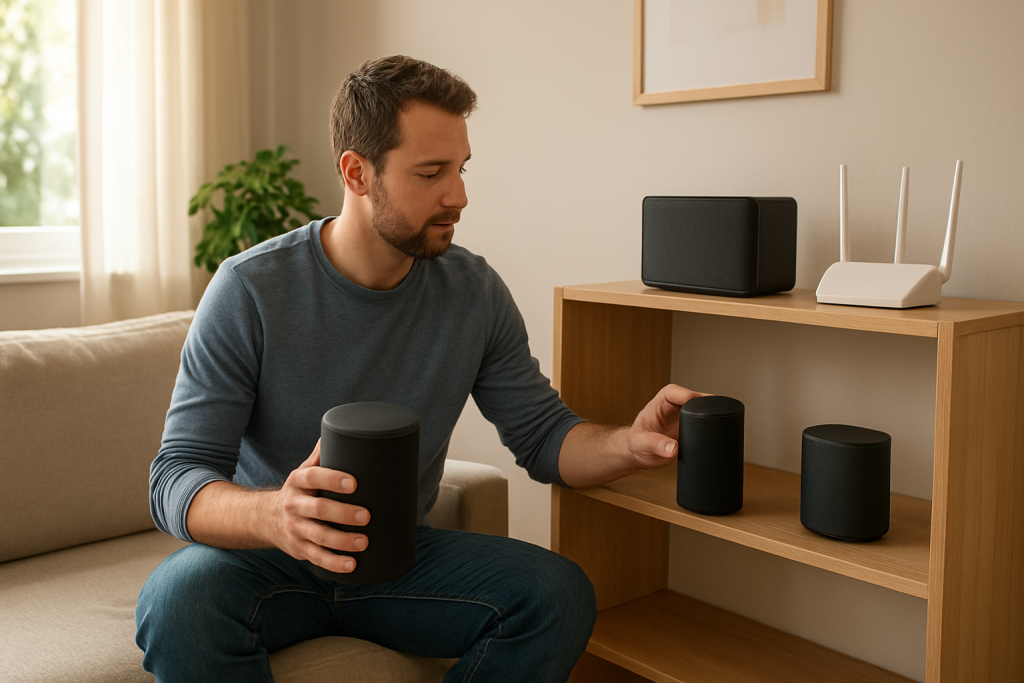
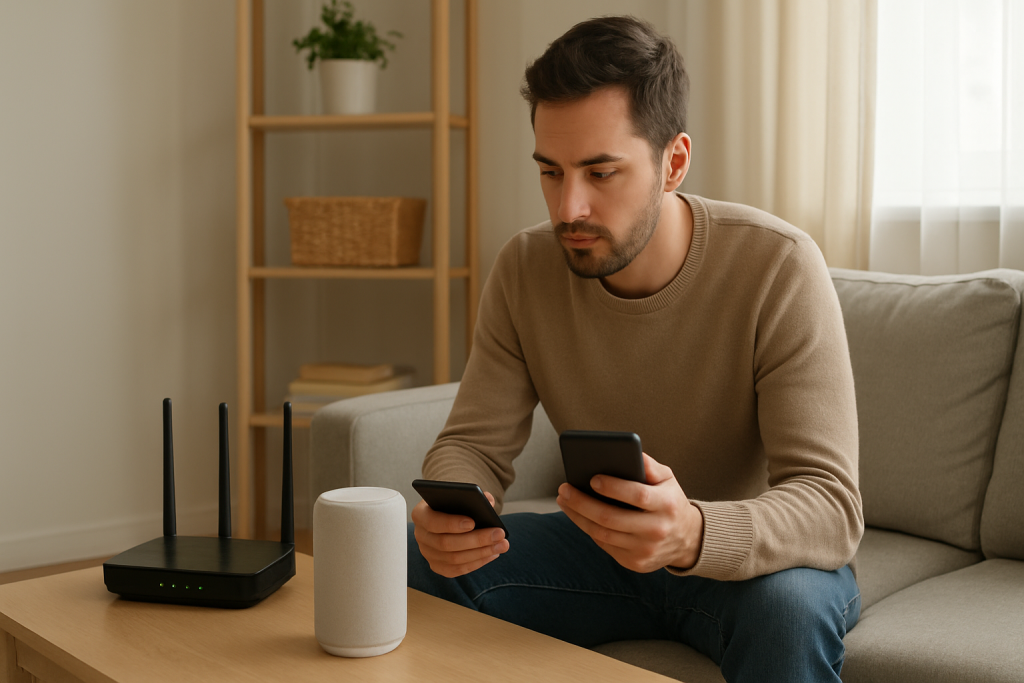
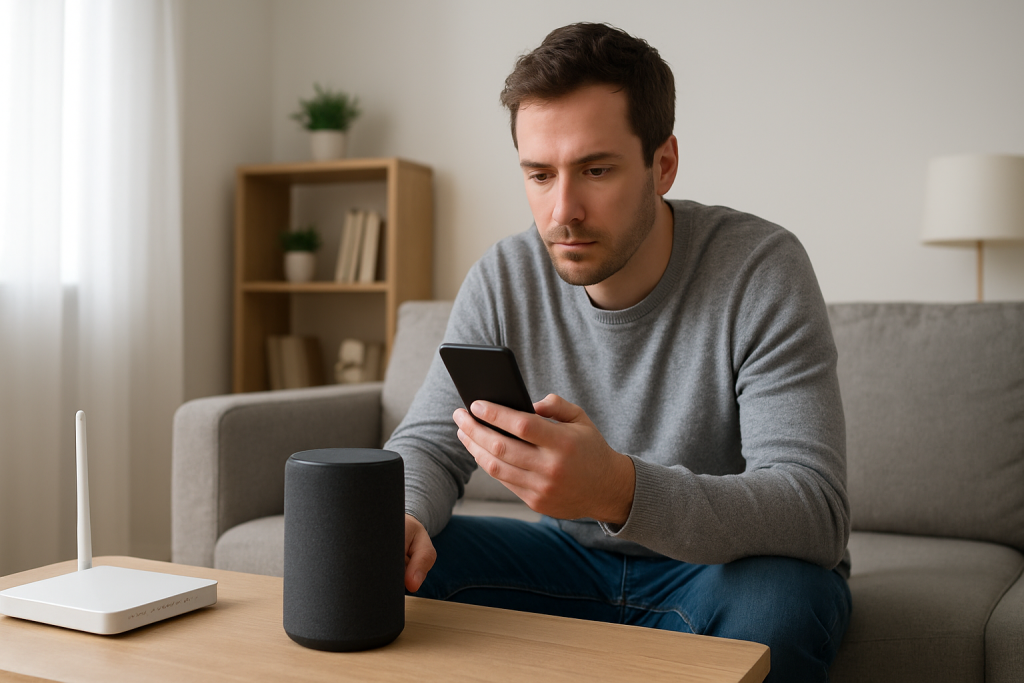
When Alexa multi-room music is out of sync, the usual cause is timing drift between speakers combined with network jitter. Each Echo is trying to stay on the same beat, but small differences in clock timing and inconsistent packet delivery make one device play slightly ahead or behind the others.
The fastest high-impact fixes are: make sure every speaker in the group is on the same Wi-Fi network and band, reduce jitter by simplifying the path to the router (or temporarily disabling mesh “steering” features), and then restart in the correct order so the group re-syncs cleanly.
Why This Happens
Multi-room audio is more sensitive than normal streaming because it’s not just “play music.” It’s “play the same audio at the same time in multiple places.” To do that, each Echo needs a stable clock reference and a steady flow of audio packets. When either the timing reference drifts or the packet delivery varies, the group timing slips and you hear an echo, flanging, or one room lagging behind.
Common, tightly related causes include:
1) Speaker clock drift: Each device has its own internal timing. Alexa continuously corrects timing, but if conditions are unstable, the correction can’t keep up and the group slips out of alignment.
2) Network jitter: Even if your internet speed is “fast,” the audio packets may arrive with inconsistent delay. That variability forces devices to buffer differently, and buffering differences create audible offset.
3) Mixed Wi-Fi paths inside the same group: One Echo may be on 2.4 GHz while another is on 5 GHz, or one is connected to a mesh node while another is connected to the main router. Different paths mean different latency and jitter.
4) Mesh roaming/band steering: Mesh systems often move devices between nodes or bands automatically. That’s great for general browsing, but it can interrupt the steady timing multi-room audio needs.
5) Router load or queueing: When the router is busy (uploads, cameras, cloud backups), it may delay some packets more than others. That uneven delay is exactly what breaks sync.
6) Overlooked cause: one device is on a “guest” network or has Wi-Fi assist behavior: A single Echo on a guest SSID, isolated VLAN, or a network with client isolation can still appear online, but group timing and coordination can become unstable or partially blocked.
A real-world scenario: after a power outage, your mesh system comes back up with nodes in a different order. One Echo reconnects to a farther node in the garage while another connects to the main router in the living room. Music still plays everywhere, but now one path has more delay and more jitter, so the group slowly drifts out of sync.
A common user mistake is building a speaker group that includes devices connected to different Wi-Fi names (for example, “HomeWiFi” and “HomeWiFi-5G”) or mixing in a device that was set up months ago on an old router name. The Alexa app may still show them in the same home, but the timing won’t be consistent.
Step-by-Step Fix
Confirm it’s a group timing issue (not a single-device delay).
What to do: Play music to one Echo only. Stand near it and confirm it sounds normal. Then play the same music to the multi-room group and listen for a distinct echo or “double voice” between rooms.
What the result means: If single-speaker playback is fine but group playback is not, you’re dealing with group sync timing (clock/jitter), not a broken speaker.
If it fails: If the single speaker stutters or drops, fix that device’s connection first (move it closer to Wi-Fi, reduce interference, or reconnect it) before troubleshooting group sync.
Check that every device in the group is on the same Wi-Fi network name.
What to do: In the Alexa app, open Devices > select each Echo involved > open its settings (gear icon) > look for Wi-Fi Network. Verify every device shows the same SSID (same exact name).
What the result means: If one Echo is on a different SSID (including a “-5G” variant or guest network), it’s likely taking a different network path and adding latency/jitter, which causes drift.
If it fails: Move that device onto the same SSID as the others (forget and rejoin Wi-Fi in device settings). If you use separate 2.4/5 GHz names, choose one band and keep the whole group on it for testing.
Do a quick “jitter check” by temporarily reducing Wi-Fi complexity.
What to do: If you have a mesh system, temporarily place all Echos in the same general area (even just for 10 minutes) so they connect to the same node, then test multi-room music again.
What the result means: If sync improves when they’re near each other, the problem is usually variable latency between nodes/bands (jitter/roaming), not the speakers themselves.
If it fails: If it’s still out of sync even when close together, move to the next steps focusing on software state and group configuration.
Restart in a sequence that forces a clean timing re-sync.
What to do: Unplug the Echos in the group. Then restart networking in order: power off the modem (if separate) for 30 seconds, power it back on and wait until it’s fully online. Restart the router/mesh main unit next and wait until Wi-Fi is stable. Finally, plug Echos back in one at a time, waiting about 30–60 seconds between devices.
What the result means: This clears stale network timing and forces the group to rebuild its coordination with a stable router state. If sync improves, jitter or timing negotiation was likely stuck after a network change.
If it fails: If the group is still drifting, it’s time to isolate whether the issue is the network path, the group configuration, or account/cloud state.
Rebuild the speaker group to clear timing and membership glitches.
What to do: In the Alexa app, go to Devices > Groups. Delete the multi-room music group. Wait 30 seconds. Create it again with the same devices. Then test playback.
What the result means: If it fixes the issue, the group configuration likely had stale membership or timing parameters after a device update, router change, or power event.
If it fails: Continue to a controlled network test to prove whether jitter is coming from your home network.
Run a practical test: temporary mobile hotspot (one speaker at a time).
What to do: Create a hotspot on your phone with a simple name and password. Connect two Echos to that hotspot (not the whole house—just enough to test sync). Create a test group with only those two devices and play music.
What the result means: If sync is solid on the hotspot, your Echos are likely fine and your home Wi-Fi is introducing jitter/variable latency. If it’s still out of sync on the hotspot, the issue is more likely device/software/account related.
If it fails: If the hotspot test is better, focus on stabilizing your home Wi-Fi path for those Echos (next section). If it’s not better, focus on firmware/account checks (advanced section).
Reduce sources of jitter during playback.
What to do: While testing multi-room music, pause or temporarily stop high-traffic activities on your network (large uploads, cloud backups, multiple 4K streams). Then test again.
What the result means: If sync improves during a “quiet network” test, your router is likely queueing traffic unevenly, which shows up as jitter to the speakers.
If it fails: If there’s no change, the issue is less about overall load and more about roaming/band switching, firmware state, or group/account conflicts.
Advanced Troubleshooting
Account and cloud state issues (timing coordination depends on it)
Multi-room groups rely on Amazon’s cloud coordination plus local networking. If your household has multiple Amazon accounts, or a device was recently deregistered and re-registered, group timing can behave oddly.
What to check: In the Alexa app, confirm all devices are registered to the same Amazon account (or correctly set up in the same household). If one Echo “belongs” to a different account, it may still play audio but group control and timing can become inconsistent.
Diagnostic clue: If the group sometimes drops a device, renames it, or shows it as unavailable, that points to account/home assignment problems more than Wi-Fi strength.
Network path issues that specifically affect clock sync and jitter
Mesh roaming and band steering: If your system automatically moves devices between nodes/bands, try to keep the Echos “sticky” during playback. One practical approach is to place speakers so they naturally connect strongly to one node rather than hovering between two. If your system has an option to reduce roaming aggressiveness, use it cautiously and retest.
Mixed 2.4/5 GHz behavior: For multi-room groups, consistency often beats raw speed. If some devices are far away and fall back to 2.4 GHz while others are on 5 GHz, you can get different latency and buffering. A useful test is putting the entire group on the same band temporarily (whichever is stable at their locations) and checking if drift stops.
Router client list check: Log into your router and look at the connected clients. Confirm each Echo is connected where you expect (main router vs a distant node). If one device keeps hopping, that’s a strong indicator of jitter/roaming causing the sync problem.
Firmware/software causes
Echos update automatically, and occasionally one device updates earlier than the others. A mixed firmware state can cause group timing to be less stable until all devices are aligned.
What to do: Leave all Echos powered on overnight so they can complete updates. The next day, test again. If you notice one Echo frequently “restarting” on its own or taking a long time to become ready, that device may be stuck updating or having software issues that disrupt timing.
Configuration conflicts (routines, audio settings, and permissions)
Routines and announcements: If a routine triggers announcements, timers, or “brief mode” responses during music, it can interrupt buffering and cause a re-sync that doesn’t land cleanly. Temporarily disable routines that run during your typical listening time and retest.
Do Not Disturb and communication features: Different communication settings across devices can change how they handle interruptions. The goal is consistency across the group while testing.
Misconception to avoid: Many people assume out-of-sync audio is caused by “slow internet.” In reality, it’s usually inconsistent delivery (jitter) and timing drift inside the home network, which can happen even with fast internet service.
When to Reset or Replace the Device
Try a soft restart first when: the problem started after a power outage, router change, or a device update; the issue is intermittent; or the group works sometimes but drifts later. A restart clears temporary timing state and forces a fresh sync negotiation.
Consider a factory reset when: one specific Echo is consistently the “late” or “early” speaker across multiple tests (including the hotspot test), or the device frequently shows as unavailable, won’t stay on Wi-Fi, or won’t rejoin groups correctly.
What you lose with a factory reset: The device is removed from your account and must be set up again. You’ll need to re-add it to groups, reapply device-specific settings, and reconnect any preferences tied to that device.
Replace or stop using the device immediately if you notice overheating, a burning smell, unusual buzzing from the power adapter, or visible damage. Unplug it and contact support. Do not attempt to open the device or repair internal components.
How to Prevent This in the Future
Keep the group on a consistent network path. Use one Wi-Fi name for the household when possible, and avoid mixing guest networks into speaker groups. If you maintain separate 2.4 and 5 GHz names, keep the entire multi-room group on the same one.
Place speakers to avoid “edge of coverage” roaming. The most common drift setups are speakers placed where Wi-Fi is barely acceptable. Move the speaker a few feet, rotate it, or relocate it away from dense obstacles so it holds a stable connection to one access point instead of bouncing between two.
After router or mesh changes, rebuild groups. If you replace your router, rename Wi-Fi, add mesh nodes, or change network settings, plan to delete and recreate your multi-room group. It prevents stale timing relationships from carrying over.
Keep account ownership consistent. Avoid mixing devices registered to different Amazon accounts in the same group. If your household changes accounts or you add a previously owned device, confirm it’s properly deregistered and added to the correct home.
Manage routines that interrupt playback. If you rely on routines for announcements, consider scheduling them away from listening times, or limit which devices they target. Fewer interruptions means fewer re-sync events.
FAQ
Why does it start in sync and then drift apart after a few minutes?
That pattern usually points to clock drift being corrected imperfectly because network jitter keeps changing. The group starts aligned, then small timing differences build until you can hear them. Focus on stabilizing the network path (same SSID/band, less roaming between mesh nodes) rather than chasing internet speed.
Is this caused by slow internet?
Not usually. Multi-room sync is more sensitive to inconsistent delay than to raw bandwidth. You can have fast internet and still get out-of-sync audio if your Wi-Fi is introducing jitter, roaming events, or uneven buffering between speakers.
One Echo is always behind the others. Does that mean it’s defective?
Not automatically. It often means that Echo has a different network path (farther node, weaker signal, different band) or it’s frequently roaming. If it remains the lagging device even when tested close to the router or on a hotspot with another Echo, then a device-specific software issue becomes more likely.
Will Bluetooth fix multi-room sync?
No. Bluetooth adds its own latency and does not provide coordinated timing across multiple speakers. Alexa multi-room music sync is designed for Wi-Fi-based playback where the system can coordinate timing; Bluetooth generally makes group audio timing harder, not easier.
Do I need to factory reset all my Echos to fix this?
No. Start with network consistency checks, a clean restart sequence, and rebuilding the group. Factory reset is best reserved for the one device that consistently misbehaves across controlled tests (especially a hotspot test) or won’t stay properly registered and available.
There’s a strange calm to it, the kind that settles in after the noise clears and you realize you can finally move on. The gap between what people worry about and what actually happens starts to feel smaller, almost reasonable.
Not everything becomes perfect overnight, but the pressure eases. The day-to-day looks more like it did before—just with one fewer thing taking up mental space.