WiFi Keeps Switching Bands and Smart Devices Disconnect: How to Stabilize It
Quick Answer
If your WiFi keeps “jumping” between 2.4GHz and 5GHz and your smart devices drop offline, the most common cause is band steering instability. Band steering is a router feature that tries to push devices to the “best” band, but many smart home devices (and some phones) react poorly to frequent steering decisions, especially when signal strength is borderline.
The fastest stabilization is to reduce band steering pressure: separate your 2.4GHz and 5GHz network names (SSIDs) or disable band steering temporarily, keep smart devices on 2.4GHz, and improve signal consistency (distance, interference, and channel choice). Then confirm the router isn’t also causing disconnects via DHCP/IP conflicts or firmware bugs.
Why This Happens
Band steering is designed to improve performance by encouraging capable devices to use 5GHz (faster, less congested) while leaving 2.4GHz (longer range, better wall penetration) for devices that need it. The problem is that the steering logic relies on signal thresholds and timing that can be “noisy” in real homes. When a device sits near the edge of 5GHz coverage, the router may repeatedly nudge it to 5GHz, then the device falls back to 2.4GHz, then gets nudged again. Each flip can look like a disconnect to smart devices and cloud services.
Smart home gear is especially sensitive because many devices use low-power radios, simplified WiFi stacks, and long-lived connections. A smart plug or thermostat may not roam cleanly, may not retry quickly, or may “hang” after a band change. Some devices also only support 2.4GHz; if your router presents a combined SSID, the device may initially join but later struggle when the router’s steering, security settings, or compatibility modes change.
A real-world scenario: in an apartment with neighboring networks on every channel, your router’s auto-channel feature may change channels or bandwidth width. Combine that with band steering and a phone moving between rooms, and you get constant re-evaluation of “best band.” Add thick walls or a metal appliance near the router and 5GHz becomes inconsistent, triggering repeated steering events that look like random dropouts.
One common user mistake is assuming “one WiFi name for everything” is always best. A single SSID can be convenient, but it often hides band steering behavior and makes it harder to keep smart devices stable on 2.4GHz. Another overlooked technical cause is a router’s “smart connect” implementation that also changes transmit power, minimum data rates, or 802.11k/v/r roaming assistance in ways that confuse older or low-cost IoT chipsets.
Finally, not every disconnect is purely RF. If the router’s DHCP server is unstable, leases are too short, or two devices end up with the same IP address (an IP conflict), devices can appear to “drop” even though WiFi signal is fine. This can happen after a router firmware update, when using an ISP modem-router combo plus a second router, or when a device is configured with a manual/static IP that overlaps the DHCP range.
Step-by-Step Fix
Confirm the pattern: is it band switching or full WiFi loss? On a phone or laptop, open your WiFi details and watch whether it flips between 2.4GHz and 5GHz when you walk a short distance or close a door. If you can, check the router’s client list for a device “bouncing” between bands. If smart devices drop at the same time your phone flips bands, band steering is the likely trigger.
Stabilize smart devices by forcing 2.4GHz. Create separate SSIDs: one named something like “Home-2.4” and the other “Home-5.” Then connect smart devices to the 2.4GHz SSID only. 2.4GHz travels farther and handles walls better, which reduces borderline signal conditions that trigger steering. Keep phones, laptops, and streaming devices on 5GHz where possible for speed.
Disable band steering (or “Smart Connect”) temporarily. In your router settings, look for Band Steering, Smart Connect, WiFi Optimization, or a “single SSID” toggle. Turn it off for testing. If disconnects stop, you’ve confirmed the dominant root cause. You can later re-enable it with stricter settings (if available) or keep separate SSIDs permanently for reliability.
Lock down channels and bandwidth to reduce churn. Set 2.4GHz to channel 1, 6, or 11 (choose the least congested) and use 20MHz width. For 5GHz, pick a stable non-DFS channel if your area allows (DFS channels can cause sudden channel changes if radar is detected). Avoid “Auto” channel during troubleshooting because automatic changes can look like random drops.
Check security and compatibility settings. Use WPA2-Personal (AES) for the 2.4GHz IoT SSID unless all your devices explicitly support WPA3. Mixed WPA2/WPA3 modes can cause some smart devices to fail re-authentication after a roam. Also disable features labeled “PMF required” or “802.11w required” for the IoT SSID if older devices can’t connect reliably.
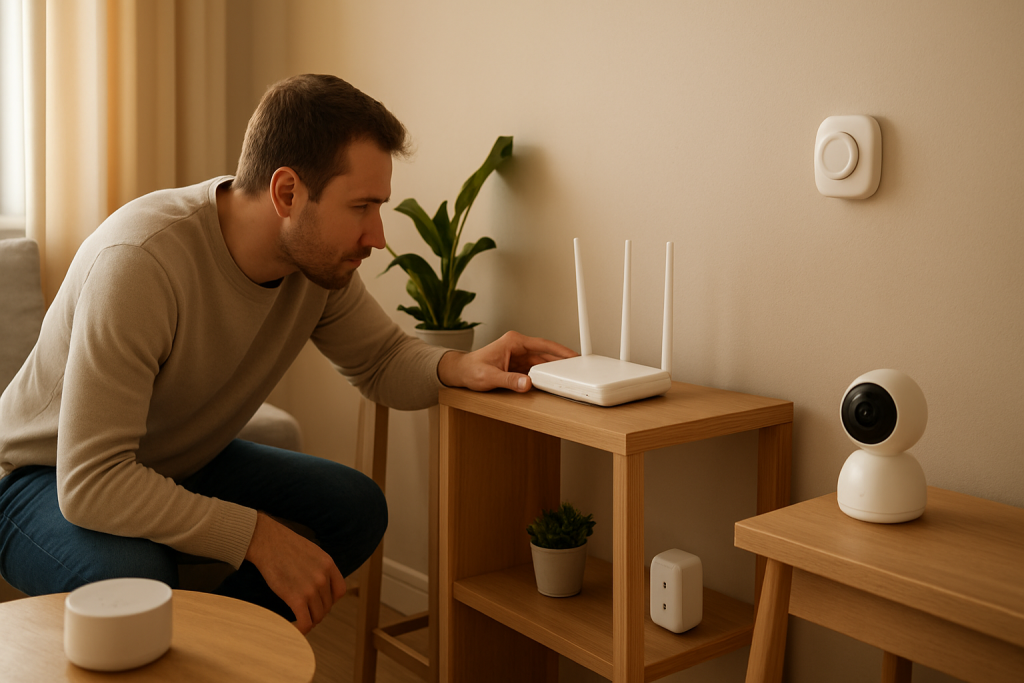
Reduce interference and improve placement. Move the router away from microwaves, cordless phone bases, baby monitors, and dense metal objects. If your router is inside a cabinet or behind a TV, relocate it into open air. Distance matters: a router at one end of a long home can create a 5GHz “dead edge” where steering thrashes. If you use a mesh system, ensure nodes aren’t too far apart; weak backhaul can also trigger client instability.
Fix DHCP stability and avoid IP conflicts. Set DHCP lease time to something reasonable (for many homes, 24 hours is fine). If you have an ISP modem-router combo plus your own router, put one device into bridge mode or access point mode to avoid “double NAT” and competing DHCP servers. If any device uses a manual/static IP, ensure it’s outside the DHCP pool so it can’t collide with automatically assigned addresses.
Update firmware and reboot in the right order. Update router firmware (and mesh node firmware) to the latest stable release. Band steering issues are often improved in updates. After updating, power-cycle in this order: modem/ONT first, then router, then mesh nodes, then smart devices. This helps rebuild clean associations and DHCP leases.
Advanced Troubleshooting
Use a practical testing method: run a controlled “stickiness” test. Put your phone in one location where it previously flipped bands (for example, a hallway between the router and a bedroom). Watch the connected band for 5–10 minutes. If it toggles without you moving, that suggests unstable RSSI thresholds, interference, or router steering logic. Repeat after each change (separate SSIDs, fixed channels, disabled band steering) to confirm which adjustment actually improved stability.
Inspect RSSI and minimum data rate settings. Some routers let you set a minimum RSSI (signal threshold) or minimum data rate. If these are too aggressive, devices get “kicked” and forced to reconnect, which can look like band switching. For IoT stability, avoid strict minimums on 2.4GHz. If your router offers “Airtime Fairness,” consider disabling it for testing; it can starve low-rate IoT devices and cause retries or disconnects.
Check for DFS and radar events on 5GHz. If your 5GHz network is on a DFS channel, the router may be forced to change channels when it detects radar signals. That channel change disconnects clients and can trigger a fallback to 2.4GHz, which looks like band steering but is actually regulatory behavior. Switching to a non-DFS 5GHz channel often eliminates sudden drops.
Look for mesh backhaul problems. In mesh systems, a node with a weak connection to the main router can cause clients to bounce between nodes and bands. If your mesh supports Ethernet backhaul, use it. If not, reposition nodes so the backhaul signal is strong (not barely one bar). Also confirm the mesh isn’t set to “auto optimize” too frequently, which can trigger reconfiguration events.
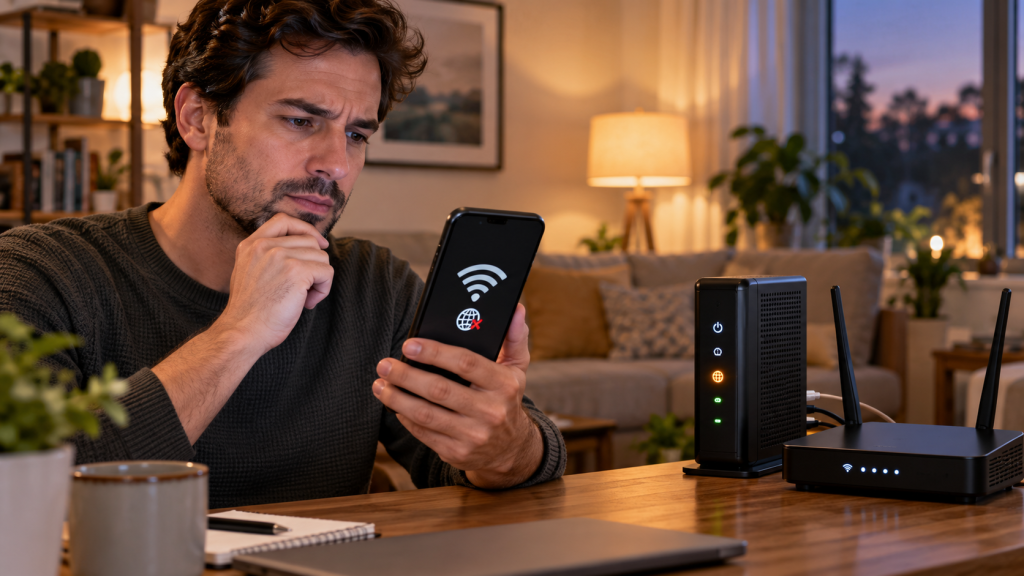
Validate you don’t have two routers doing “smart” things. A common overlooked cause in homes with an ISP modem-router combo is running a second router in router mode behind it. Both devices may broadcast WiFi, both may run DHCP, and both may attempt band steering. The result is unpredictable roaming and IP assignment. Put the ISP unit in bridge mode (preferred) or disable its WiFi and DHCP, then let your main router handle everything.
Review device-specific quirks. Some smart devices disconnect if the SSID contains special characters, if the network is hidden, or if the 2.4GHz SSID is set to 40MHz width. Others fail if the router uses “Auto” security transitions. If one device is the main offender, temporarily create a simple 2.4GHz SSID (letters/numbers only), WPA2-AES, 20MHz width, and test that device alone.
When to Reset or Replace the Device
Reset a smart device when it repeatedly drops while other devices on the same 2.4GHz SSID remain stable, or when it won’t reconnect without power cycling. After you stabilize the network settings, remove the device from its app, factory reset it, and re-add it to the dedicated 2.4GHz SSID. This clears cached WiFi parameters that can survive normal reboots.
Reset the router (to factory defaults) if settings have become inconsistent after multiple firmware updates, migrations, or importing old backups. Band steering and roaming features can interact in unexpected ways when old configurations persist. If you do reset, reconfigure manually rather than restoring a years-old backup.
Replace hardware if your router lacks controls to disable band steering, separate SSIDs, or set stable channels, or if it reboots/crashes under load. ISP modem-router combos are common culprits: they often have limited WiFi tuning and aggressive “optimization” features. If you have many smart devices, consider a router or mesh system known for strong IoT compatibility and explicit band steering controls.
How to Prevent This in the Future
Keep smart devices on a dedicated 2.4GHz SSID. This single choice prevents most band steering instability from affecting IoT. Use a clear naming convention and avoid changing it often; smart devices dislike frequent SSID/password changes.
Use stable RF settings. Prefer fixed channels over auto during normal use if your environment is predictable. Keep 2.4GHz at 20MHz width. On 5GHz, avoid DFS channels if you’ve seen unexplained drops. Place the router centrally and in open air to reduce “edge-of-coverage” conditions that trigger steering.
Manage updates deliberately. Keep router firmware current, but after updating, monitor stability for a day before changing additional settings. If a new firmware introduces band steering issues, check release notes and consider rolling back if your router supports it.
Prevent IP assignment problems. Ensure only one DHCP server exists on your network. If you need static IPs (for hubs, cameras, or a home server), use DHCP reservations rather than manual static settings when possible. This prevents IP conflicts while keeping addresses consistent.
Avoid the convenience trap. The “single SSID for everything” approach is the most common setup mistake in smart homes with mixed device quality. Convenience is real, but reliability is usually better with a deliberate split: 2.4GHz for smart devices, 5GHz for performance devices.
FAQ
Should I use 2.4GHz or 5GHz for smart home devices?
Most smart home devices should use 2.4GHz because it has better range and penetrates walls more reliably. 5GHz is faster but drops off quickly with distance, which increases the chance of band steering flips and disconnects.
Will turning off band steering slow down my network?
Not necessarily. Phones and laptops can still connect to 5GHz if you give it its own SSID. Disabling band steering mainly removes the router’s automatic pushing between bands, which is often the source of instability for IoT devices.
Why do disconnects happen more in apartments or dense neighborhoods?
More neighboring WiFi networks means more interference and congestion, especially on 2.4GHz. That interference can cause fluctuating signal quality, which triggers band steering decisions and re-authentication events. Choosing stable channels and keeping 2.4GHz at 20MHz width usually helps.
Can DHCP really cause “WiFi” disconnects?
Yes. If a device loses its IP address, gets an address that conflicts with another device, or two routers are both handing out addresses, the device may appear offline even though it still shows connected to WiFi. Fixing DHCP to ensure only one router assigns IPs and using reservations can eliminate these dropouts.
What’s one quick way to confirm band steering is the main problem?
Separate the SSIDs and connect the problem device to the 2.4GHz SSID only. If the device stays online for 24 hours without dropping while it previously disconnected multiple times a day, band steering instability (often combined with borderline 5GHz coverage) was the dominant cause.
There’s a strange comfort in watching the noise fade and the shape of things come into focus. The answer isn’t buried under jargon or grand gestures—it just fits, like the last puzzle piece you didn’t know you were missing.
What’s left feels less dramatic and more real. Not a miracle, not a slogan—just a steadier everyday reality where you can stop thinking about it and start living around it.