Random WiFi Slowdowns Every Few Minutes: Causes and Fixes That Work
Quick Answer
If your WiFi gets slow every few minutes, the most common cause is channel congestion and overlap: your router and nearby networks are competing for the same limited radio space, so devices take turns talking and your connection “stutters” in cycles. This is especially common on 2.4GHz, where only a few non-overlapping channels exist.
The fastest fix that works for most homes is to pick a cleaner WiFi channel (or let the router do it correctly), prefer 5GHz where possible, and reduce interference and distance issues. If smart devices are involved, stabilizing 2.4GHz with a non-overlapping channel and correct bandwidth settings often stops the periodic slowdowns.
Why This Happens
WiFi is shared radio. When multiple routers use the same channel, or partially overlapping channels, they must contend for airtime. Your devices may show “connected,” but actual throughput drops as they wait to transmit. This can feel like random slowdowns, but it often repeats every few minutes as neighbors’ traffic patterns, background cloud sync, and smart device check-ins spike and collide.
Channel overlap is most damaging on 2.4GHz. In many regions, only channels 1, 6, and 11 are truly non-overlapping. If your router is on channel 4, for example, it overlaps with both 1 and 6, creating extra interference. Many routers default to “Auto” channel selection, but some choose poorly, stick to a busy channel, or change channels at inconvenient times.
5GHz usually has more available channels and less neighborhood congestion, so it often feels faster and more stable. However, 5GHz has shorter range and is more affected by walls and floors. In a home with thick plaster walls, a long hallway, or a router tucked in a cabinet, devices may bounce between a weak 5GHz signal and a crowded 2.4GHz signal, creating periodic slowdowns and reconnect behavior.
Real-world scenario: in an apartment building, you might see 20–40 nearby WiFi networks. At dinner time, streaming and video calls increase, and your router’s channel becomes saturated. Smart devices (cameras, doorbells, speakers) often use 2.4GHz only, so they get hit hardest. You may notice a pattern: everything is fine, then every few minutes the video doorbell lags, music buffers, and pages load slowly, then it recovers.
Other contributors can amplify the problem. A common user mistake is running 2.4GHz at 40MHz channel width to “make it faster.” In crowded areas, 40MHz on 2.4GHz increases overlap and makes performance worse for you and your neighbors. An overlooked technical cause is background scanning and band-steering behavior: some routers aggressively steer devices between 2.4GHz and 5GHz, causing brief drops that feel like slowdowns. Firmware bugs, misconfigured QoS, or a noisy power supply can also create intermittent performance dips.
Finally, network management issues can masquerade as WiFi slowdowns. If your router has DHCP problems (the service that hands out IP addresses), devices may briefly lose a valid address or experience an IP conflict (two devices trying to use the same address). That can interrupt traffic every so often, especially when many smart devices reconnect after sleeping.
Step-by-Step Fix
Confirm it’s WiFi (not the internet connection) and capture the pattern.
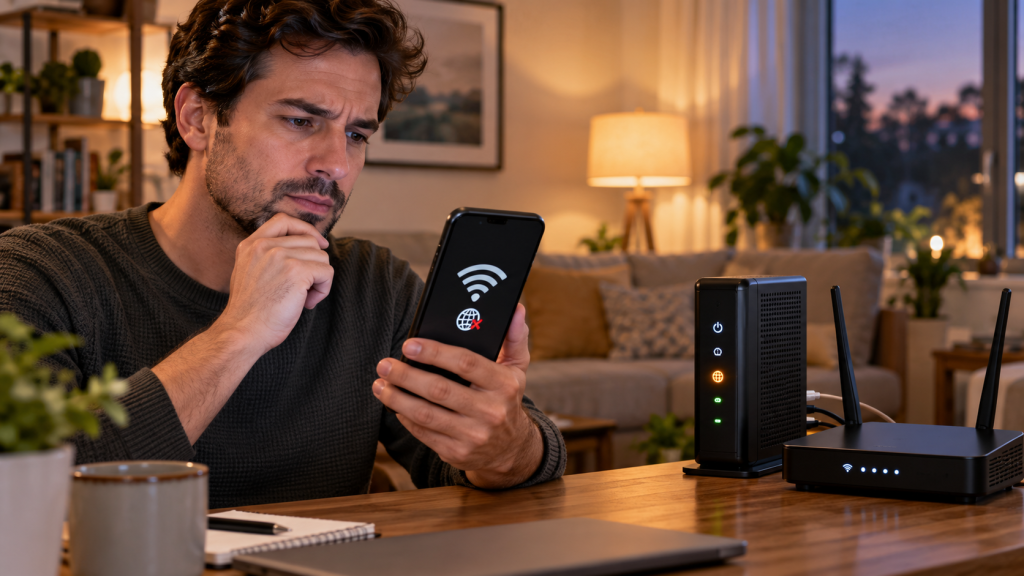
Stand near the router and run two tests: (1) a speed test to the internet and (2) a local test such as copying a file to a NAS/PC on your network or running a LAN speed test app. If local traffic stays fast while internet slows, the issue may be ISP-related. If both slow together, it’s likely WiFi airtime congestion or interference.
Scan channels and pick a non-overlapping option (dominant fix).
Use a WiFi analyzer app on a phone or laptop to view nearby networks and their channels. For 2.4GHz, choose channel 1, 6, or 11 based on the least congestion (lowest number of strong neighboring networks). Avoid channels 2–5 and 7–10 because they overlap and increase contention. Apply the change in your router’s WiFi settings, then wait a few minutes and retest.
Set 2.4GHz channel width to 20MHz (avoid the “40MHz is faster” trap).
In crowded environments, 20MHz is usually more stable and often faster in real use because it reduces overlap and retransmissions. Reserve 40MHz for very rural/low-density areas. After changing to 20MHz, reboot the router and test again during a time when slowdowns usually happen.
Separate SSIDs for 2.4GHz and 5GHz (temporarily) to stop band-steering loops.
Create distinct network names like “Home-2G” and “Home-5G.” Connect phones, laptops, TVs, and consoles to 5GHz if they are within good range. Keep smart home devices that require 2.4GHz on the 2.4GHz SSID. This prevents devices from bouncing between bands and helps you see which band is actually slowing down.
Improve placement and reduce interference sources.
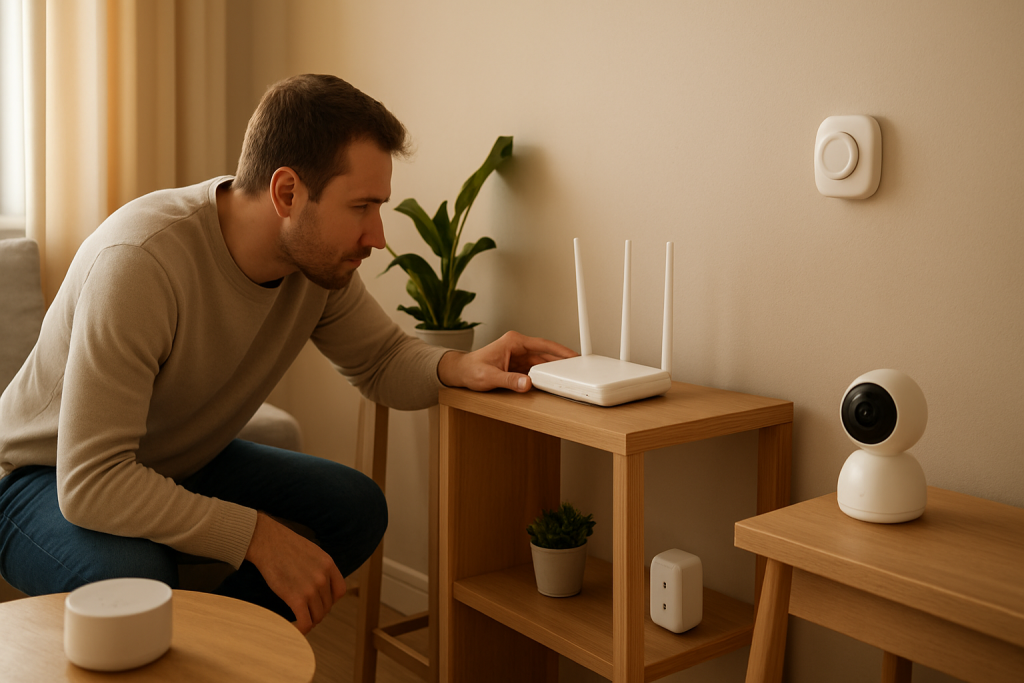
Move the router higher and more central, away from thick walls, metal shelves, fish tanks, and large appliances. Keep it away from cordless phone bases, baby monitors, and microwave ovens (2.4GHz interference). Even a 3–6 foot shift can change reflections and reduce collisions in apartments.
Update router firmware and client device software.
Install the latest router firmware from the manufacturer (or your ISP if it’s a modem-router combo). Also update phone/laptop WiFi drivers and smart device firmware. Periodic slowdowns can be caused by known bugs in band steering, airtime fairness, or WPA security handling that are fixed in updates.
Check for router configuration issues that create periodic slowdowns.
Disable “auto channel” temporarily if it keeps changing channels. Turn off overly aggressive QoS or “game accelerator” features if they’re misclassifying traffic. If your router has “Airtime Fairness,” test both on and off; in some mixed-device homes, it can starve older smart devices and cause stuttering behavior.
Verify DHCP settings and prevent IP conflicts.
Ensure DHCP is enabled on only one device (usually the main router). If you have an ISP modem-router combo plus your own router, put one in bridge mode or disable DHCP on the secondary unit. Consider reserving IP addresses for critical devices (smart hubs, cameras, work PC) so they always get the same IP and don’t collide with others.
Advanced Troubleshooting
If the steps above improved things but you still see slowdowns every few minutes, focus on proving whether the problem is channel contention, interference, or router behavior. The goal is to isolate variables and stop guessing.
Use a practical testing method: continuous ping plus a WiFi scan
Run a continuous ping to your router’s IP address (often 192.168.0.1 or 192.168.1.1) from a laptop on WiFi while watching a WiFi analyzer. If ping spikes or drops coincide with bursts of neighboring network activity on the same channel, that’s strong evidence of congestion/overlap. If ping stays stable but internet speed drops, look at ISP issues or DNS problems instead.
Check for hidden interferers and “non-WiFi” noise
Some interference doesn’t show up as a normal WiFi network: Bluetooth devices, wireless speakers, USB 3.0 devices near the router, and poorly shielded HDMI cables can raise the noise floor. If slowdowns happen when a specific device is active (for example, a baby monitor or microwave), test by powering it off for 10–15 minutes and repeating your ping and speed tests.
Validate mesh or extender backhaul quality
If you use a mesh system or WiFi extenders, periodic slowdowns can occur when the backhaul link is weak or congested. Place nodes closer together or use Ethernet backhaul if possible. A common mistake is placing an extender at the far edge of coverage; it must be placed where it still receives a strong signal, otherwise it repeats a bad connection and multiplies airtime use.
Look for channel conflicts between 2.4GHz and smart home density
Homes with many smart devices can flood 2.4GHz with small but frequent transmissions. If your analyzer shows your channel is “busy” even when you’re not actively using WiFi, that background chatter may be the cause. Moving 2.4GHz to the cleanest of 1/6/11 and locking 20MHz usually provides the biggest stability gain.
ISP modem-router combos: double NAT and WiFi duplication
In many homes, the ISP gateway is still broadcasting WiFi while a second router also broadcasts WiFi nearby. Two radios inches apart on similar channels can create self-inflicted congestion. Either disable WiFi on the ISP device and use your router, or use the ISP device alone. If you keep both, ensure they are on different non-overlapping channels and physically separated.
When to Reset or Replace the Device
Reset or replacement becomes reasonable when you’ve already addressed channel overlap and basic configuration, but the router still behaves unpredictably.
Consider a factory reset if:
You changed many settings over time (QoS, parental controls, VPN, custom DNS, extenders) and can’t track what’s affecting performance. After resetting, configure only essentials: SSIDs, WPA2/WPA3 security, manual 2.4GHz channel (1/6/11), 20MHz width, and a stable 5GHz configuration, then test for 24 hours before adding extra features.
Consider replacement if:
The router is older (especially WiFi 4/802.11n-era), runs hot, reboots on its own, or can’t hold a stable channel. Also replace if firmware updates have stopped and you rely on many smart devices; modern routers handle dense environments better with improved scheduling and radios. If you live in an apartment with heavy congestion, a router with stronger 5GHz performance and better channel management can reduce the impact of neighbors.
How to Prevent This in the Future
Start with a channel plan. For 2.4GHz, commit to channel 1, 6, or 11 at 20MHz and re-check congestion every few months (or after new neighbors move in). For 5GHz, choose a stable channel range your devices support; if radar-detection (DFS) channels cause occasional drops in your area, use non-DFS channels for consistency.
Keep smart devices organized. Put 2.4GHz-only devices on the 2.4GHz SSID and keep bandwidth-heavy devices (streaming boxes, laptops, consoles) on 5GHz when in range. If your router supports a guest network or IoT network, placing smart devices there can reduce broadcast chatter on your main network and simplify troubleshooting.
Maintain firmware and avoid “set-and-forget” auto features that misbehave. Schedule a reminder to check router updates quarterly. If “Auto channel” repeatedly picks congested channels, set it manually. If band steering causes devices to flap between bands, keep separate SSIDs or tune steering sensitivity if your router allows it.
Finally, address physical layout early. Place the router in an open, central location, and if you have thick walls or multiple floors, plan for a mesh system with strong backhaul (preferably Ethernet). Good coverage reduces retransmissions, which reduces airtime use, which reduces the chance that congestion turns into periodic slowdowns.
FAQ
Why does my WiFi slow down every 5–10 minutes even when I’m not downloading anything?
Background traffic can still saturate airtime: smart cameras uploading clips, cloud backups, phones syncing photos, and neighbors’ networks contending on the same or overlapping channel. On 2.4GHz, even small bursts can trigger retries and waiting, which feels like periodic slowdowns.
Should I use 2.4GHz or 5GHz to stop the slowdowns?
Use 5GHz for devices that are close enough to get a strong signal because it usually has less congestion and more channels. Use 2.4GHz for long range and for smart devices that only support 2.4GHz, but stabilize it by choosing channel 1/6/11 and setting 20MHz width to minimize overlap.
Is “Auto” channel selection bad?
It’s not always bad, but it can be unreliable in dense areas. Some routers choose a channel based on a quick scan at boot, then never reconsider, or they switch channels at inconvenient times. If you see periodic slowdowns, manually selecting the cleanest non-overlapping 2.4GHz channel is often more stable.
Can DHCP or an IP conflict really look like WiFi slowness?
Yes. If two devices end up with the same IP address, or if a secondary router is also handing out addresses, devices can briefly lose connectivity or route traffic incorrectly. That can show up as intermittent lag, buffering, or smart devices going “offline” and then recovering. Ensuring only one DHCP server is active and using DHCP reservations for key devices helps.
Do extenders make periodic slowdowns worse?
They can. Many extenders repeat traffic on the same channel, which doubles airtime usage and increases contention, especially on 2.4GHz. If you must use an extender, place it where it still has a strong signal from the router, or use a mesh system with a good backhaul (ideally Ethernet) to avoid repeated congestion.
After all that back-and-forth, the path feels less like a maze and more like a doorway you can finally see. The noise fades, and what’s left is just the work—plain, real, and strangely manageable.
Maybe the best part is how quickly your attention comes back to ordinary life. Not solved like a movie ending, but settled enough to let you breathe, and carry on.